Vice President JD Vance’s new memoir serves as a preamble to a potential 2028 presidential bid, with the Republican reflecting on his faith and political career — and how he sees the former informing the latter.
A Decade After 'Hillbilly Elegy'
“Communion: Finding My Way Back to Faith” hits shelves Tuesday, almost exactly 10 years after the release of “Hillbilly Elegy,” Vance’s memoir about growing up in Appalachia that catapulted him to national recognition while he was still a private citizen working at a venture capital firm. Now he’s the sitting vice president, and the most widely speculated 2028 presidential contender in either political party.
Spiritual Journey
In the new book, Vance chronicles his spiritual journey as a child cycling through different churches, to young adulthood and discarding religion entirely, and his eventual conversion to Catholicism in 2019. He invokes philosophers, political thinkers, modern-day writers and literary works more frequently than biblical scripture, seemingly cobbling together a personalized worldview that doesn’t necessarily fall in lockstep with his chosen religion.

Vance writes that he was fascinated and frustrated by the Terri Schiavo case, the 2005 right-to-die battle that consumed national media and religious conservatives for months. He was “sympathetic to the moral worldview of the people who wanted to save her life” but also confused why faith communities prioritized what seemed to him an extraordinary edge case while showing comparatively little outrage over the ordinary suffering of everyday people, such as those in his family who struggled with addiction.
Political Controversies
That concern for everyday people is arguably less present in the sections where he discusses the 2024 presidential campaign and Trump administration policies that received criticism. He admits the occasional error, but doesn’t offer apologies or do much to set the record straight on his most controversial moments. He walks back calling Democratic women “childless cat ladies,” for example, writing that it was a “boneheaded” comment. Still, he doesn’t address some of the more serious derisive comments he has made — including amplifying baseless claims that Haitian immigrants were eating people’s pets in Springfield, Ohio.
Faith vs. Policy
Vance leans on his faith (or lack thereof, depending on the life stage) to contextualize his beliefs throughout most of his life. And although the book is ostensibly about his spiritual formation and his choice to convert to Catholicism in 2019, the vice president doesn’t appear to seek reconciliation with the church, which has pushed back on some of the administration’s policies.
This is most clear when he talks about the Trump administration’s immigration crackdown. Vance recalls an April 2025 meeting with Vatican diplomats about immigration, in an interaction he described as “unsettling.”
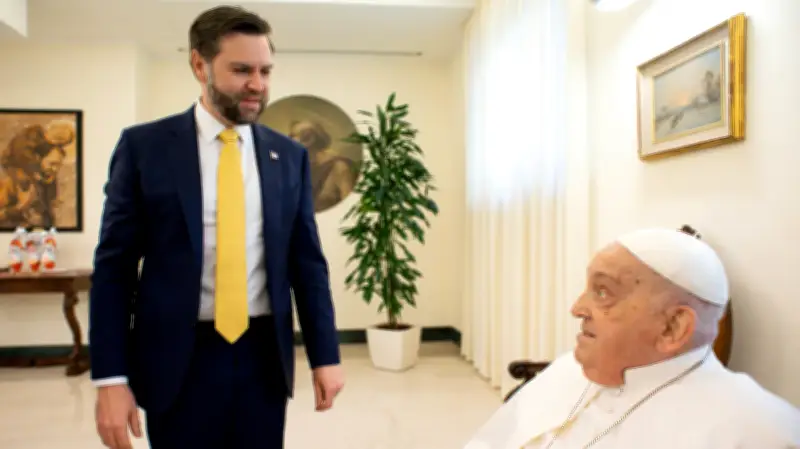
During the meeting, he writes, the officials acknowledged the U.S. “had the right to control its borders, but they also encouraged us to treat migrants humanely.” But he chided them in the book, saying they avoided specifics around migration policies and seemed “unwilling” to move beyond “trite platitudes.” He chalked up their sentiment in the meeting to “a desire to be, well, diplomatic,” but said it frustrated him compared to his public disagreements with Pope Francis (who died less than 24 hours after meeting Vance). “Better to have an honest conversation than one masked by clichés,” he writes.
Later that year, in November, the U.S. Conference of Catholic Bishops issued a rare rebuke of the “indiscriminate mass deportations of people,” calling such policies a violation of “God-given human dignity.” In April 2026, Vance pushed back again on the USCCB over its objections to U.S. immigration policy and military intervention.
“Of course, critics of the Trump administration say we’re too tough,” Vance writes of his visit a year prior in Rome. “The point is not to litigate this issue on these pages but to highlight that any application of moral principles in the real world requires a constant evaluation of trade-offs. Undoubtedly, that’s what the Christian faith demands of us.”