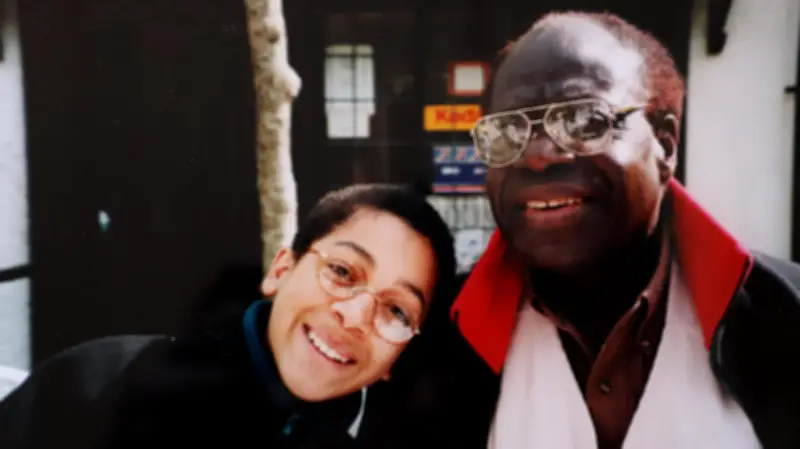
I was standing in my dad's bedroom, staring at his passport in shock. Around me were piles of work papers, used clothes, and old Reader's Digest magazines stacked so high you could barely see the floor. Under his bed, I had found a box. Inside was a marriage certificate indicating he had married a woman I had never heard of, letters from extended family in Ghana I had never met, and now here was his passport — with a date of birth I did not recognize. It was proof that my father had been using a different age and birthday for as long as I had known him. My dad had just died of prostate cancer, and it turned out he had been hiding unbelievable things from me my entire life. I thought clearing out his house would be the final act of our story. Instead, it was the beginning of a new one.
Growing Up in Wolverhampton
I grew up in Wolverhampton, a mid-sized industrial city in England, in the 1990s, and was raised by my mom, Su, and dad, Peter. They separated when I was young, and by the time my dad became ill, he was living alone. He had moved to the United Kingdom from Ghana in the 1960s. I had always seen him as dependable, if a little distant. He worked for the Commission for Racial Equality for most of his working life, and it was his passion. He believed deeply in fairness and justice, and according to those who worked with him, he did a lot of good. He drilled into me the importance of honesty and hard work.
A Different Version of Himself
However, in death, he revealed a different version of himself. A few months before my father's diagnosis, I had moved to London to pursue a career as a singer. We spoke on the phone fairly often, but he never mentioned that he was sick. Maybe he did not want to worry me. Maybe he could not admit it to himself. Either way, by the time I came home for Christmas, the man I had known had faded away. He was gaunt and frail, and our house seemed to be decaying around him. Dirty pots and pans were stacked in the kitchen. Scraps of old meals fused into the carpet. Bags of rubbish were strewn everywhere. He had totally lost control. I called the hospital that day. He was admitted on Christmas Eve, and four months later, he died at the age of 64. Or so I thought. The Ghanaian passport I found revealed that he was actually 75.

Discovering a Secret Marriage and Family
The marriage certificate I discovered listed a woman no one in our family knew existed. My parents never married, but here was evidence that decades before they met, my dad had married a woman named Irene, and they had never divorced. As I continued digging through the piles of my dad's belongings, I found letters and photographs of a Ghanaian family he had never spoken about. I knew he was one of 13 siblings, but that was about it. He did not talk about his family, and we knew not to ask him. I grew up believing he had lost contact with his family. In reality, he had hidden them from us.
I remember sitting with the documents spread out on the floor and feeling like the ground had shifted beneath me. Who was this man who raised me? And why had he spent so much of his life keeping such important parts of himself hidden? I told my mom what I had found. She was just as surprised as I was. She had known about some of his family in Ghana, but not about his wife, or his real age. We just sat there for a while and tried to make sense of everything. We realized that the man we thought we knew had lived a life neither of us had truly understood.
Putting the Search on Hold
You might think that finding out something like this would send you immediately searching for answers, but sometimes life just gets in the way. After my dad died, I threw myself into work and music in London. I was performing, traveling, and building a career. Every now and then I would think about that box under his bed — about his wife, about the letters, about the family I had never met — and I would tell myself I would look into it... soon. But I did not really know where to begin. Every clue seemed to open up a bigger mystery, and I was not sure I was ready for what I might find. The whole thing just felt overwhelming. So... the box stayed closed.

COVID-19 Reignites the Search
Then COVID arrived in 2020. Lockdown brought my career to a standstill. Overnight I went from being a busy touring musician to sitting at home watching "Tiger King" and experimenting with homemade hummus recipes. With nowhere to go and nothing to distract me, my mind drifted back to my dad. Back to the box. Back to the questions. And this time, I could not ignore them. I realized that if I did not start searching now, I probably never would. With so much time on my hands, I started digging. I looked back through everything I had kept from my dad's house. I contacted his old work colleagues and school friends. I even bought a camera to document the process. The search for the truth about my dad became my reason to get up in the morning.
A Key Clue
At the bottom of the box of my dad's paperwork was a scrap I had almost thrown away years earlier. At first glance it did not look like anything important, but when I turned it over, I realized it was the back of an envelope. In the corner, scribbled in pen, were the words: Dr. J.W. Oteng, Kpong, Ghana. That bit of paper that had almost been tossed in the recycling bin was about to become the key to finding my long-lost Ghanaian family.
I Googled "Kyebi," the small village in Ghana where my dad grew up, along with our family name, Oteng. I found an article written by Professor Alfred Oteng about Kyebi. Convinced I had located a relative, I immediately emailed him and relayed my story, including the mystery of J.W. Oteng. He replied almost straight away. Incredibly, Professor Oteng told me he had worked years earlier with a man named John Oteng: the same person referred to as "J.W. Oteng" on the envelope. He turned out to be my cousin. Thanks to that scrap of paper, I was suddenly connected to cousins I never knew existed. For the first time since discovering my hidden family, they were no longer hidden.
Traveling to Ghana
Soon after, I decided to travel to Ghana to meet them in person. The heat hit me the minute I landed in Accra, Ghana's capital city. The air was buzzing with car horns, music, and voices. It was overwhelming. During my time in Accra I stayed with newly discovered relatives — cousins from my dad's side — and they welcomed me in immediately. Even though we had never met before, they treated me as though I had always belonged there, and many of them greeted me with the same two poignant words: "Welcome home." I got to experience the city's vibrant nightlife with the younger members of the family and spent time in the kitchen with the elder members, who taught me about Ghanaian food and introduced me to fufu, a Ghanaian culinary staple.
Visiting My Dad's Hometown
After a few days, I began my trip to Nsuta Kyebi, the small town in Ghana's Ashanti region where my dad was born. When I arrived, my extended family members were there to meet me. They guided me through the town and brought me to my dad's childhood home, which was still known to the family. I had imagined making this journey a thousand times, but seeing it in real life — the red earth roads, the small houses, the place where he had once run as a boy — made everything suddenly feel real. At my dad's old home, I climbed the steps to the room where he was born. I stood there for a minute in silence. Then I heard drumming. It grew louder as locals poured into the courtyard and danced, sang, and locked eyes with me. They had been told I was coming and organized a ceremony to honor my dad and welcome me. In the center of the courtyard stood a photograph of my dad, young and proud, dressed in traditional kente cloth. It was a photo I had never seen before. Someone must have been holding onto that photo for 50 years.
I had imagined a quiet visit, but instead I found myself in the middle of a communal celebration of my father's life. This was not the somber mourning we get in England. This was grief and joy colliding. This was music, laughter, and remembrance. For the first time, I truly felt how much my dad had mattered to this place.
Becoming a Sub-Chief
Later, the village chiefs told me my dad had been part of the local royal family, and they said they were making me a sub-chief to honor him. One moment I was a visitor, and the next I was being given a role in a community my dad had never returned to. It was surreal. It was a true honor.
Meeting Irene
Another piece of the puzzle fell into place on my final day of my trip: I met Irene, my dad's secret wife. A relative managed to find her phone number for me, and it turned out she had recently moved back to Ghana. When I called and introduced myself, Irene asked how my dad was doing. She had no idea her husband had died more than a decade earlier. Breaking that news was one of the hardest moments of the journey. Three hours later, I was sitting across from her in her home. She told me my dad vanished from her life in 1977. She wrote letters, but he never replied. She called, but he never answered. He had simply disappeared. It seemed like a kind of analog ghosting, and I was angry at my dad on Irene's behalf. However, she seemed strangely calm about everything — as though she had made peace with the mystery a long time ago. I was the one who sat there wrestling with the weight of his choices.
A Changed Perspective
By the time I flew back into London, I felt changed. I had traveled to Ghana hoping to understand my dad. What I discovered was bigger than that. I found a family who welcomed me with open arms. I found cousins who I speak to regularly now. I found a community that knows and shares and cherishes stories about my dad from a time long before I was born. And I found a connection to a country that now feels like part of me.
I may not understand why my dad did what he did, but I do not blame him for the choices he made. I realize that, just as life is for me, it was complicated for him, too. Regardless of what he did or did not do, he always provided for me and kept me as close as he knew how to. I could not have expected more from him than that.
Looking Ahead
I plan to return to Ghana again soon so I can scatter my dad's ashes in his homeland. My relationship with my dad's family — my family — there continues to grow. Sometimes I wish my dad had told me the truth about his life. About Ghana. About Irene. About the family he left behind. Part of me wonders how different things might have been if he had. However, another part knows that if he had told me everything back then, I might never have gone searching for it myself. And that search changed my life. My dad spent much of his life burying parts of himself. Ultimately, uncovering them gave me something he never expected to pass on: a deeper understanding of who he was. And of myself.
Joe Jacquest is a singer and storyteller from Wolverhampton, United Kingdom, who now lives between London and Barcelona. He has performed around the world and worked as a backing singer for artists including Becky Hill, Years & Years, Gabriels, and Rita Ora. He also creates documentary content about identity and family, including "Hidden Roots," a series that charts his journey to uncover his father's secret life and reconnect with family in Ghana. Joe now aims to help others uncover their own family stories, particularly individuals with mixed heritage. You can watch the "Hidden Roots" series here and find more from him on Instagram and TikTok @HiddenRootsDoc.