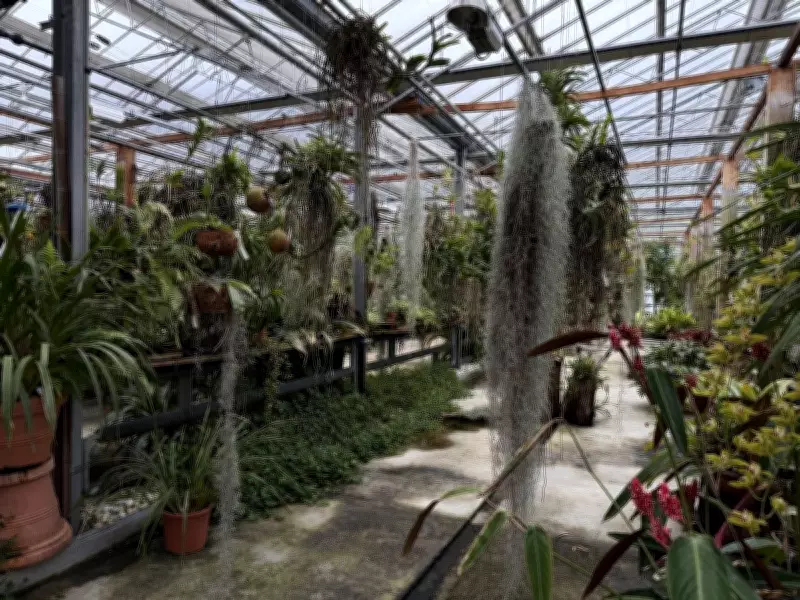
Step into the magical world of the Guerlain Orchidarium, an unassuming greenhouse complex located less than 30 minutes' drive from downtown Geneva, Switzerland. Here, François Gerard works his botanical magic, cultivating rare orchids for the French beauty brand Guerlain. His medium? Orchids. A special laboratory for these unique flowers, the greenhouse space is an epicentre of early research and innovation, so hidden that even an Uber driver might struggle to find it.
Upon arrival, a kind woman escorted me through a maze of greenhouses to a big sliding door. I had reached the Guerlain Orchidarium. There, I met Gerard and his assistant Sylvia Dusonchet to learn about their delicate work expanding the understanding of Orchidaceae plants. 'We try to be as diverse as possible, but we have a focus on the Vanda Coerulea genus,' Gerard says of the blue orchid, celebrated for its long lifespan exceeding 100 years. 'What we have here are botanical orchids, not what you find in garden centres. Those are hybrids of many species.'
Despite its ties to a major global skincare brand, the space is decidedly organic. Plants cover every available surface, empty terra cotta pots are stacked to create makeshift pedestals, and the paths between rows are more suggestions than designated routes. 'We were the first to work here as a green greenhouse, you could say. Green horticulture. Without pesticides,' Gerard says of the 600-square-metre space. Started nearly 20 years ago, the Orchidarium now houses more than 300 orchid species and 3,000 individual plants. 'It's quite rare to have a collection of so many different species. For a private collection, it's quite something,' he adds.

The final ingredients from this research are used primarily in Guerlain's luxury skincare range, Orchidée Impériale, but the team also explores orchid scents for perfumes. The next station of research takes place at the Tianzi Exploratory Reserve in China, a 'jungle farming' operation that protects biodiversity and boosts economic interests. Gerard, considered one of the world's foremost ethnobotanists, has dedicated his career to advancing orchid biology. His interest in plants, he says, has always been to put a value on each—not for profit, but for protection.