Calgary's Cultural Renaissance: Art Mirrors a Growing City's Soul
As Calgary's population surges toward two million, its cultural landscape is evolving in tandem, with art serving as a mirror to the city's expanding diversity and urban sprawl. This growth is sparking unprecedented investments and philosophical shifts within the arts community, aiming to ensure that the city's soul is not lost in its scale.
A Festival as a Microcosm of Growth
In early February, the Exposure Photography Festival launched at Contemporary Calgary, offering a vivid snapshot of the city's interconnected artistic ecosystem. Featuring hundreds of local and international photographers, the festival partners with 30 venues across Calgary and beyond, from major institutions to cozy coffee shops and artist-run collectives. The range of work spans traditional wildlife photography to bold, experimental pieces.
On February 5, Contemporary Calgary hosted a gala for the festival's central exhibitions, drawing nearly 1,300 attendees in a single evening—a record-breaking turnout that signals Calgary's emergence as a significant artistic hub in Canada. "When you look at some other cities and communities in this country and others, they are shocked," says David Leinster, CEO of Contemporary Calgary. "Getting 1,300 people to an opening in an evening is not common."

Unprecedented Infrastructure Investments
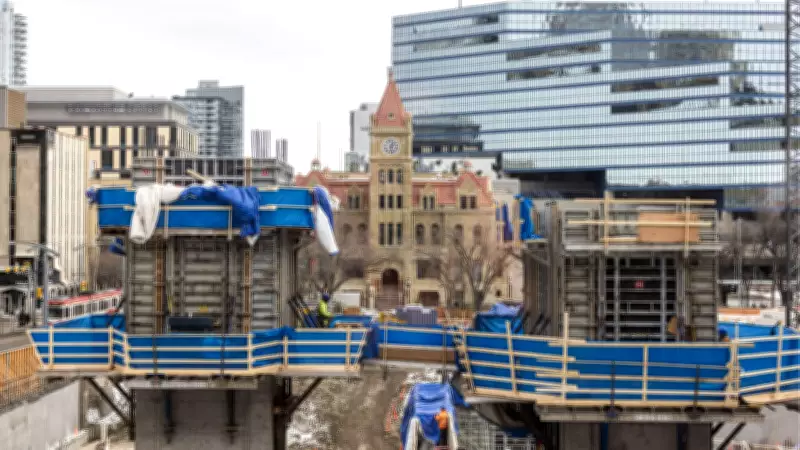
Calgary's cultural ascent began a decade ago with the opening of the $191-million National Music Centre in East Village, followed by the $245-million Central Library. By 2029, as the population nears two million, renovations will conclude at the Werklund Centre (formerly Arts Commons), Contemporary Calgary, The Glenbow Museum, and Olympic Plaza, representing a total investment of nearly $990 million from government, philanthropists, and fundraising efforts.
Additionally, Scotia Place, the $926-million future home of the Calgary Flames, is set to open in 2027. This venue, part of the developing Culture and Entertainment District, will host concerts for up to 20,000 people, potentially attracting major touring artists who previously bypassed the city due to the limitations of the Saddledome.
Programming for a Diverse Population
While world-class venues may draw tourists, programming must resonate with Calgary's residents. The Glenbow Museum is undergoing a philosophical transformation alongside its $205-million physical overhaul. Outgoing CEO Nicholas Bell notes that the museum will shift from static exhibits to up to 36 constantly renewed displays, many drawn from its extensive collection. This change aims to end "generational visiting" by making the museum a regular destination.
To enhance accessibility, a $35-million donation from the JR Shaw family will enable free admission. Glenbow will also collaborate with cultural communities to develop exhibits, moving beyond in-house expertise. "If there were organizations that were irrelevant in a city of 1.2 million, they will continue to be irrelevant in a city of two million people," warns Alex Sarian, president and CEO of the Werklund Centre.
Balancing Hardware and Software
Sarian, author of The Audacity of Relevance, emphasizes the need to balance "hardware" (buildings and infrastructure) with "software" (artists, organizations, and audiences). "My biggest fear is that people spend too much time and resources and energy on the hardware and the infrastructure without giving proper attention to the software," he says. "I want to make sure that 20 years from now, 30 years from now, Werklund Centre is thriving not because it's a beautiful facility but because Calgarians feel like they want to breathe life into it."
Key to this is fostering a thriving local artist community. While new venues may attract global stars like Taylor Swift, Calgary's culture must be defined by its homegrown talent. "It doesn't matter how beautiful the Werklund Centre is, if Calgary becomes too unaffordable for the artist community then we have lost," Sarian adds.

Challenges and Strategies for Artists
Supporting local artists faces hurdles, including affordability and venue sustainability. A 2024 report by West Anthem advocated for Calgary to become a "music city" akin to Nashville or Austin, suggesting repurposing spaces, increasing funding, and addressing housing issues for musicians. Despite a decline in live music venues—from 67 multi-purpose spaces in 2010 to 58 in 2023—there is growing awareness of the need to bolster this sector.
"We've seen more conversations around being a music-friendly city than we've ever had in the history of this province," says Andrew Mosker, co-founder of West Anthem and CEO of the National Music Centre. "To be prepared for a city of two million people, there's opportunity there, so let's get ready."
The Artist's Role in a Growing City
According to a 2025 report by Hill Strategies, Calgary had 33,300 workers in arts, culture, and heritage occupations as of 2021, including 7,020 professional artists. However, a 2023 survey by Calgary Arts Development found that only nine percent of artists rely solely on their practice for income, highlighting the gig economy's challenges.
Patti Pon, president and CEO of Calgary Arts Development, stresses that artists are "our storytellers, meaning-makers and our sense-makers" who help navigate change. "As we make our way to two million, there's the 35,000-foot level where the role for artists to play is quite significant and very much needed," she says. "Then there's the practicality part, which is about affordability."
In 2024, Calgary Arts Development supported 41,000 arts experiences attracting 5.3 million attendees. "There's no point building those big institutions if there is nothing underneath to support it," Pon notes.
Personal Stories from the Front Lines
Visual artists Caitlind r.c. Brown and Wayne Garrett, known for immersive installations like Fisher Ladder and Delta Garden + City Unseen, illustrate the struggles and triumphs of local creators. They rent a house in Ramsay with a flexible landlord but recall past housing searches where they had to conceal their profession. "I think we are sort of successful artists in our own way, so to have to lie to every landlord in the city except for these ones I think says a lot about how people see artists," Brown shares.
Their project Idle Worship, a convoy of mobile exhibits, critiqued Calgary's car-centric sprawl and oil-based economy. "It reflects the city back on itself and critiques the way that we think about and develop our shared amenities," Brown explains. "You really need artists to do that, because who else is going to?"
As Calgary grows, its cultural scene stands at a crossroads, balancing massive investments with the need to nurture the artists who give the city its unique voice. The journey to two million is not just about numbers but about ensuring that art continues to reflect and shape the city's evolving identity.