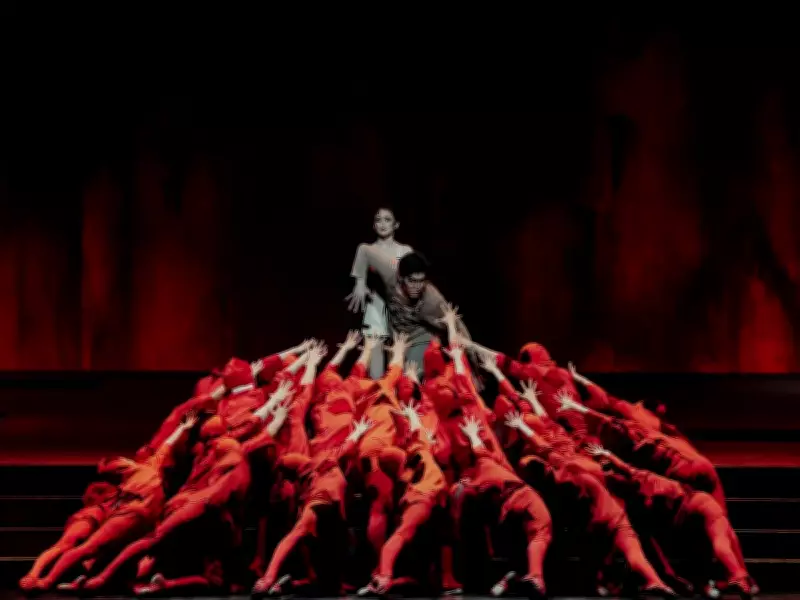
The ballet Notre-Dame de Paris, choreographed by Roland Petit over six decades ago, is now receiving its Canadian premiere courtesy of Alberta Ballet, serving as the grand finale of their season. This production offers a straightforward yet thrilling interpretation of Victor Hugo's classic tale, The Hunchback of Notre Dame.
A Ballet of Contrasts
This rendition is both vibrant and dark, painting images of beauty amidst shadows, much like the hunchback Quasimodo's love for Esmeralda. While some moments feature overly literal movement that lends a hollow quality to certain scenes, the overall production is one of beautiful contrasts. The narrative follows the traditional arc of Hugo's novel, with Aaron Anker portraying Quasimodo and Alexandra Anker-Hughes as Esmeralda. Kelley McKinlay and Yaroslav Khudych round out the primary cast as Claude Frollo and Captain Phoebus, respectively. These four dancers carry the ballet's narrative, often executing the most technically demanding sequences.
Costume Design and Choreography
The opening scene effectively establishes the contrast between the townspeople and Quasimodo, not only through movement but also through the costumes designed by Yves Saint Laurent. The corps de ballet appears in bright hues—sky blues and emerald greens—while Quasimodo's costume is muted grey and beige, illustrating how others perceive him as lacking color. The townspeople's choreography is expansive, featuring synchronized full-extension movements that contrast with Quasimodo's brilliantly crafted sequences. Anker simultaneously portrays a crippled appearance while maintaining the grace of a ballet dancer, revealing hidden strength behind his movements and occasionally appearing zombie-like. His presence is captivating in every scene.

Costume choices also clarify character traits: Frollo is clad in all black, often appearing as a shadow in the background, with McKinlay's choreography restrained—no grand jetés or leaps—carefully aligned to his character. Esmeralda is the opposite; Anker-Hughes wears white in the first act and a beautiful purple in the second. She is the only dancer en pointe, her movement full of beauty and grace with a spark that reflects Esmeralda's spirit.
Emotional Duets
The beauty and softness portrayed by Anker and Anker-Hughes permeate the production, most poignantly in the sanctuary duet. Here, the choreography emulates the care Quasimodo bestows upon his beloved bells, which he also offers to Esmeralda. Their movements together resemble swaying bells, and Anker performs lifts with remarkable grace while still conveying the character's deformity. This contrasts with other duets of possession between McKinlay and Anker-Hughes, where the choreography is more controlling. Anker-Hughes remains graceful en pointe, but the lifts and movements carry an edge of control.
Notre-Dame de Paris is a production of beautiful contrasts, brought to life by Alberta Ballet's talented dancers and stunning design elements.