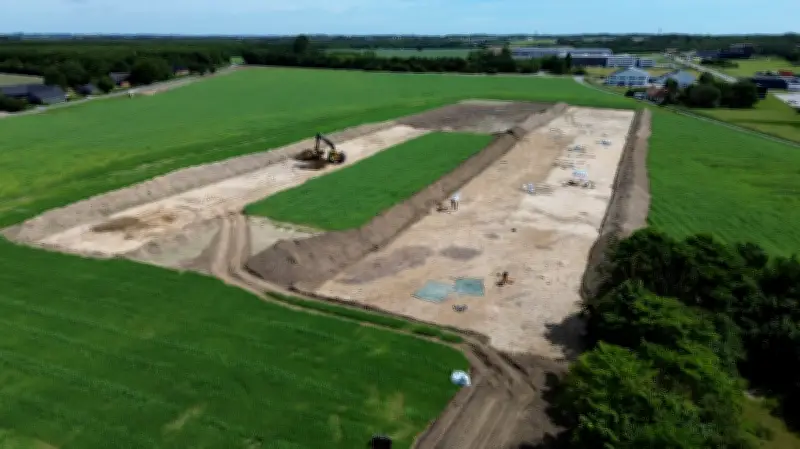
Archaeologists have discovered a huge Viking textile production site in Soften, near Aarhus, Denmark, revealing extensive cloth manufacturing operations dating back over a thousand years. The find, announced on June 22, 2026, challenges previous assumptions about the scale of Viking domestic industries.
Scale of the Discovery
The site spans several acres and includes remains of multiple longhouses equipped with looms, dyeing pits, and storage facilities. According to lead archaeologist Dr. Søren Madsen of the Moesgaard Museum, the sheer volume of artifacts—including hundreds of spindle whorls, loom weights, and fragments of fabric—indicates that textile production was a major economic activity. "This was not just a cottage industry; it was an organized, large-scale operation that could have supplied cloth for trade across the Viking world," Madsen said.
Radiocarbon dating places the site's peak activity between 800 and 1000 AD, the height of the Viking Age. The team estimates that the facility could produce enough cloth to outfit dozens of ships annually.

Artifacts and Techniques
Excavations uncovered tools for every stage of textile production, from shearing sheep to weaving and dyeing. Dyeing pits contained residues of woad, madder, and lichen, indicating a sophisticated understanding of natural dyes. A particularly well-preserved loom weight, carved with runic inscriptions, suggests that some workers may have been literate. "This rune-inscribed weight is a rare personal touch," Madsen noted. "It shows that textile workers were valued members of Viking society."
The site also yielded bones of sheep and goats, confirming that wool was the primary fiber. However, traces of flax indicate linen production as well.
Implications for Viking Trade
The discovery has significant implications for understanding Viking trade networks. Textiles were a key export, exchanged for silver, spices, and other goods. "We knew Vikings traded cloth, but finding a production center this large suggests they were major players in the European textile market," said Dr. Emma Lindqvist, a textile historian at Uppsala University. The site's proximity to Aarhus, a major Viking trading port, supports this theory.
The find also highlights the role of women in Viking economies, as textile production was primarily women's work. "These women were the backbone of a massive industry," Madsen emphasized.
Future Research
The excavation is ongoing, with plans to expand the dig area and analyze soil samples for pollen and other microfossils to reconstruct the local environment. The team hopes to uncover more about the workers' lives and the site's connection to other Viking settlements.
The discovery has already sparked interest among historians and the public, with a temporary exhibition planned at the Moesgaard Museum later this year.