Reflected Sunlight Nearly Caused Serious Train Collision Near Victoria Bridge
Canada's Transportation Safety Board has issued a renewed call for accelerated implementation of automatic train control systems after a dangerous incident where reflected sunlight nearly caused a collision between passenger and freight trains near Montreal's Victoria Bridge.
Signal Misinterpretation Due to Sunlight Reflection
In a report released Tuesday, the TSB detailed how sunlight reflecting off a signal light created an optical illusion that made a red light appear yellow to a Via Rail engineer. This misinterpretation led the passenger train to proceed onto a track where a CN freight train was traveling, bringing the two trains within approximately 500 metres of collision.
The incident occurred on September 29, 2024, as a Via Rail train that had just completed its Toronto-to-Montreal journey was making its way from Central Station to the maintenance facility in Pointe-St-Charles. At approximately 5:32 p.m., with the late afternoon sun positioned low in the western sky, the engineer reported difficulty confirming the colour of a trackside signal about 300 metres before a track switch.

Dangerous Conditions Created by Optical Illusion
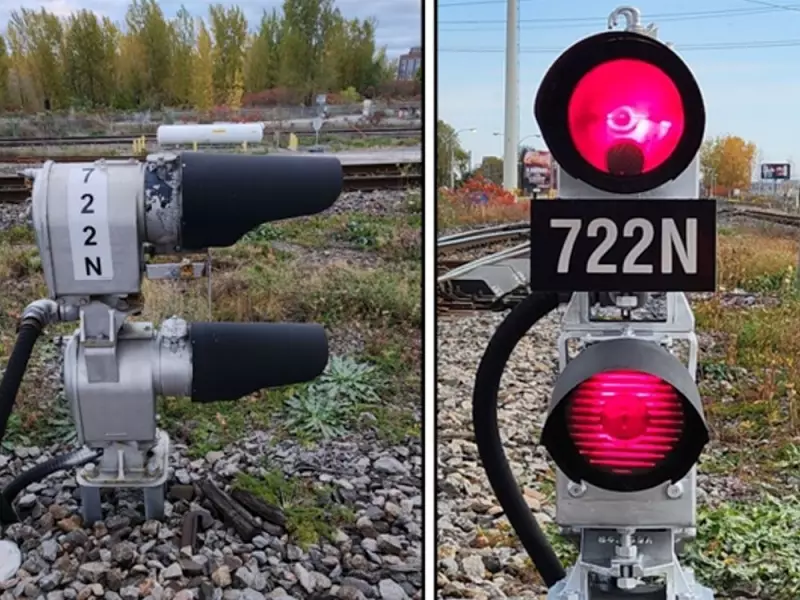
The TSB investigation determined that the signal light showed red throughout the entire incident, with no mechanical failure that could explain a yellow indication. Instead, sunlight reflecting off the signal's outer lens created conditions where the red light appeared yellowish to the observing engineer.
"In certain conditions, a red light may appear yellowish to an observer when the incident light, reflected by the surface of the outer lens of the light, causes slight defocusing," the report stated, citing a 2005 study published in Investigative Ophthalmology & Visual Science.
The sun's position—just 10 degrees above the horizon and directly behind the engineer—created ideal conditions for this optical effect, despite the signal lights being equipped with extended hoods designed to mitigate sunlight reflection.
Emergency Response Averted Disaster
When the engineer realized the track switch was not properly set for the train's movement, he immediately instructed the locomotive to stop. By this time, part of one train car had already passed the switch position. The crew made an emergency radio call to alert other rail traffic, and a CN freight train traveling west across the bridge at approximately six kilometres per hour was able to stop about 500 metres from the switch after being alerted by another freight train.
Rail traffic control systems automatically detected the track violation and also ensured the freight train came to a complete stop. Fortunately, no injuries occurred during the incident, and there were no passengers aboard the Via Rail train at the time.
Repeated Incidents Highlight Systemic Safety Concerns
The TSB report noted that this was not an isolated occurrence. Since 2000, there have been four previous incidents where train crews mistakenly believed red lights were yellow due to reflected sunlight, including another incident involving a Via Rail train misinterpreting the same signal light near the Victoria Bridge in 2006.
The safety board emphasized that relying solely on "administrative defences"—rules, policies, and procedures followed by train crews—creates unacceptable risks.
"Administrative defences, even when layered, still rely on strict crew adherence to rules and procedures and remain vulnerable to the inherent limitations of human cognition," the report stated. "These limitations underscore the need for additional layers of defence that do not rely solely on crew compliance to ensure the safe operation of trains."
Call for Automated Safety Systems
The Transportation Safety Board has been advocating for some form of automatic train control since 2000. Such systems, already implemented in Europe, Japan, Australia, and the United States, can automatically bring a train to a stop when it violates a stop signal, providing a critical failsafe beyond human observation and decision-making.

In April 2024—five months before this incident—the TSB sent a letter to Canada's transport minister strongly urging acceleration of physical fail-safe train controls on high-speed rail corridors and key routes. At the time of the report's publication, the board had not received a response to this urgent recommendation.
Government Response and Future Implementation
Transport Canada published a notice of intent in 2022 regarding implementation of enhanced train control technologies across the country. Following public consultations, a report published in October 2025 indicated the government will develop a regulatory framework to have enhanced train control systems implemented by 2030.
The recent near-collision near Victoria Bridge underscores the pressing need for these safety enhancements, particularly as similar incidents continue to occur due to environmental factors like sunlight reflection that challenge human perception and judgment.