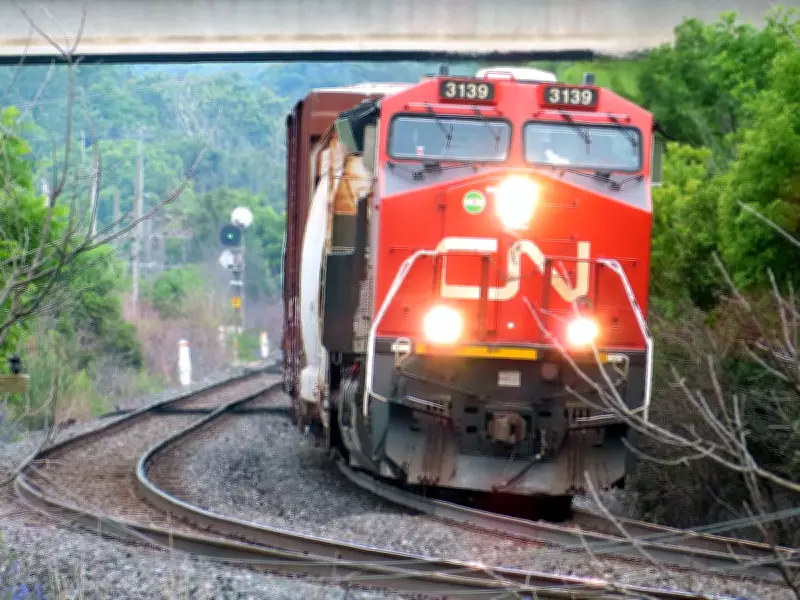
Canada's Major Rail Operators Navigate $550 Million Tariff Impact in 2025
Canada's two largest railway networks, Canadian National Railway Co. (CN) and Canadian Pacific Kansas City Ltd. (CPKC), absorbed a substantial financial blow from tariffs and trade volatility in 2025, with combined impacts exceeding $550 million. Despite these significant headwinds, both companies managed to report modest revenue growth, demonstrating resilience in an unpredictable cross-border trade environment.
Direct Financial Impacts from Trade Uncertainty
During recent earnings calls, executives from both railway giants detailed the specific financial consequences of shifting trade policies. Janet Drysdale, CN's executive vice-president and chief commercial officer, revealed that "tariffs, trade uncertainty and volatility impacted our full-year 2025 revenues by over $350 million." This substantial figure represents a direct hit to the Montreal-based company's bottom line.
Meanwhile, Calgary-based CPKC faced similar challenges. Keith Creel, chief executive of CPKC, noted during a Wednesday earnings call that the company had "already absorbed a pretty significant hit from all the uncertainty" amounting to approximately $200 million in revenue impact, maybe higher. These combined impacts highlight how cross-border trade policies directly affect Canada's critical transportation infrastructure.

Revenue Growth Despite Trade Headwinds
Remarkably, both railway operators managed to post revenue increases despite these substantial tariff-related challenges. For the fourth quarter of 2025, CN reported revenues exceeding $4.4 billion, representing a two per cent increase compared to the same period the previous year. The company's total annual revenues reached $17.3 billion, also reflecting a two per cent increase over 2024 figures.
CPKC demonstrated similar resilience, with fourth-quarter 2025 revenues climbing to $3.9 billion – a one per cent increase over the previous year. The company's total annual revenues grew by four per cent to reach $15.1 billion. These figures indicate that both organizations successfully navigated the challenging trade landscape while maintaining their fundamental business operations.
Ongoing Trade Uncertainty and CUSMA Renewal
The trade challenges facing Canada's railways stem largely from shifting policies emanating from the White House. Since U.S. President Donald Trump took office early last year, the Canada-United States border has become what industry observers describe as a "hotbed for trade disputes" characterized by various on-and-off tariffs throughout 2025.
Adding to the uncertainty is the upcoming renewal of the Canada-United States-Mexico Agreement (CUSMA), scheduled for July. This critical trade agreement has largely shielded goods from tariffs between the three nations, but its pending renewal casts what industry leaders describe as a "veil of uncertainty" over North American trade relationships.
Tracy Robinson, CN's chief executive, acknowledged the difficulty in predicting future outcomes, telling analysts that "the outcome of the CUSMA review could influence trade and freight demand in ways that are tough to size up today." She added that based on current conditions, the company's "base case expectation is that volumes will be flattish with 2025."
Strategic Positioning and Future Outlook
CPKC's unique position as the only single rail line connecting Canada, the United States, and Mexico gives it particular insight into North American trade dynamics. The company gained the latter half of its current name following Canadian Pacific's 2021 acquisition of U.S.-based Kansas City Southern for US$31 billion, creating this continent-spanning network.
Despite current challenges, industry leaders remain cautiously optimistic about long-term prospects. Creel emphasized that "these three nations will trade together, and we uniquely, because of our network, enable it." He acknowledged that while "we've gone through some choppy waters" that "may get more choppier," ultimately "we'll get through the storm."

Both CN and CPKC continue to play vital roles in Canada's economic infrastructure, moving goods across borders despite policy uncertainties. Their ability to maintain revenue growth while absorbing substantial tariff impacts demonstrates the resilience of Canada's railway sector in the face of shifting international trade dynamics.