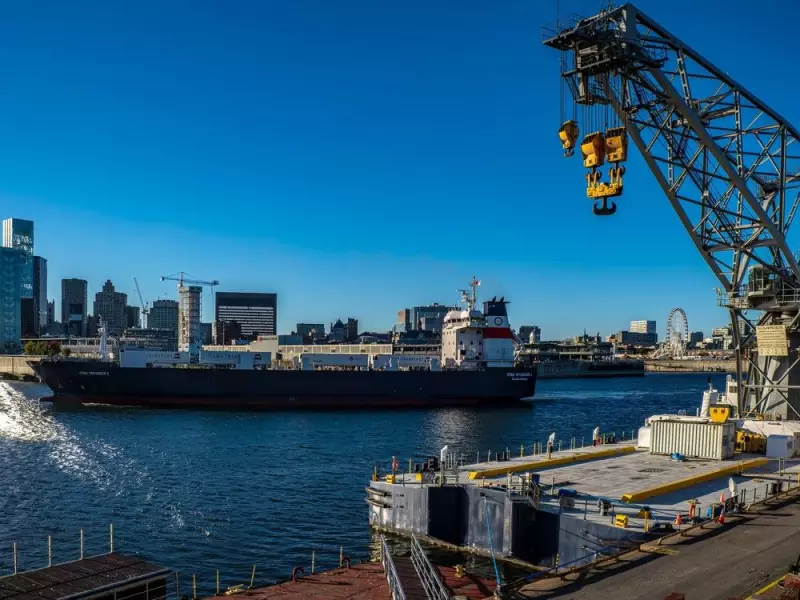
OTTAWA — Prime Minister Mark Carney's ambitious pledge to double Canada's exports to markets outside the United States is colliding with a stark reality on the ground: the nation's critical port infrastructure may not be ready for the surge. Analysts and industry leaders warn that several key ports are already operating at or near their maximum capacity, and the timelines for necessary expansions are measured in years, if not decades.
The Capacity Challenge: A Bottleneck for Growth
Diversifying Canada's export markets away from its dominant southern neighbour was already a formidable task. Buyers globally have established suppliers chosen for reasons like price, quality, and reliable logistics. However, a recent announcement from a major Canadian natural resources exporter has thrown a spotlight on a more immediate physical constraint. The company revealed plans to soon ship future exports to overseas markets from a port in Washington state, bypassing Canada's own West Coast facilities entirely.
This decision raises urgent questions about whether Canadian ports possess the spare capacity to handle a significant increase in diversified trade. Any existing inefficiencies would be dramatically magnified if exporters succeed in meeting Carney's target of doubling non-U.S. exports within the next decade. While trade with the U.S. flows mostly overland via road, rail, and pipeline, commerce with the rest of the world depends overwhelmingly on sea and air links.

"There's not a lot of slack," stated Dennis Darby, CEO of Canadian Manufacturers & Exporters, the country's largest trade association. "We don't have the capacity we thought we have." He emphasized that port inefficiencies directly translate to lost business opportunities and Canadian jobs.
Infrastructure Timelines Clash with Political Goals
Industry and government sources confirm that expansion timelines for port infrastructure mirror those of other major projects—they are long-term endeavors. Julien Baudry, chief of staff at the Port of Montreal, succinctly framed the strategic shift: "The future is east-west." Yet, redirecting trade flows requires reshaping entire networks, not just docks.
Challenges extend beyond the ports themselves to connected infrastructure. Labour disruptions, single-track railway lines, and other bottlenecks can cause significant slowdowns, undermining reliability for international shippers. Daniel-Robert Gooch, CEO of the Association of Canadian Port Authorities, indicated that even a modest increase of 5 or 6 per cent in shipped exports would strain a number of Canadian ports.
The scale of the coming pressure is quantified in a Scotiabank report from June. It found that every 10 per cent increase in the share of overall Canadian trade directed outside the U.S. would intensify pressure on ports by 4 per cent and on air infrastructure by 2 per cent.
Conclusion: A Decade of Building Ahead
The path to reducing Canada's reliance on the U.S. market is now clearly marked with a significant, material obstacle. Prime Minister Carney's export diversification vision, announced in late 2025, depends on a transportation backbone that current analyses suggest is already under stress. The coming years will test whether port expansion projects can be accelerated to match political and economic ambitions, or if capacity constraints will force a recalibration of one of the government's central economic goals. The decision by exporters to use American ports serves as an early warning that the global market will seek the most efficient routes, with or without Canadian infrastructure.