

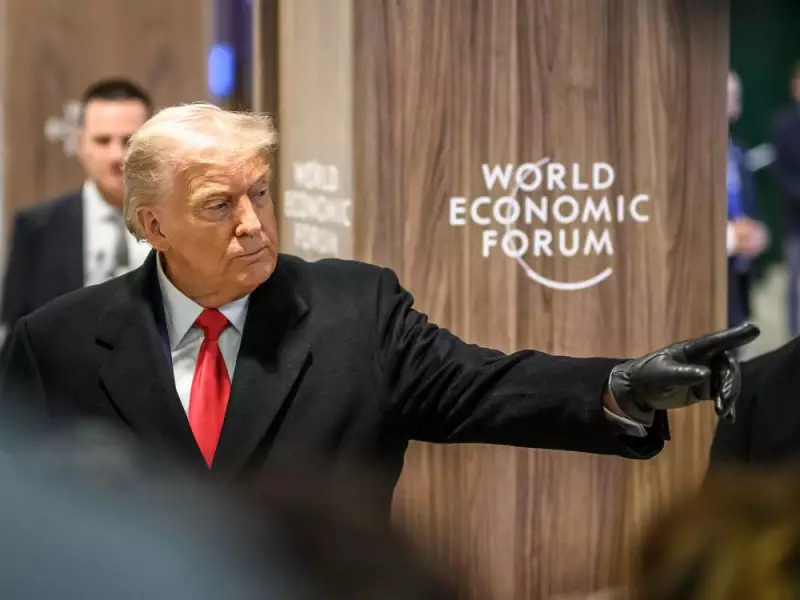
Wall Street Stages Strong Recovery After Trump's Greenland Announcement
Financial markets experienced a significant rebound on Wednesday as President Donald Trump's claim of reaching a framework agreement regarding Greenland helped calm investor nerves about escalating trade tensions with Europe. The announcement came after a brief but sharp market selloff that had rattled global investors.
Market Rally Follows Geopolitical Uncertainty
Following what some analysts described as a revival of the "Sell America" trade sentiment, Wall Street saw substantial gains across multiple sectors. The S&P 500 index climbed approximately 1.4 percent, with nearly 400 of its component stocks advancing during the trading session. This recovery effectively erased the index's losses for the year 2026, bringing it to around 6,885 points.
Small-capitalization stocks continued their impressive performance streak, outperforming the broader U.S. equity benchmark for the thirteenth consecutive trading day. Meanwhile, energy shares maintained strength near record levels, contributing to the overall market optimism.

Trump's Announcement Eases Trade War Concerns
President Trump revealed through social media that he had reached "the framework of a future deal" with NATO regarding Greenland and the broader Arctic region. This development followed what he described as a "very productive meeting" with NATO Secretary General Mark Rutte.
Most significantly for financial markets, Trump announced he would refrain from imposing tariffs on goods from European nations that had opposed his efforts regarding Greenland. These tariffs had been scheduled to take effect on February 1st, creating substantial uncertainty among investors and businesses with European exposure.
"Based upon this understanding, I will not be imposing the Tariffs that were scheduled to go into effect on February 1st," Trump stated in his social media post, providing the clarity that markets had been seeking.
Fixed Income and Currency Markets Respond
The positive sentiment extended beyond equity markets into fixed income and currency trading. The yield on 10-year U.S. Treasury notes declined by four basis points to settle at 4.25 percent, reflecting increased demand for government bonds amid the improved risk environment.
A substantial $13 billion auction of 20-year Treasury bonds attracted solid investor interest, further indicating confidence in the U.S. debt market. The U.S. dollar exhibited mixed performance, wavering as traders assessed the implications of the geopolitical developments.
Analyst Perspectives on Market Recovery
Market analysts offered cautious optimism about the sustainability of the recovery. Fawad Razaqzada of Forex.com noted that "the markets breathed a sigh of relief during Trump's speech marathon, where the United States President ruled out the use of military to acquire Greenland." However, he added the important qualification that "time will tell" whether this represents a genuine return to risk-on sentiment or merely temporary relief.
James McCann of Edward Jones highlighted that while Trump has ruled out military force to acquire Greenland, his continued push for negotiations maintains pressure on this sensitive geopolitical issue. "We will be watching carefully for further signals from the president and European counterparts over coming days," McCann stated, emphasizing that clarity on resolving U.S. defense concerns while protecting local sovereignty remains crucial.
Recent Market Volatility as Political Signal
Bob Michele of JPMorgan Asset Management interpreted the recent market turbulence as a message to the Trump administration. "The recent selloff in markets was a message to the Trump administration to take action to restore calm," he explained, drawing parallels to how officials responded after Liberation Day tariffs unsettled investors the previous year.
Michele further noted that "things are a bit chaotic and the markets do feel a bit panicked," suggesting that investors need reassurance similar to what followed previous episodes of market stress.

Investor Sentiment Remains Fragile
Mark Hackett of Nationwide offered important context about current market psychology, observing that Tuesday's trading action served as a reminder that investors remain highly sensitive to geopolitical and tariff-related headlines. With record allocations to equities across many portfolios, Hackett suggested there is "little margin for error" when unexpected developments occur.
The market's dramatic response to Trump's Greenland announcement underscores how geopolitical developments continue to drive financial market movements, particularly when they intersect with trade policy considerations that directly affect corporate profitability and economic growth prospects.





