

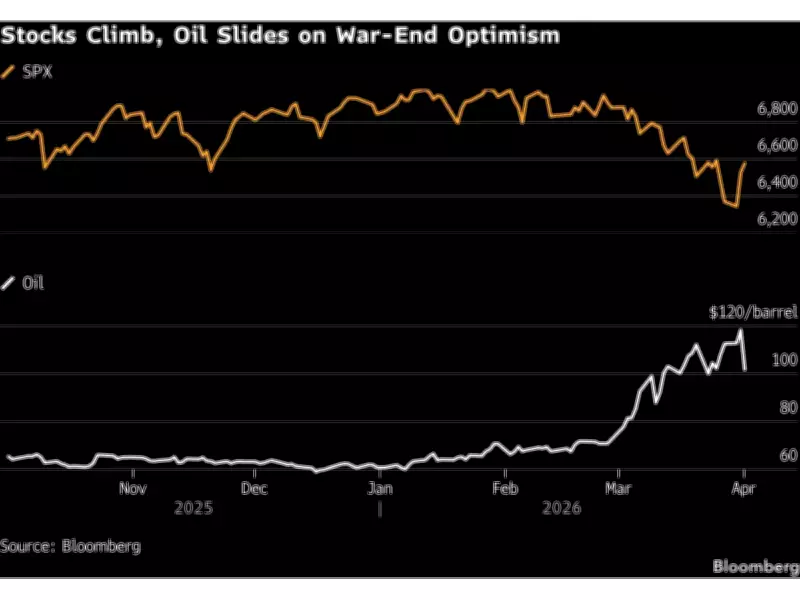
Stock and Bond Markets Plunge as Oil Prices Surge Amid War Uncertainty
Global financial markets experienced significant declines as oil prices surged to new highs, driven by renewed concerns over the ongoing war in the Middle East. President Donald Trump's recent address shattered earlier optimism that the conflict was nearing a swift resolution, leading to fears of prolonged disruptions in energy supplies.
Market Movements and Key Indicators
S&P 500 futures dropped by 1.2%, mirroring retreats in European and Asian benchmarks. Brent crude oil jumped 6.9% to exceed $108 per barrel, while European diesel futures reached a staggering $200 per barrel. This surge followed Trump's pledge for more aggressive actions against Iran over the next two to three weeks, with no concrete plans to reopen the critical Strait of Hormuz.
Bond markets also tumbled as traders anticipated that elevated oil prices would persist, prompting bets on tighter monetary policies. The dollar advanced the most in a week, and gold snapped a four-day streak of gains, reflecting shifting investor sentiment.

Expert Insights and Economic Implications
Laurent Lamagnere, deputy CEO at Alphavalue in Paris, expressed deep concern, stating, "This market just isn't manageable. We're really worried about second-round effects, not only on oil prices but also on supply chains, such as airlines cutting destinations with severe impacts on tourism."
Russ Mould, investment director at AJ Bell, highlighted the significance of oil prices, noting, "Oil has rarely dipped below $100 per barrel since its initial surge. This may be a better indicator of the situation than global indices, as the world confronts a disruption affecting around 20% of global supply."
Sector Performance and Policy Expectations
In premarket trading, shares in oil and gas companies like Venture Global Inc. and Exxon Mobil Corp. rebounded, while travel, mining, and semiconductor stocks fell. Nasdaq 100 futures dropped 1.6%, indicating broad-based market weakness.
Treasury yields rose across the curve, with the two-year rate increasing three basis points to 3.83%. Traders reduced the odds of a Federal Reserve rate cut in 2026 to about 10% from over 20%, while money markets fully priced in two quarter-point hikes by the Bank of England and nearly three by the European Central Bank for the year.
Long-Term Outlook and Investor Strategies
ECB Governing Council member Fabio Panetta warned that the war's damage would continue to negatively impact the global economy even if hostilities end soon. Traders are likely to trim stock holdings ahead of the long weekend, with many markets closed for up to four days. Since the conflict began, the S&P 500 has shown cumulative gains early in the week but has cratered 9% on Thursdays and Fridays.
Mabrouk Chetouane, global head of market strategies at Natixis IM Solutions, advised caution, suggesting there is little sense in buying protection or hedging positions ahead of the break as events remain highly unpredictable.






