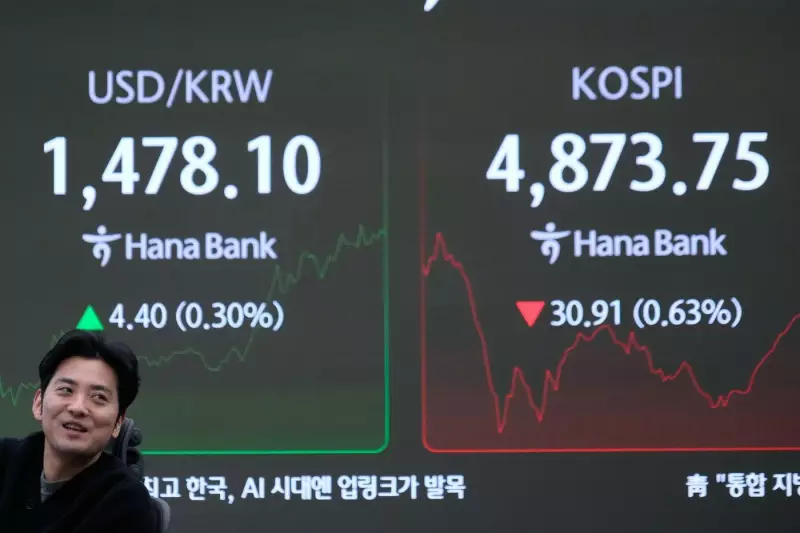
Global financial markets experienced a sharp downturn on Tuesday, January 20, 2026, as investor sentiment was rattled by former U.S. President Donald Trump's renewed political efforts to claim Greenland. The anxiety triggered a sell-off in U.S. stock futures and sent shares lower across major Asian and European exchanges.
Market Reaction to Geopolitical Uncertainty
The immediate fallout was visible in trading rooms worldwide. In Seoul, currency traders watched screens intently as the Korea Composite Stock Price Index (KOSPI) fell alongside a fluctuating exchange rate between the U.S. dollar and the South Korean won. The scene at the Hana Bank headquarters, captured in an Associated Press photograph, reflected the broader unease gripping international finance.
The core of the market's concern stems from the potential for significant geopolitical and trade disruption. Trump's push to acquire the vast, autonomous Danish territory, which he has publicly coveted since his first term, introduces a new layer of uncertainty into an already complex global landscape. Investors are weighing the risks of strained international relations, particularly with NATO allies, and the possible impact on Arctic resource development and shipping routes.

Broader Implications and Regional Concerns
The market tremor coincides with notable comments from Canadian political leaders, highlighting the regional stakes. Manitoba's premier pointed to the port of Churchill as a critical national asset, calling it "our only hope" should a serious dispute over Greenland's future escalate. This statement underscores how the issue directly affects Canadian economic and strategic interests in the North.
Meanwhile, other business and economic news competed for attention but failed to offset the negative momentum from the Greenland story. Reports on Canadian canola trade risks with China and Bank of Canada Governor Mark Carney's activities at the World Economic Forum in Davos were overshadowed by the market's focus on geopolitical risk.
A Pattern of Volatility
Financial analysts note that markets under Trump's presidency were frequently sensitive to his unexpected policy announcements and geopolitical maneuvers. The reaction on January 20 suggests that traders anticipate a return to this pattern of volatility, pricing in the potential for abrupt shifts in U.S. foreign policy that could destabilize international agreements and economic partnerships.
The decline was not isolated to futures. Major stock indices in Asia and Europe followed suit, with commodities and currencies also experiencing heightened volatility. The event serves as a stark reminder of how political developments can swiftly translate into financial market movements, affecting investment portfolios and economic forecasts worldwide.