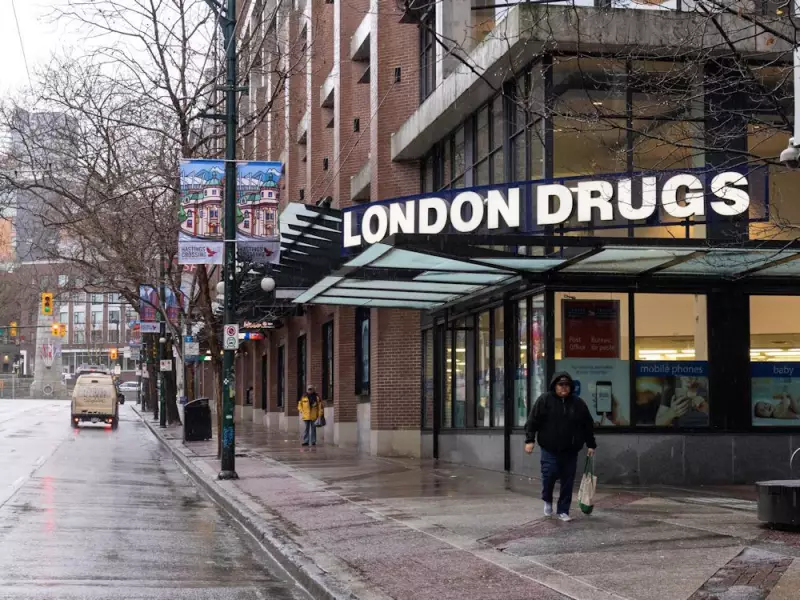
A stark economic crisis is unfolding in the cores of Canadian cities, where a surge in street disorder, violence, and theft is pushing businesses to the brink of collapse. New data reveals that up to one-fifth of retailers now report that persistent crime is making their operations unsustainable, forcing closures and reduced hours from Vancouver to Thunder Bay.
Vancouver Closure Highlights a National Trend
The issue came into sharp focus in early January 2026, when London Drugs announced the closure of its prominent Woodward's building location in Vancouver's Downtown Eastside. The retailer cited "persistent safety incidents and significant operating losses" as the reason for leaving the troubled neighbourhood. London Drugs president Clint Mahlman told the Vancouver Sun the location had lost "tens of millions of dollars."
This closure coincided with British Columbia Premier David Eby's admission that the province's drug decriminalization experiment had contributed to unchecked public disorder. The London Drugs store faced not just chronic shoplifting but an atmosphere of constant violence and intimidation, making it a potent symbol of a nationwide problem.

From Coast to Coast: Businesses Under Siege
The story in Vancouver is far from isolated. Across Canada, downtown businesses are shutting down or scaling back operations due to what many describe as anarchic conditions.
In Kelowna, B.C., the owner of Gallery Streetwear, Todd Daniels, reported an employee was bear-sprayed "for no reason" and posted images of repeated smash-and-grab robberies. "As it stands, downtown Kelowna is heading toward serious decline," Daniels stated.
In Thunder Bay, Ontario, a Tim Hortons in a high-crime area recently closed its dining room to the public. A summer 2025 survey by the Business Improvement Association of British Columbia found alarming statistics: 67% of respondents noted increased street disorder, and 74% dealt with heightened fear and anxiety among staff. Most critically, 19% said their business would not survive if conditions did not improve.
The Soaring Financial and Social Cost
The economic toll is staggering and rapidly accelerating. The Canadian Federation of Independent Business (CFIB) found that in 2023, 24% of its members reported being directly impacted by crime or community safety issues. By 2024, that figure had nearly doubled to 45%.
Industry groups are sounding the alarm. Alex McMillan, CEO of the B.C. Chamber of Commerce, told the Union of BC Municipalities in September 2025 that "businesses have closed and many others are teetering on the brink" due to disorder linked to addiction, mental health challenges, and those who exploit vulnerable populations.
On a national scale, the Retail Council of Canada estimates that businesses are now absorbing a collective $9.1 billion in losses from theft, a figure driven significantly by chronic shoplifting. This combination of direct financial loss, security costs, and the inability to retain staff or attract customers is creating a perfect storm for urban retail districts, threatening the economic and social vitality of downtowns from coast to coast.