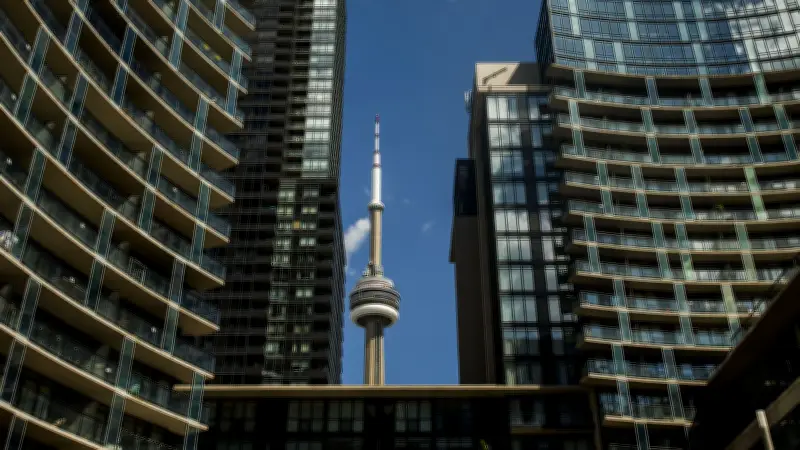
Davelle Morrison listed her client's 650-square-foot condo in downtown Toronto's Corktown neighbourhood for $558,000 at the beginning of March 2026 — then reduced the price by $38,000 in a hopeful effort to attract more interest. When the interest did not materialize, Morrison relisted the property for $399,000 on May 4 with an offer night scheduled for a week later. Not long ago, such a price point and sales strategy would have guaranteed a frenzy of activity.
This time, however, after just a handful of showings, nothing happened.
“We had an offer night on Monday, and it was crickets. Nobody came to the table,” said Morrison, an agent with Bosley Real Estate. “This is definitely a very new thing for this market.”

For agents who had grown accustomed to the insatiable investor demand, rapidly rising prices and bidding wars of the speculative condo boom that peaked in early 2022, moments like that are a clear sign that the tides have turned for Toronto's condo market.
Sellers today are dealing with a very different reality: weak to no investor appetite, plummeting prices and buyers in no rush to make a decision. And the shift is showing up in the data.
In its recent market outlook, TD Economics said GTA resale benchmark condo prices fell 10 per cent year over year in the first quarter of 2026 and projects prices will not trend higher until 2028. The bank expects that by that time, prices will have fallen 25 to 30 per cent from their early 2022 peak.
According to the Toronto Regional Real Estate Board (TRREB), benchmark condo prices were at the mid $700,000 range at the peak in early 2022. By TD's estimates, prices could bottom out somewhere in the mid to high $500,000 range before recovery takes hold.
“The rate of decline should slow in 2027 as demand recovers, with prices only returning to a sustained uptrend in 2028 — keeping this correction as one of the longest on record,” the bank said in its report.
Meanwhile, the Corktown condo has spent 105 days (and counting) awaiting its match. Four years after Toronto's feverish condo market reached its peak, a never-ending correction has buyers, sellers, realtors and investors grasping for the elusive bottom. From silent offer nights to stalled construction sites, this is where Toronto's condo land stands today.
Where have all the buyers gone?
Morrison has had other condo listings languish in the past year. One client listed their one-bedroom place in Toronto's upscale Yorkville neighbourhood in September 2025, only to have it sit on the market for five months. After four price reductions, the suite, located just across the street from the Four Seasons flagship hotel, finally sold for $637,500, roughly $88,000 under asking.
“That's the way the market is right now,” said Morrison. Instead of having buyers lined up at the door, realtors are now watching listings linger for months on end.
“There's a lack of showings,” said Toronto realtor Tim Yew. “The buyers are not out there.”
According to TRREB, there were 6,668 active condo listings in the GTA at the end of the first quarter of 2026. Canadian Real Estate Association (CREA) data show that although condo inventory improved somewhat, declining from 6.3 months of inventory at the end of 2025 to 5.4 at the end of the first quarter of 2026, buyers are taking longer to make a decision. The median number of days on the market for a sold condo in Toronto was 41 in the first quarter, up slightly from 36 days, year over year, according to real estate research firm Urbanation.
And the TD Economics report said condo sales declined by 11 per cent year over year in the first quarter of 2026 — roughly 40 per cent below the 10-year average for that period. “The imbalance behind the downturn persists, with demand levels insufficient to absorb elevated supply,” the bank said.
Morrison believes the shift is less about buyers disappearing altogether and more about the lack of urgency. “People are not rushing,” she said. “They know they have the luxury of time to think about things.”

Some sellers taking major losses, others refuse to sell
Toronto realtor Sewit Tamene recalled a client who thought she had made a savvy purchase when she bought a penthouse unit at the Merchandise Building near Dundas and Jarvis in January 2024 for $1.125 million. The previous owner had bought the unit at the height of the market in 2022 for $1.372 million, making the discount seem like a bargain. Tamene's client had intended to live in the unit but when her dream condo came to market just one year later, she stretched herself financially by buying the second property before offloading the first.
“At the time, no one expected the market to be where it is today,” Tamene said. As condo sales weakened, and spring turned to summer and then fall, the penthouse remained unsold. Carrying two properties for months on end became a financial burden that forced Tamene's client to repeatedly slash the asking price in an effort to attract a buyer. After about eight months and six price reductions, the asking price of $999,999 finally produced a buyer. By this point, the seller had accepted a six-figure loss of about $125,000, not including transaction costs.
Real estate technology firm Teranet suggests that the time of purchase plays a major role in whether the owner sells at a loss. Properties purchased in 2022 have had the highest loss rates over the last four years. By 2025, 36.6 per cent of homes bought that year were selling for less than their purchase price, compared with 24.6 per cent of homes purchased in 2023 and 21.9 per cent purchased in 2021. Properties bought in 2020 only had a five per cent loss rate. Real estate acquired before the pandemic boom are far less likely to lose money since it was usually purchased at much lower prices.
By now, those who bought earlier have a larger equity cushion, making them less vulnerable to today's market correction. They have also benefitted from years of mortgage repayment and, for investors, rising rents before condo values started to decline. Realtors representing sellers who are not as lucky say the steep losses are driving them to delist rather than try to sell in such a stagnant market.
Morrison said one couple she worked with, who were selling due to a separation, pulled their King West condo off the market after months of lowball offers and weak interest. Instead of selling at a loss, the pair began exploring whether one partner could buy the other out and hold the property until market conditions improved. “They didn't want to sell anymore,” Morrison said, adding that the couple hoped that waiting a few years would allow them to recover what they originally paid for the unit.
Yew said investors who bought near the peak of the market are stuck carrying properties for which rent no longer covers costs. He described one investor with a variable-rate mortgage whose monthly carrying costs jumped from $2,200 a month to over $3,000 after interest rates surged. He explained that some owners who bought condos in recent years are now cash-flow negative in monthly expenses — forcing them to choose between selling at a significant loss or absorbing steep monthly costs. “Those are the people who are bleeding out right now,” he said. In many cases, these owners are choosing to hold and suffer the monthly losses instead of selling right and losing “hundreds of thousands of dollars.”
Assignment sales have turned into a 'bloodbath'
Jeff Carr of Re/Max City Teams, East End Homes specializes in assignment sales. In the first quarter of this year, he represented a client who took a significant hit unloading their condo before closing. The client had purchased the place for nearly $560,000 at a pre-sale event in April 2021 and planned to rent it out. But as the completion date approached, and with the market already down, they found they no longer had the appetite to be a landlord. Closing on the unit still required a significant cash input of roughly $40,000, and there was the prospect of losing money every month as the rent would not cover the carrying costs. Believing the market would not turn around quickly enough for them to break even and eager to avoid the headache of carrying the place long term, they listed it on the assignment market. Carr managed to unload it in just a couple of weeks, but for $300,000 less than the purchase price.
“A loss like that catches the buyer's attention,” said Carr. Assignment sales have long been a part of the pre-construction condo market. Particularly because the lengthy period between purchasing a unit and taking possession — sometimes five years or more — life circumstances can change dramatically. One purchaser bought a one-bedroom waterfront condo at Toronto's Pier 27 during the pre-sale period in 2007. Construction did not begin until 2011/2012, and was finally completed between 2014 and 2015. In the roughly eight years between signing the purchase agreement and the occupancy period, the purchaser got married, with a baby now on the way. The 507-square-foot condo that once suited his lifestyle no longer met his needs. Selling the contract on assignment allowed him to exit the deal without ever taking possession of the home.
In another case, a downsizing senior waiting for the completion of a low-rise condo in the city's west-end suffered a debilitating stroke. After her daughter decided to move her into the family home, an assignment sale provided a way for the family to transfer the purchase agreement to another buyer, relieving them of the financial burden. Historically, assignment sales have offered a way for purchasers to transfer the contract and therefore the financial responsibility to another buyer before closing. However, during the housing boom, assignments evolved into something else entirely. Investors flocked to the pre-construction market with the intention of never taking possession, but rather selling their contracts for a profit. Many doubled their money — or more in some cases. In order for this strategy to keep working, prices had to keep rising — but then the market went cold.
Speculators headed for the exit at the same time, flooding the assignment market with listings. Investors facing the prospect of closing on a unit that would be cash-flow negative as a rental, also rushed to sell. This resulted in a crowded marketplace where buyers who genuinely need to get out of a deal were sinking under the weight of excess supply.
“It's a bloodbath for sellers in the assignment market today,” said Royal LePage real estate adviser Thomas Delespierre. Carr says assignment sales have gone off a cliff. “A lot of them aren't happening anymore,” he said, “because the price gap is just so wide.” Carr said one of the main reasons this type of deal falls through is the discrepancy between the original contract price and what a buyer is willing to pay today. “If a buyer agreed to purchase a $1-million condo and put down 20 per cent, the builder expects the full purchase price at closing,” he said. “But if the unit is now worth $700,000, someone must cover the difference.” Many sellers are discovering that the condo they bought at the peak of the market is now worth far less. “I don't think I've spoken to anyone in the last couple months who didn't pay at least another $100,000 to get out of it,” said Carr.
Sellers who do not have the means to bridge the price gap either default, close the deal and lease the property, or face legal consequences from the developer. Those who still have access to capital but want out nonetheless are throwing in incentives, such as covering closing costs. “There are sellers paying people to take over the contracts,” said Yew. TD Economics believes falling rental rates and the region's shrinking population have reduced the attractiveness of condos as investment assets, which is weighing heavily on “already-weak” investor demand. Additionally, some industry observers say investor activity has been the leading cause of today's excess condo supply. Strong demand from investors helped fuel the wave of pre-construction condo launches for a number of years, but when interest rates began climbing, investors left the dance floor. A glut of units emerged just as the pool of buyers faded.
Has the condo market hit bottom?
“When I see supply dropping and demand increasing, that's when it's going to bottom out. That's when prices will start to go the other way,” Yew said. Other realtors believe the market has already begun to stabilize. “I don't see how it can go lower, unless there's an unfortunate event, like third world war,” Delespierre said. In May, 1,535 condo units traded hands in Toronto, a 4.2 per cent increase year over year. Prices, however, continued to shrink — falling 9.12 per cent to a benchmark price of $539,400. Elsewhere in Canada, a similar story is playing out. Prices in the Greater Vancouver Area peaked in fall 2023 and have since declined by about 10 per cent. Population growth and condo prices simultaneously took off in Calgary in the third quarter of 2024. Since then, prices have also dropped by 10 per cent. Back in Toronto, TRREB's chief information officer, Jason Mercer, said stiffer competition between buyers could push prices up again, especially with far fewer condos coming to market.
Developers are shelving units
The fallout does not end with realtors, investors and sellers. Developers — where it all begins — are taking a major hit. Construction sites across Toronto are sitting idle while developers continue to carry the cost of land they expected to have already broken ground on — or may have already but had to put shovels down. “Almost no project can move forward right now,” said Pouyan Safapour, president at Devron Developments. For decades, Toronto's condo scene relied on pre-sales where buyers would purchase condo units years before completion — enough of them that developers could secure loans and construction would move along as normal. Today, it is a completely different ball game.
“Sales are down approximately 90 per cent from the 10-year norm,” said Safapour. “Almost no project can move forward right now.” Safapour, the developer behind The Winslow Condos in Lawrence Park, said a number of land parcels in the GTA, especially those in downtown Toronto, are sitting in limbo while builders wait for demand to return. In the meantime, the debt-financed land is costing up to hundreds of thousands per month. “Nearly all development lands have a loan,” he said. “Depending on the size of the site, carrying costs can range from $25,000 or $30,000 a month to as much as $400,000 or $500,000 per land per month.”
This is exactly what some of the largest development companies in the city are encountering. Michael Cooper, chief executive of Dream Unlimited, said his company has sites that could bring thousands of units to market — some of which should be under construction by now. Instead, the company has decided to wait and see. “We had hoped to be building other sites by selling condos, but that hasn't happened, so we're carrying the land for years longer than we expected. Every year we spend money carrying land, so it affects us for real,” Cooper said. He added that, in some cases, projects that would have moved forward in a year or two post pre-sales are now facing delays of several years.
For both developers, the challenge is not only weak demand. It is also having to price new products high enough to cover the cost of land, construction, financing and development charges. “If you want to build a new condo, you would have to compete with all this inventory that people try to sell at below cost,” Cooper said. “Not just below the price they paid, but below what it would cost to build it.” He explained that if comparable units are available on the resale market for less, buyers have little incentive to commit to a pre-construction purchase that may not be completed for several years, if at all. “There's more condos than people need right now,” Cooper said. Which means the projects continue to sit.
Over the past few months government incentives aimed at improving affordability have come into play with the intention of stimulating demand and reviving homebuilding activity. Both Ontario's temporary Harmonized Sales Tax (HST) relief on new homes and an $8.8-billion initiative to reduce municipal development charges are now in play, after industry advocates appealed to policymakers to introduce buyer incentives as home sales weakened. TD said demand in the new home market has faced several headwinds, including a soft labour market, slower population growth, cost-of-living pressures and elevated economic uncertainty. The bank also noted that recent price declines may be keeping buyers sidelined as they wait for steeper discounts.
A recent joint report from Altus Group and the Building Industry and Land Development Association (BILD) said that although overall sales in the housing market have softened, the HST rebate may not be enough to revive condo demand. Within the first month of the HST rebate program, which started on April 1 and runs until March 31, 2027, new condo sales hardly improved, the groups found. Condo apartment sales in April came in at just 199 units, 88 per cent below the historical norm. BILD recorded 13,331 units of unsold inventory in April, consisting of 4,757 units in pre-construction projects, 6,259 units in buildings under construction and 2,315 completed units. So, as realtor Tim Yew puts it, even as prices soften and buyers gain more negotiating power and rebates, economic caution is still the status quo. “The biggest thing,” he said, “is fear.”