Quebec City Area Real Estate Market Signals Highly Competitive Spring Season
The Quebec Professional Association of Real Estate Brokers (QPAREB) has released its residential real estate market statistics for February 2026, revealing a market characterized by tight supply and intense competition. The data, drawn from the Centris provincial database, indicates that the Quebec City Census Metropolitan Area (CMA) is poised for a highly competitive spring market.
Transaction Trends Show Modest Growth Driven by Condominiums
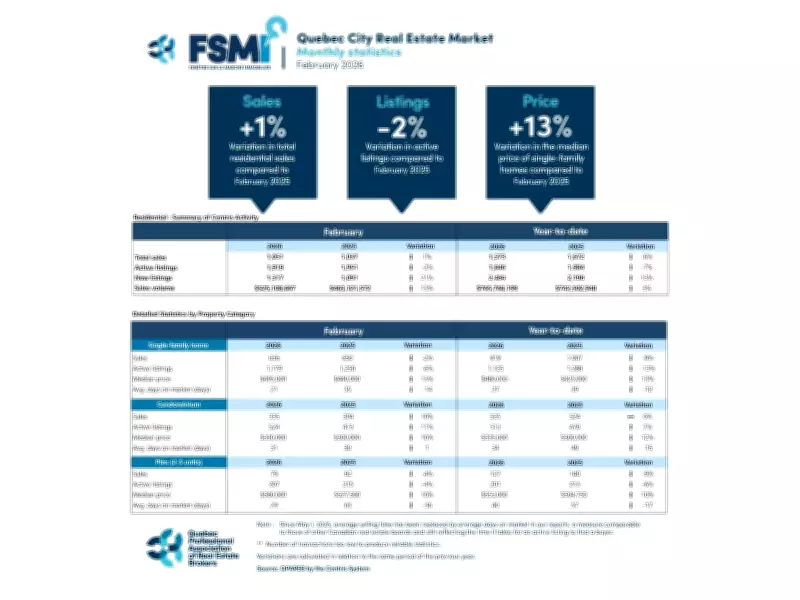
In February 2026, the Quebec City Metropolitan Area recorded 1,051 residential transactions, representing a marginal increase of 1 percent compared to the same period last year. This modest growth was primarily fueled by strong condominium sales, which surged by 10 percent to reach 335 transactions. In contrast, single-family homes experienced a slight decline of 2 percent with 636 transactions, while plexes saw a 4 percent decrease with 79 transactions.
Geographically, the Agglomeration of Quebec City was the only area to post positive growth, with 725 transactions marking a 6 percent increase. Sales on the South Shore edged down by 3 percent, while the Northern Periphery experienced a more pronounced drop of 17 percent, totaling just 109 transactions.

Historic Supply Shortages Create Seller's Market Conditions
The supply of properties listed for sale continued its downward trajectory for the 25th consecutive month, reaching the lowest level ever recorded for a February. This scarcity is largely attributed to significant declines in active listings for single-family homes (down 6 percent) and plexes (down 4 percent). Interestingly, condominium listings bucked this trend with an 11 percent increase.
This persistent shortage has created exceptionally favorable market conditions for sellers across all property categories. The number of months of inventory in the Quebec City CMA reached a historic low in February 2026, indicating that properties are selling rapidly in this supply-constrained environment.
Price Increases and Accelerated Sales Timeline
In this context of strong pressure on supply, prices continue their upward trajectory. The median price of single-family homes rose by 13 percent, while condominiums and plexes saw increases of 10 percent each. The average number of days on market dropped significantly for plexes (down 36 days) and, to a lesser extent, for single-family homes (down 14 days). For condominiums, the situation remained stable, with properties taking an average of 31 days to sell.
"In February, the greater Quebec City market remained heavily constrained by an insufficient supply of properties on the market, despite listings showing some tentative signs of adjustment," notes Charles Brant, QPAREB Market Analysis Director. He explains that sales have stabilized at levels well above the historical average for this time of year, reflecting sustained demand despite supply challenges.
Intense Competition and Affordability Concerns
In this scarcity-driven environment, competition among buyers remains intense. Nearly 45 percent of transactions were concluded following an overbidding process, a proportion virtually unchanged from the same period last year. This indicates that multiple-offer situations continue to be common in the Quebec City real estate market.
"This ongoing pressure continues to drive rapid price growth, which is making affordability an even greater challenge in the area, particularly for first-time buyers," adds Charles Brant, QPAREB Market Analysis Director. The combination of rising prices and competitive bidding processes creates significant hurdles for those attempting to enter the housing market.
The February 2026 data suggests that the Quebec City real estate market will remain highly competitive through the spring season, with supply constraints continuing to drive price increases and creating challenging conditions for buyers while benefiting sellers across all property categories.