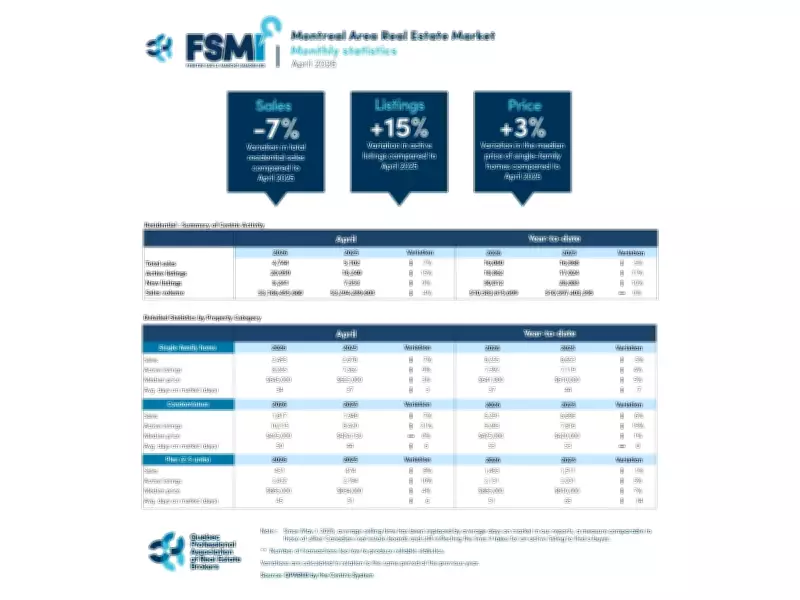
The Quebec Professional Association of Real Estate Brokers (QPAREB) has released its residential real estate market statistics for the Montreal Census Metropolitan Area (CMA) for April 2026. The data, drawn from the Centris provincial database, reveals a 7% decline in sales compared to April 2025, with 4,744 transactions recorded. Despite this decrease, activity remains close to the ten-year average, indicating a still-active market.
Sales Decline Across All Property Types and Regions
All property categories experienced a drop in sales. Single-family homes and condominiums both saw a 7% decline, while plexes recorded a sharper 9% decrease. Geographically, all six major sectors of the Montreal CMA reported slowdowns. Vaudreuil-Soulanges (-17%) and Saint-Jean-sur-Richelieu (-11%) posted the steepest declines, while the South Shore (-4%) showed the most moderate decrease. Other sectors saw drops ranging from 7% to 8%.
Supply Increases for Ninth Consecutive Month
The supply of properties for sale rose significantly, with 20,959 active listings in April, marking the ninth consecutive monthly increase. Condominiums led the growth with a 21% rise compared to April 2025, followed by single-family homes (+9%) and plexes (+10%). Market conditions have gradually eased, but the market still favors sellers, except for condominiums on the Island of Montreal, where conditions are now more balanced.

Price Growth Moderates
Price growth slowed for single-family homes and plexes. The median price for single-family homes reached $645,000 (+3%), while plexes stood at $865,000 (+4%). Condominium prices remained stable at $425,000. The average days on market shortened for single-family homes (34 days) and plexes (45 days), but increased for condominiums to 50 days (+6 days), reflecting easing conditions.
Economic Uncertainty and Buyer Caution
Camille Laberge, QPAREB Assistant Director and Senior Economist, noted: “April’s data confirm the slowdown in sales in Montreal, which are now close to the historical average. Demand is being held back by economic uncertainty and high price levels, particularly challenging for first-time buyers.” Charles Brant, QPAREB Market Analysis Director, added: “Consumer confidence has weakened due to a slowdown in the Quebec economy and inflation risks from geopolitical uncertainties. Many households are taking a step back before proceeding with a real estate project.” Laberge also mentioned that “announced changes to the welcome tax could provide support to some first-time buyers, while the more balanced condominium market could help improve housing affordability.”