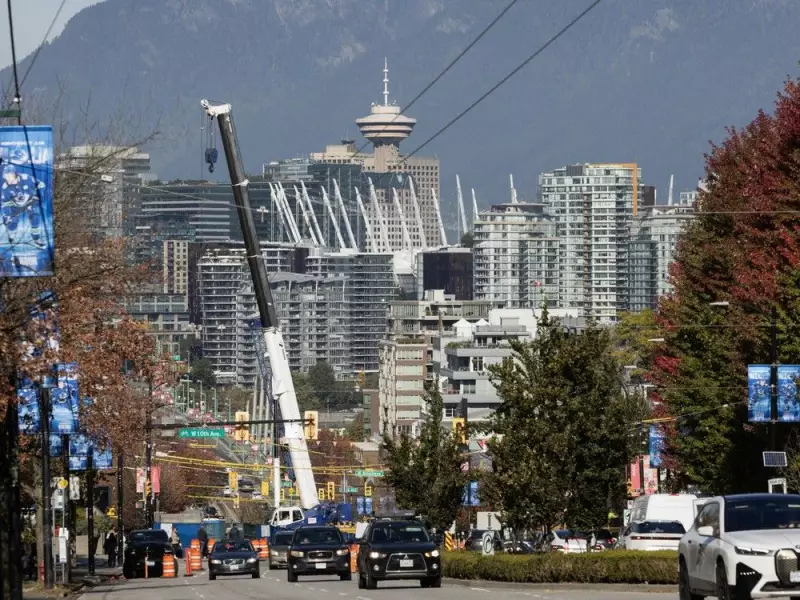
The latest property assessment data from the B.C. Assessment Authority paints a picture of a diverging provincial real estate market. Released in early January 2026, the figures show a clear trend: residential property values have softened across the populous Lower Mainland, while many communities in the northern part of the province have seen appreciable gains.
A Tale of Two Markets: South vs. North
Bryan Murao, a provincial assessor with B.C. Assessment, summarized the shift, noting that many homeowners in the Lower Mainland can expect decreases, typically in the range of zero to minus ten percent. "The softening housing market is being reflected in 2026 property assessments," Murao stated. This stands in contrast to the North Central region, where he indicated most homeowners could see changes from minus five percent to a significant plus fifteen percent, highlighting the area's relative stability and growth.
The overall numbers are stark. The total value of all properties in the Lower Mainland—which includes Greater Vancouver, the Fraser Valley, Sea to Sky, and the Sunshine Coast—fell from $2.01 trillion on July 1, 2024, to $1.92 trillion on July 1, 2025. This represents a $90 billion drop in total value. When accounting for $24 billion in new construction and subdivisions, the decline in value for existing properties was even more pronounced at $114 billion.

Lower Mainland: Detached Homes and Condos See Declines
The assessment details reveal varied declines across Lower Mainland municipalities for detached homes:
- White Rock led the downturn with an average nine percent drop to $1.58 million.
- University Endowment Lands, City of Langley, and Richmond each saw average decreases of eight percent.
- Surrey detached homes fell six percent to an average of $1.464 million.
- Vancouver detached homes decreased five percent to an average of $2.092 million.
The condo market followed a similar pattern. Surrey condos fell an average of seven percent, with Richmond and White Rock seeing six percent declines. In Vancouver, the average condo value decreased three percent to $772,000. Notably, markets like Whistler and Hope reported no change, while Squamish was an outlier with a two percent increase.
Northern Stability and Growth
While the south cooled, northern communities experienced a different reality. The North Central region, encompassing about 70 percent of the province's land mass, saw values climb.
- Fort St. James posted a notable fourteen percent increase, bringing the average detached home value to $244,000.
- Hazelton saw values rise by ten percent.
- Prince Rupert reported a three percent gain.
- Prince George, a major northern hub, saw a two percent increase for a detached home, reaching an average value of $459,000.
Murao attributed this trend to a stable northern real estate market, which is now reflected in the updated assessments. It's important to note that these assessment values are based on market conditions as of July 1, 2025. Subsequent data from Greater Vancouver Realtors indicates the composite benchmark price for Metro Vancouver properties has fallen an additional 3.2 percent since that valuation date, suggesting the market adjustment may be ongoing in the south.