VANCOUVER, British Columbia – Stallion Uranium Corp. (TSX-V: STUD; OTCQB: STLNF; FSE: B76) has announced the successful recommencement of drilling operations at its Moonlite Project in the Athabasca Basin, northern Saskatchewan. The company also provided shareholders with an update on the April 1, 2026 incident.
Drilling Update
Drilling has resumed at the Moonlite Project. To date, the company has completed approximately 1,900 meters of the planned 4,000-meter Phase 1 diamond drill program. Every drill hole completed so far has intersected significant alteration and structure.
Drill Hole Summary
- ML26-001: Lost due to poor rock conditions
- ML26-001A: Completed at 677.0 meters
- ML26-002: Lost due to poor rock conditions
- ML26-002A: Lost due to the April 1, 2026 incident
- ML26-003: Ongoing
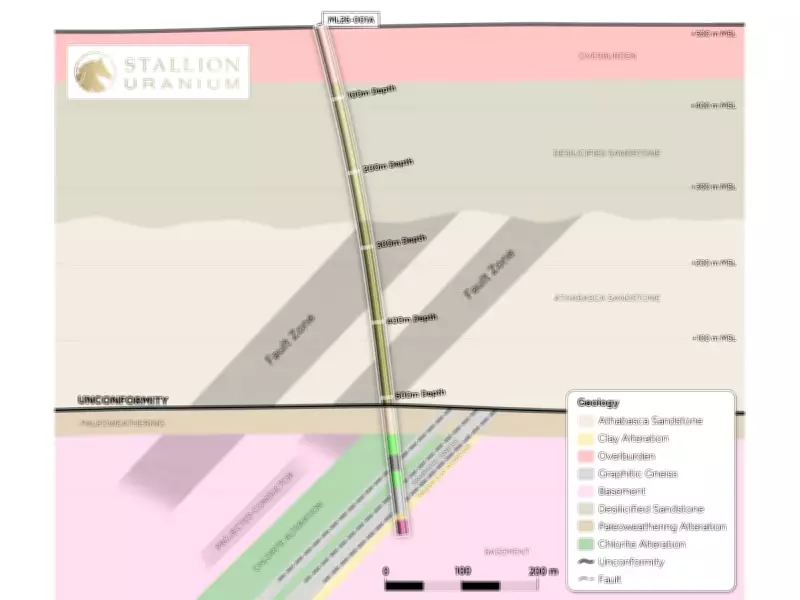
The first completed drill hole (ML26-001A) successfully intersected multiple fault zones in both sandstone and basement rocks. This included two wide fault zones (approximately 66 to 109 meters) in the sandstone exhibiting strong quartz dissolution, brecciation, and broken core. In the basement, a significant graphitic fault zone was encountered, associated with strong to locally massive clay alteration. This zone is interpreted to represent the primary conductive source identified in the company’s geophysical datasets.

Darren Slugoski, Vice President Exploration, said, “The consistent intersection of significant alteration and structural features in every hole drilled is highly encouraging for uranium exploration in the Athabasca Basin. We are observing key indicators for uranium mineralization, including sandstone bleaching and dissolution, clay alteration, brecciation, and faulting. These elements often serve as pathways and traps for uranium-bearing fluids in the basin, and we look forward to advancing the program with refined targeting informed by real-time results.”
Importantly, the intersection of a graphitic fault zone together with significant structural complexity and alteration strongly validates the company’s integrated geophysical targeting model. These results confirm a structurally complex and altered system consistent with the Coyote corridor and support the presence of a fertile hydrothermal system.
Drilling continues to test priority areas within the interpreted conductive corridor, with emphasis on zones of structural complexity and alteration favourable for uranium mineralization. Stallion remains fully funded to complete the current program and continues to prioritize safety, environmental stewardship, and technical excellence as it advances exploration at the Moonlite Project.