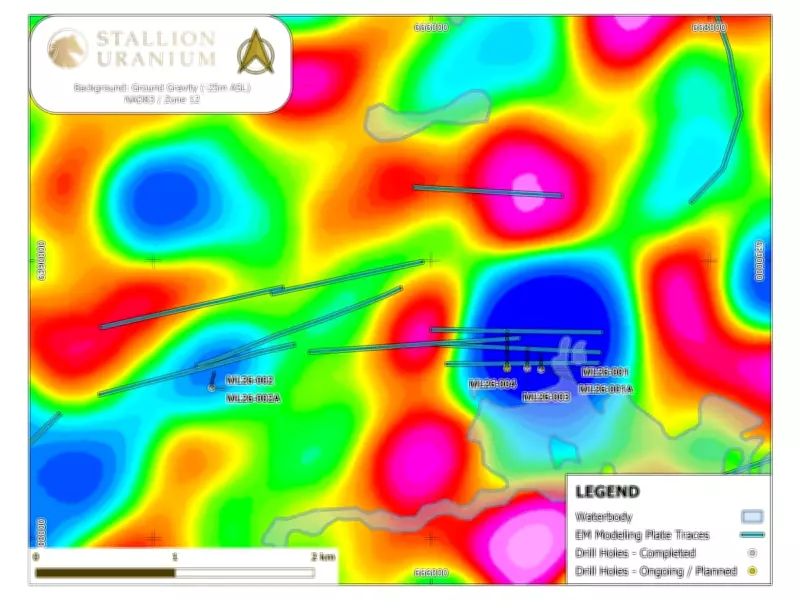
Stallion Uranium Corp. (TSX-V: STUD; OTCQB: STLNF; FSE: B76) has announced an expansion of its ongoing drilling program at the Coyote Target within the Moonlite Project in the Athabasca Basin, Saskatchewan. The program has been increased from 4,000 meters to 5,500 meters following encouraging early results.
Positive Early Indicators
The decision to expand the program comes after the intersection of significant hydrothermal alteration, complex structural corridors, and elevated radioactivity in the initial drill holes. These features are recognized as key indicators of a potentially larger mineralized uranium system in the Coyote Corridor.
Matthew Schwab, CEO of Stallion Uranium Corp., expressed excitement about the early indicators. “The scale of alteration and strong structural features combined with elevated radioactivity reinforce our belief in the potential for a meaningful mineralized system. We look forward to stepping up our drilling efforts to further test this highly prospective corridor.”

Based on the promising current drilling results, samples have been sent for assay, and the company is awaiting further analysis as the drilling program progresses.
Additional Geophysical Survey
In support of the expanded drill program, the Company has engaged Abitibi Geophysics to complete additional Ground SWML (Step-Wise Moving Loop) TDEM survey coverage over the Coyote Corridor. This work aims to further refine and optimize future drill targets by enhancing the understanding of subsurface conductors.
The SWML-TDEM survey will cover three 3.2 km-long lines using seven transmitter loops (each 400 m x 600 m) with overlapping measurements. It will record high-resolution electromagnetic responses at regularly spaced receiver stations along the profile. The survey will be conducted using Abitibi Geophysics’ proprietary ARMIT-TDEM system, which captures both B-field and dB/dt responses across three components simultaneously. These two data types are sensitive to different conductivity ranges and, when combined, enhance the detection and resolution of subsurface conductors.
The use of stepwise loops with overlapping measurements improves resolution compared to conventional fixed-loop surveys and is particularly well-suited for identifying discrete conductors in the complex basement geology of the Athabasca Basin. The data will be collected using a 10 Hz base frequency, with robust stacking, QA/QC protocols, and real-time data validation to ensure high-quality results.