SAGA Metals Announces Significant Assay Results from 2026 Drilling Campaign at Trapper South
VANCOUVER, British Columbia, March 18, 2026 – SAGA Metals Corp., a North American exploration company dedicated to discovering critical minerals, has released additional assay results from its ongoing diamond drill program at the Trapper Zone. This zone is part of the company's fully owned Radar Titanium-Vanadium-Iron Project located near Cartwright, Labrador, Canada. The latest findings come from drill holes R-0018, R-0019, and R-0020, conducted in 2026 as part of the maiden Mineral Resource Estimate (MRE) initiative.
High-Grade Intercepts Highlight Resource Potential
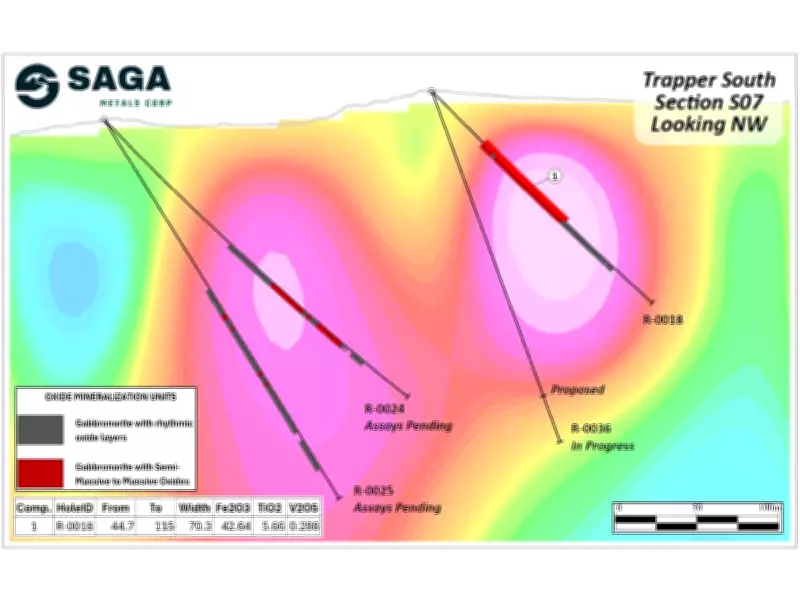
The analytical results reveal impressive intercepts that underscore the project's mineral richness. Specifically, hole R-0019 returned 45.7 meters at 49.51% iron oxide (Fe₂O₃), 6.56% titanium dioxide (TiO₂), and 0.374% vanadium pentoxide (V₂O₅). Other notable intercepts include hole R-0018 with 70.3 meters at 42.64% Fe₂O₃, 5.66% TiO₂, and 0.288% V₂O₅, and hole R-0020 with 40.7 meters at 37.62% Fe₂O₃, 4.93% TiO₂, and 0.239% V₂O₅.
These results bring the total number of diamond drill holes with assays received in 2026 to five, building on earlier reports from March 5, 2026, which included holes R-0016 and R-0017. The earlier holes showed intercepts such as 50.60 meters at 52.05% Fe₂O₃, 7.21% TiO₂, and 0.375% V₂O₅, and 90.01 meters at 51.86% Fe₂O₃, 6.76% TiO₂, and 0.417% V₂O₅, respectively.

Expanded Drilling Efforts and Geological Insights
To date in 2026, SAGA Metals has completed twenty-one drill holes, numbered R-0016 to R-0036, with significant oxide intercepts including 154.77 meters in hole R-0026 and 151.41 meters in hole R-0032. These intercepts are predominantly composed of semi-massive oxides with extensive rhythmic layering, a geological feature that indicates consistent mineralization patterns.
Multiple holes have intercepted broad zones of semi-massive oxide, with thicknesses up to 87.08 meters, confirming increased oxide concentration and thickness in the Trapper South area. The observed rhythmic banding and semi-massive to massive oxide mineralization align with prior high-grade results from the Trapper North zone, suggesting a cohesive mineralized system across the project.
Drilling operations are progressing efficiently, with 4,492 meters already completed in 2026. Hole R-0037 is currently in progress, indicating ongoing exploration activity. Additionally, sample processing is underway, with Impact Global Solutions (IGS) Laboratories receiving 340 samples from holes R-0021, R-0022, and R-0023 on March 9, 2026, and assays expected within a couple of weeks. A further 507 samples from holes R-0024, R-0025, and R-0026 were cut, sampled, and shipped to IGS on March 16, 2026.
Detailed Drilling Summary for 2026
The following table summarizes key drilling data from the Trapper South campaign, highlighting depths, oxide intervals, and layering observations:
- Hole R-0016: Total depth 206 meters, with 45.8 meters of semi-massive oxide and 12.16 meters of rhythmic layering.
- Hole R-0017: Total depth 161 meters, featuring 50.56 meters of semi-massive oxide and 140.64 meters of rhythmic layering.
- Hole R-0018: Total depth 188 meters, including 44.7 meters of semi-massive oxide and 156.37 meters of rhythmic layering.
- Hole R-0019: Total depth 182 meters, with 66.55 meters of semi-massive oxide and 133 meters of rhythmic layering.
- Hole R-0020: Total depth 206 meters, showing 50.8 meters of semi-massive oxide and 138 meters of rhythmic layering.
Additional holes, such as R-0021 to R-0036, have been logged with varying degrees of completion, with some still in progress. The consistent azimuth of 38° and dips ranging from -45° to -70° indicate a systematic drilling approach aimed at optimizing resource delineation.
This comprehensive drilling effort not only enhances the understanding of the Trapper South zone's mineralogy but also positions SAGA Metals for potential resource expansion and future development in the critical minerals sector. The company remains focused on advancing its exploration activities to unlock the full potential of the Radar Project in Labrador.