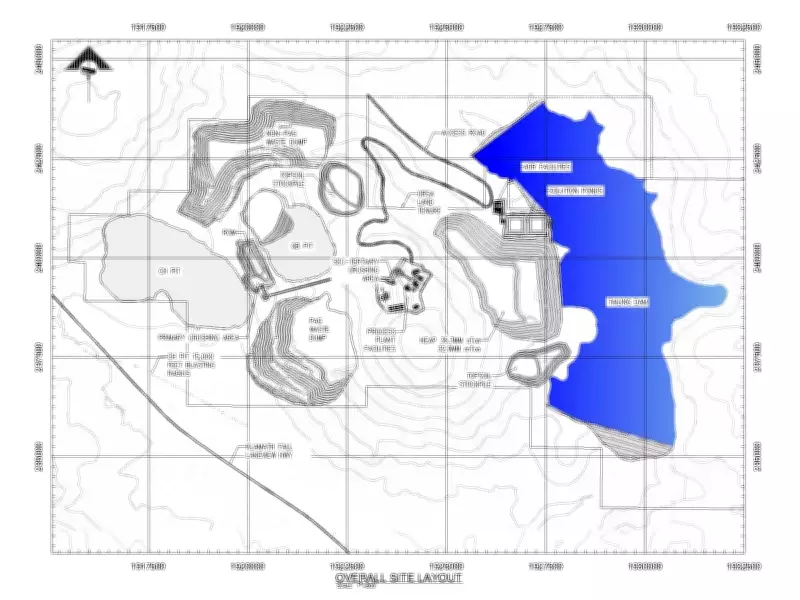
QGold Resources Ltd. has announced the results of its maiden Preliminary Economic Assessment for the Quartz Mountain Gold Project, positioning the company as a premier gold development asset in the United States. The PEA reveals robust economic metrics that underscore the project's potential as a significant gold mining operation.
Strong Economic Fundamentals
The Preliminary Economic Assessment demonstrates compelling financial returns for the Quartz Mountain Gold Project. At a conservative 24-month trailing average gold price of US$3,265 per ounce, the project shows an after-tax Net Present Value of US$1.71 billion using a 5% discount rate. The after-tax Internal Rate of Return reaches an impressive 55.2%, highlighting the project's strong economic viability.
These figures become even more significant when compared to current market conditions. The base case gold price used in the assessment represents less than 45% of the current spot gold price, which stands at approximately US$4,800 per ounce. This substantial difference suggests significant additional upside potential in the current gold price environment.

Project Details and Production Profile
The Quartz Mountain Gold Project, located in Lake County, Oregon, presents a long-life mining operation with a projected 14-year mine life. The operation is expected to produce an average of 135,400 ounces of gold annually, with peak production reaching 166,300 ounces per year. Over the life of the mine, total gold production is estimated at 1.9 million ounces.
The project benefits from a low strip ratio of 0.65:1 and gold recovery rates of 79.6%. These technical parameters contribute to the project's efficient operational profile and strong economic returns.
Cost Structure and Capital Requirements
Quartz Mountain demonstrates an attractive low-cost profile that positions it competitively among North American gold projects. Cash operating costs are estimated at US$1,010 per ounce, while All-In Sustaining Costs come in at US$1,214 per ounce. This cost structure provides strong margins even at conservative gold price assumptions.
Initial capital expenditure requirements total US$290 million, which includes equipment taxes, working capital, and contingency provisions. The project delivers rapid capital recovery with an after-tax payback period of just 1.80 years, highlighting its capital efficiency.
Mineral Resource Base
The updated NI-43-101 Mineral Resource Estimate provides a solid foundation for the project's development. The resource includes 2.01 million ounces of gold in the Indicated category and an additional 494,000 ounces in the Inferred category. This substantial resource base supports the 14-year mine life and provides opportunities for future expansion through additional exploration.
Management Perspective and Forward Path
Company management expressed strong confidence in the project's potential following the PEA results. "The completion of the Quartz Mountain PEA represents an important milestone as the Project advances toward a future construction decision," stated company representatives. "These metrics highlight the Project's strong margins, compelling capital efficiency, and resilience across commodity price cycles."
The PEA was prepared by Kappes, Cassiday & Associates of Reno, Nevada, a leading engineering firm with extensive gold project expertise. The assessment confirms the technical and economic viability of the project and provides the foundation for advancing toward a Feasibility Study.
Looking forward, QGold Resources plans to conduct drilling and exploration programs in 2026 focused on metallurgical test work, resource expansion, and infill drilling to upgrade the resource classification. The company has established constructive relationships with the U.S. Forest Service, Oregon state government, and Lake County stakeholders, providing important social license and permitting momentum for the project's development.