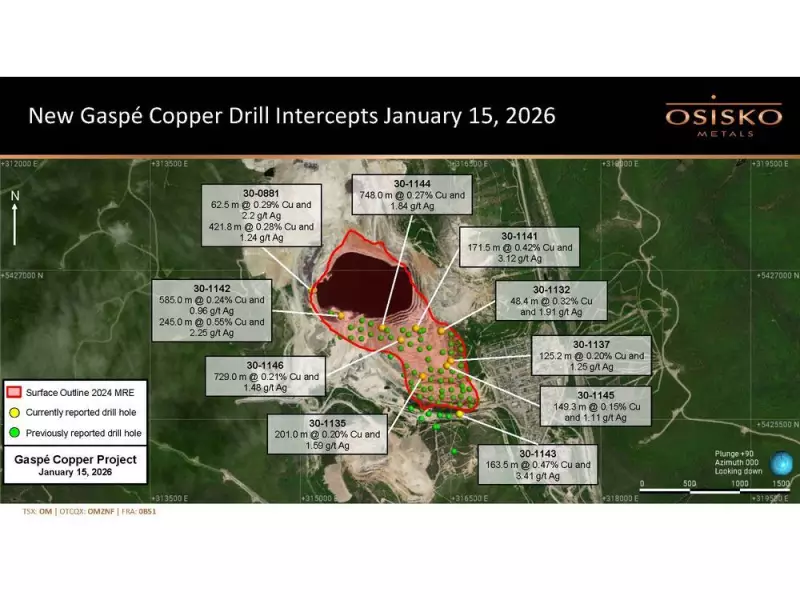
Osisko Metals Incorporated has released a new set of promising drill results from its Gaspé Copper Project, located on the Gaspé Peninsula in Eastern Québec. The data, announced on January 15, 2026, includes 35 mineralized intercepts from ten drill holes, showcasing both infill drilling within the known resource and expansion into new areas.
Standout Drill Results and Project Highlights
The latest campaign has yielded several exceptionally long and consistent intercepts of copper mineralization. The most notable result came from drill hole 30-1144, which cut a continuous 748.0 metres averaging 0.27% copper (0.37% copper equivalent). This intercept combines both infill and expansion drilling.
Other significant results include:

- Drill hole 30-1146: 729.0 metres averaging 0.21% Cu.
- Drill hole 30-1142: 585.0 metres averaging 0.24% Cu, including a higher-grade expansion zone of 245.0 metres at 0.55% Cu.
- A southern extension hole, 30-1143, intersected 163.5 metres averaging 0.47% Cu, indicating potential for growth in that direction.
The company also reported successful results from re-assaying a historical drill hole, 30-0881, which added a new deep expansion intercept of 421.8 metres averaging 0.28% Cu.
Strategic Goals: Upgrading and Expanding the Resource
The drilling program serves two primary purposes for Osisko Metals. The infill drilling is focused on areas inside the existing 2024 Mineral Resource Estimate (MRE) model. Its goal is to convert inferred mineral resources into the higher-confidence measured or indicated categories, which is a critical step for future mine planning.
Simultaneously, the expansion drilling targets areas outside the current resource model. Intercepts like the 245-metre zone of 0.55% Cu in hole 30-1142 and the southern extension in hole 30-1143 are designed to potentially add new tonnage to the project. These new resources will be formally classified in the next MRE update.
Implications for the Gaspé Copper Project
The consistently long intercepts reported by Osisko Metals underscore the large-scale, bulk-tonnage nature of the Gaspé Copper deposit. The ability to expand mineralization at depth and along strike, as seen in holes on the eastern margin extending to depths over 850 metres, points to a robust and growing system.
These positive results are expected to strengthen the project's economics and advance it further along the development pathway. The company's work continues to highlight the Gaspé Peninsula as a significant copper district in Québec, a stable mining jurisdiction in Canada.
All reported drill results are based on standard industry quality assurance and quality control protocols. Detailed maps and further technical information are available on the company's official website.