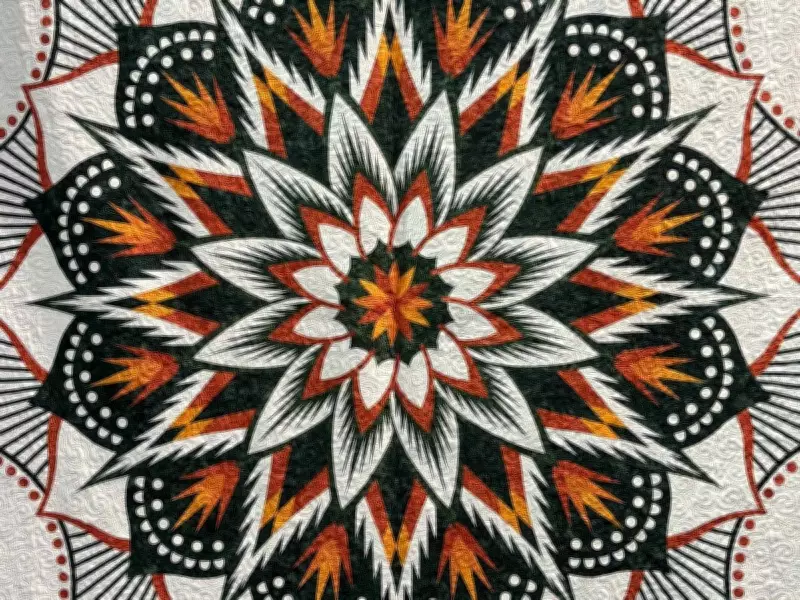
A couple of weekends ago, the Boundary Bay Quilters Guild staged a quilt show at the South Delta Recreation Centre in Tsawwassen. I can’t tell you how unexcited I was at the prospect of this. I know nothing about quilts. I have never had the urge to take up quilting. For one thing, I do not sew. For another, quilting requires patience, and I do not do patience.
But it was my wife’s idea to go to the show, so I, in husband mode, tagged along, mildly disinterested, with the expectation that I would see nothing much more than the image I had of quilts in my mind’s eye — patchwork bedspreads, pleasant granny stuff, that sort of thing.
And yet what I saw there astounded me. There were quilts the size of murals. There were quilts exploding with colour. There were funny quilts, quilts that tugged at the heart and quilts that expressed every iteration of love — for babies, children, spouses, the dead. There were quilts so luminous they transcended craftsmanship and rose up to the realm of art. They deserved to be hung in a museum or art gallery, not a gymnasium.

A Range of Quilts
“If you walked the show,” said Dawn Fielden, vice-president of the Boundary Bay Quilters Guild, “you saw the range of quilts that were hung there, and some of them are very utilitarian. It’s like you look at a quilt and you’d say, ‘Yep, that’s lovely and it’s going to go on somebody’s bed.’ But there were lots and lots of pieces in that show that were art. It’s simply another medium of expression, like painting in fabric, really. As much as painting or sculpture or any type of tangible art is, it’s an expression of the person who makes it.”
Modern Quilting Movement
That expression can manifest itself in different ways and under different schools of quilting. The modern quilting movement, for example, tends to attract younger quilters, leans toward abstraction, impressionism, solid colours and negative space. Readers can see examples at the Vancouver Modern Quilt Guild’s website.
Studio Art Quilt Associates
The Studio Art Quilt Associates promotes quilting as fine art, and works tend to be more painterly and figurative. Readers can see examples at their website.
Craftivism
And then, Fielden said, there are the “craftivists” — quilting as a form of activism to advocate political and social change. One of the most famous examples is the AIDS Memorial Quilt, the world’s largest piece of community folk art. Begun in the mid-1980s, it weighs 54 tons, spans over a million square feet and is comprised of over 50,000 quilted panels inscribed with 110,000 names of those who died of HIV/AIDS.
“Quilting,” Fielden said, “has changed within the last 50 years. It really went into decline after the Second World War, when nobody wanted to have handmade stuff anymore: They wanted a blanket that was made in a factory and bought in a store.”
But the American bicentennial in 1976 spurred an interest in old-time crafts, she said, and quilting — spurred on by new quilting TV shows and magazines — experienced a renaissance. Clubs sprouted up across the U.S. and Canada. Membership lists blossomed. Fielden estimates there are over 100 quilters guilds in B.C. alone, but, she said, modern tastes for convenience and emerging demographics may be working against it.