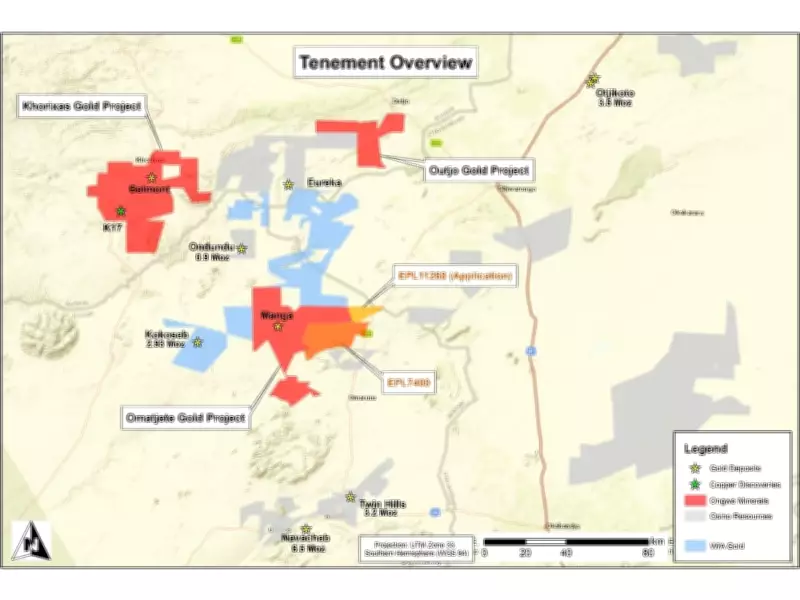
Ongwe Minerals Inc. (TSXV:OGW) has announced a significant expansion of its Omatjete project in Namibia, securing new licenses that increase the project area by up to 42%. This strategic move enhances the company's control over the highly prospective Okondeka Fault Zone and reveals a new parallel fault system for exploration.
License Acquisition and Project Growth
In a recent development, Ongwe Minerals acquired a 90% stake in the adjacent EPL7400 license, covering 36,600 hectares, and submitted an application for the EPL11268 license, spanning 8,200 hectares. This acquisition effectively increases the Omatjete project area from its previous size, bringing the total controlled area to a substantial scale. The new licenses are contiguous, allowing for seamless exploration and development across the expanded territory.
Enhanced Control Over Key Geological Structures
With these new licenses, Ongwe now controls approximately 50 kilometers of strike on the Okondeka Fault Zone (OFZ), a critical geological feature that hosts significant gold deposits. The OFZ includes the Kokoseb deposit, managed by WIA Gold with an estimated 2.9 million ounces, and the newly discovered Manga Gold Prospect. This extended control positions Ongwe as a dominant player in the emerging Northwest Damara Belt of Namibia.

David Underwood, CEO of Ongwe, emphasized the importance of this expansion, stating, "Since the initial discovery of the Manga Gold Prospect, we have been working hard behind the scenes to expand the licence package and cover the full extent of the highly prospective Okondeka Fault Zone. We are happy to report that this has now been achieved."
Discovery of Parallel Fault Zone
A recent structural re-analysis by Ongwe's technical team has identified a prospective relay system and the parallel Okakongo Fault Zone within the newly acquired license area. This discovery adds a second, 25-kilometer-long fault system to the company's exploration portfolio. Underwood highlighted the significance, noting, "This now gives us a second, 25km long, significant fault system to explore."
The gold mineralization in the Damara Belt is primarily controlled by deep-seated structures that act as conduits for hydrothermal fluids. Ongwe's expertise in identifying these faults, along with associated splays and relays, enhances its ability to target high-potential areas for gold extraction.
Ongwe's Flagship Projects in Namibia
Ongwe Minerals manages three key projects in Namibia, solidifying its position in the region:
- The Khorixas Project (154,000 hectares): Includes the Belmont Prospect, an orogenic gold system with a surface footprint of 12km by 6km and numerous high-grade visible gold rock chips at surface.
- The Omatjete Project (151,800 hectares): Contains the Manga Prospect, an orogenic gold system located 30km along strike from the Kokoseb deposit, with a surface footprint of 4.5km by 1km.
- The Outjo Project (46,000 hectares): Positioned along strike from Osino's Eureka Gold Discovery, sharing a similar geological setting.
These projects leverage Namibia's rich mineral resources and Ongwe's strategic land holdings to drive exploration efforts forward.
Future Exploration and Implications
The expansion of the Omatjete project and the identification of the Okakongo Fault Zone open new avenues for gold exploration in Namibia. Ongwe plans to continue its exploration activities along these fault systems, focusing on areas with high fluid concentration potential. This development not only boosts the company's asset base but also contributes to the growing mining sector in Namibia, known for its untapped mineral wealth.
As Ongwe moves forward, stakeholders can expect increased drilling and analysis in the expanded license areas, aiming to uncover further gold deposits and enhance resource estimates. This announcement underscores Ongwe's commitment to leveraging geological insights for sustainable mining growth in Africa.