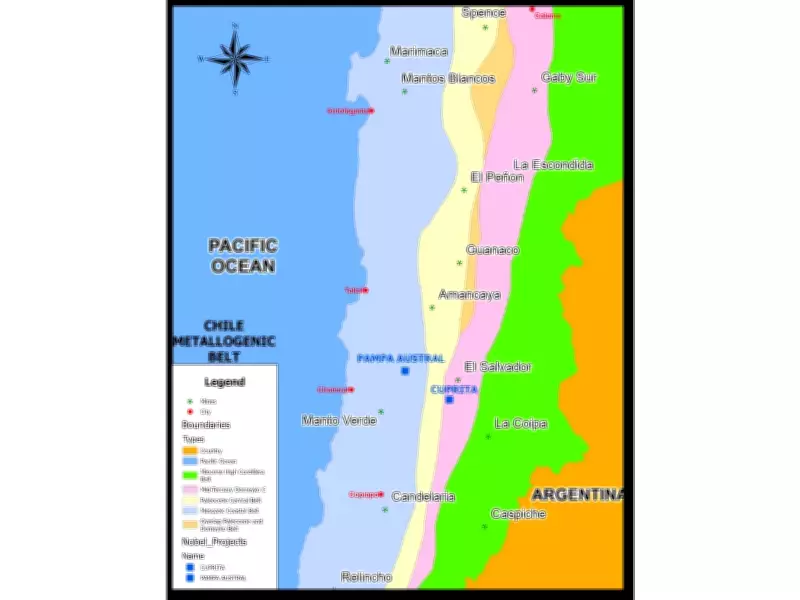
TORONTO, May 15, 2026 – Nobel Resources Corp. (TSX-V: NBLC; OTCPK: NBTRF) has announced the commencement of diamond drilling at its Pampa Austral property in Chile. The initial phase includes two planned drill holes targeting a zone where historical reverse circulation drilling reportedly intersected 70 meters grading 0.70% copper, including 14 meters grading 2.1% copper and 0.1 g/t gold, as reported by Farwest Mining in 2004.
Pampa Austral Drilling Campaign
The mineralized hole is located adjacent to an Induced Polarization (IP) chargeability anomaly identified through surveying conducted by the optionor of Pampa Austral after Farwest's drilling. Nobel plans to test this IP anomaly during its current drilling campaign. The company aims to evaluate the potential for porphyry copper-gold mineralization in the area.
Cuprita Project Advances
At the Cuprita project, Quantec Geophysics is conducting an extensive IP survey, now approximately 75% complete. Preliminary results reveal a chargeability anomaly extending south and west beneath the lithocap that was the target of the initial drill program, as detailed in the company's April 23, 2026 news release.

Additionally, a Photosat high-resolution satellite imagery survey has been completed. Results confirm that alteration mineral assemblages characteristic of mineralized porphyry systems in the region are associated with the extensive lithocap at Cuprita.
Vernon Arseneau, CEO and Director of Nobel, stated: “The results at Cuprita are encouraging. Satellite data will be integrated with the IP survey, when completed, and detailed geological mapping to improve drill targeting for a future campaign.”
Quality Assurance and Quality Control
Sampling is conducted following industry-standard QA/QC procedures, including systematic insertion of certified reference materials, blanks, and duplicate samples to monitor laboratory performance. Drill core samples are typically collected over intervals of 1 to 2 meters, depending on geological boundaries, with shorter intervals avoided to maintain consistency. Core is geologically logged and photographed before being split along the axis using an electric rock saw. One half is sent for analysis, while the other is retained for reference.
Information regarding adjacent properties is provided for context only and is not necessarily indicative of mineralization or potential at Nobel's projects.