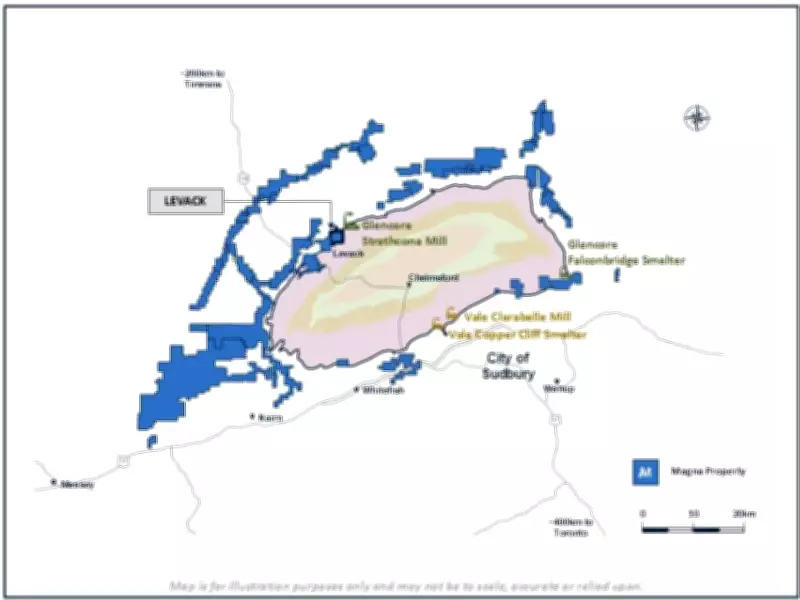
SUDBURY, Ontario – Magna Mining Inc. (TSXV: NICU) (OTCQX: MGMNF) (FSE: 8YD) has released impressive new assay results from its ongoing exploration activities at the past-producing Levack Mine, situated in the North Range of the Sudbury Basin in Ontario, Canada. The company is also providing a comprehensive update on various operational advancements, including underground development, as it moves closer to a potential restart decision anticipated in the second half of 2026.
Exceptional Drill Results Unveiled
The latest drilling campaign has continued to intersect substantial copper-rich massive sulphide veins over an approximate downhole length of 175 metres within the R2 Footwall Zone. Highlights from drillhole MLV-26-14A W1 are particularly noteworthy, showcasing the high-grade mineralization present in this region.
Key Assay Highlights
- MLV-26-14A W1: 23.2% copper, 5.6% nickel, 21.4 grams per tonne combined platinum, palladium, and gold, and 225.0 grams per tonne silver over 2.4 metres, starting at 975.9 metres downhole.
- Additional intercept: 10.7% copper, 1.5% nickel, 14.7 grams per tonne combined platinum, palladium, and gold, and 67.1 grams per tonne silver over 2.1 metres, from 1026.9 metres downhole.
- Including a high-grade section: 29.6% copper, 4.0% nickel, 32.4 grams per tonne combined platinum, palladium, and gold, and 181.0 grams per tonne silver over 0.7 metres, from 1028.3 metres downhole.
- FNX6083-W5: 5.7% copper, 13.7% nickel, 11.2 grams per tonne combined platinum, palladium, and gold, and 28.0 grams per tonne silver over 0.4 metres, from 1117.7 metres downhole.
Expert Insights on Exploration Strategy
Dave King, Senior Vice President of Exploration and Geoscience at Magna, elaborated on the significance of these findings. He stated, "Hole MLV-26-14A W1 was specifically drilled to test the subvertical veins along the interpreted eastern margin of the R2 Zone. This drillhole intersected multiple copper-rich veins over about 175 metres downhole, which strongly supports our structural model and highlights similarities with the controlling structures observed in the Morrison Footwall Cu-PGE Deposit."

King emphasized that understanding these structural controls is crucial for efficiently delineating footwall vein deposits in Sudbury's North Range and identifying areas where more substantial mineralization might occur within thicker vein orientations. The company plans to continue its efforts to define and expand the R2 Zone through both surface and underground diamond drilling throughout the remainder of 2026.
Ongoing Activities and Future Plans
The drilling results reported are part of Magna's extensive exploration program at the Levack Mine. These include new assays from drillhole MLV-26-14A W1, as well as additional results from drillhole FNX-6083 W5 received since the initial release in February 2026. Complete assay details from these two drillholes have been summarized in accompanying tables.
Drillhole MLV-26-14A W1 was designed to better define the eastern margin of the R2 Footwall Zone along an interpreted north-south mineralized bounding structure. Drawing parallels to the Morrison Deposit located 600 metres to the southwest, where thicker massive sulphide veins are often found in extensional environments between north-south striking structures, Magna believes the R2 Footwall Zone may exhibit similar controls. This is evidenced by the multiple veins encountered, with downhole widths ranging from 0.7 to 2.4 metres.
Based on the Morrison Deposit model, ongoing drilling at Levack will focus on defining the mineralized north-south striking structures and exploring for potential thicker east-west veins. A follow-up surface drillhole is currently underway to test the interpreted extensional environment at the R2 Footwall Zone, approximately 25-30 metres west of the intercepts in drillhole MLV-26-14A W1. Additionally, underground drilling from the 8451 drill bay on the 1800 Level has commenced to test the R2 Footwall Zone from more optimal orientations.

These activities underscore Magna's commitment to advancing the Levack Mine project, with a restart decision looming on the horizon for late 2026. The combination of high-grade assay results and strategic exploration efforts positions the company favorably in the competitive mining landscape of the Sudbury Basin.