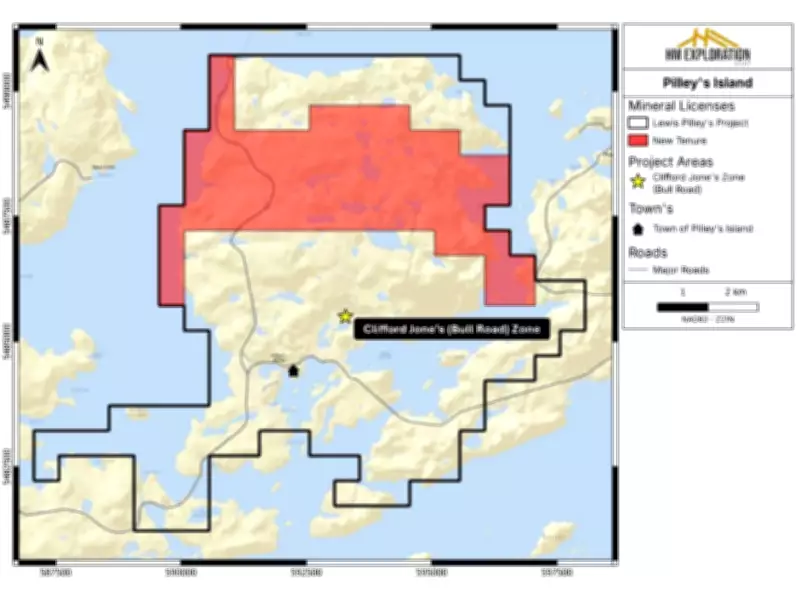
HM Exploration Corp. has announced a significant expansion of its land position at the Lewis Pilley's Project in Newfoundland, Canada. The company staked an additional 67 mineral claims, adding 17 km² to its tenure and bringing the total area to approximately 60.25 km². This new tenure connects the northern and southern claim blocks, resulting in HM Exploration controlling the entirety of Pilley's Island for the first time in recent history.
Company Statement
Nick Rodway, CEO of HM Exploration Corp., commented: "This marks the first time in recent history that the entirety of Pilley's Island has been consolidated under a single company. With district-scale control now in place, we are focused on unlocking additional VMS-style targets across the Property while continuing to aggressively drill the Clifford Jones Zone, where several compelling targets have remained untested for years. We look forward to providing further updates as drilling progresses."
Project Highlights
- Significant northern expansion of the Lewis Project increases total land position to ~60.25 km².
- The entirety of Pilley's Island is now controlled by a single entity for the first time in recent history.
- Little systematic exploration has been conducted in the new tenure outside of smaller-scale work by Brinco in the 1980s.
- Diamond drilling continues at the Clifford Jones Zone for a minimum of 2,500 metres.
Geology and Mineralization
The Property is located within the Notre Dame Subzone of the Dunnage Tectonostratigraphic Zone. Most of the Property is underlain by Ordovician submarine volcanic rocks of the Roberts Arm Group, part of the Buchans-Roberts Arm Belt that also hosts the historic Buchans mine. Mineralization occurs as lower grade (Spencer's Dock), medium grade (Old Mines), and high grade (3B-Zone/Clifford Jones) deposits of sub-seafloor replacement and exhalative varieties. These deposits are often flanked by extensive chlorite, sericite, silica, K-feldspar, and epidote alteration typical of bimodal-felsic VMS systems. The Spencer's Dock area displays sericite/silica alteration that increases in intensity near mineralized zones, while the 3B/Old Mine areas show abundant but less widespread alteration that is more intense proximal to mineralized zones.