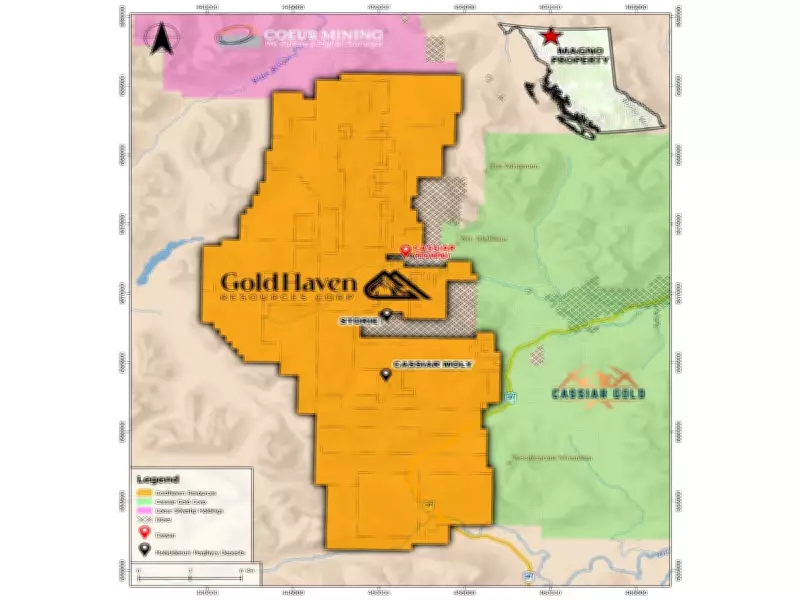
GoldHaven Resources Corp. has announced the expansion of its high-resolution airborne geophysical survey at the 100%-owned Magno Project in the Cassiar District of northern British Columbia. The survey, now covering approximately 2,237 line-kilometres, is a significant increase from the originally planned 1,741 line-kilometre program. This expansion enhances coverage across priority mineralized corridors and prospective intrusive contact zones throughout the district-scale property package.
Survey Expansion Details
The airborne survey is being conducted by Dias Airborne Limited using their proprietary QMAGT (Quantum Magnetic Gradiometry Tensor) technology. This advanced full tensor magnetic gradiometry system improves the detection and modelling of subsurface geological structures, alteration corridors, intrusive contacts, and potential mineralized feeder systems. The expanded survey area covers a broad north-south mineralized corridor associated with carbonate and sedimentary rocks in contact with intrusive granitic units, which management believes represents a highly prospective environment for multiple styles of mineralization.
Key Highlights
- Expanded airborne survey increased to approximately 2,237 line-kilometres from the previously announced 1,741 line-kilometre program.
- Survey designed to support a planned 5,000-metre 2026 diamond drill program targeting the Magno, Kuhn, and D Zones.
- Expanded coverage across prospective CRD, tungsten-bearing skarn, and porphyry-style mineralized corridors.
- High-grade surface sampling includes values up to 2,370 g/t Ag and 6,550 ppm tungsten (W).
- Dias’ QMAGT technology was utilized in geophysical targeting work associated with the Hercules Metals Leviathan discovery in Idaho.
CEO Statement
Rob Birmingham, CEO of GoldHaven, commented: “This expanded airborne program represents a major advancement in our systematic approach to unlocking the district-scale potential at Magno. Dias’ technology was successfully utilized in advancing targeting work associated with the Hercules discovery, and we believe deploying the same next-generation system at Magno significantly strengthens our ability to define and prioritize high-confidence drill targets ahead of our planned 2026 drill campaign focused on the Magno, Kuhn, and D Zones.”

Targeting and Exploration
The airborne survey is focused on defining structural controls, intrusive contacts, and alteration pathways associated with the Company’s growing inventory of silver-lead-zinc CRD mineralization, tungsten-bearing skarn systems, and interpreted porphyry-related mineralized centres. Recent surface exploration identified multiple high-priority target areas with rock sample results including silver values up to 2,370 g/t Ag, tungsten values up to 6,550 ppm W, and indium values up to 334 ppm In. These results, combined with historical exploration datasets and geological mapping, have been integrated into the airborne survey design and targeting process.