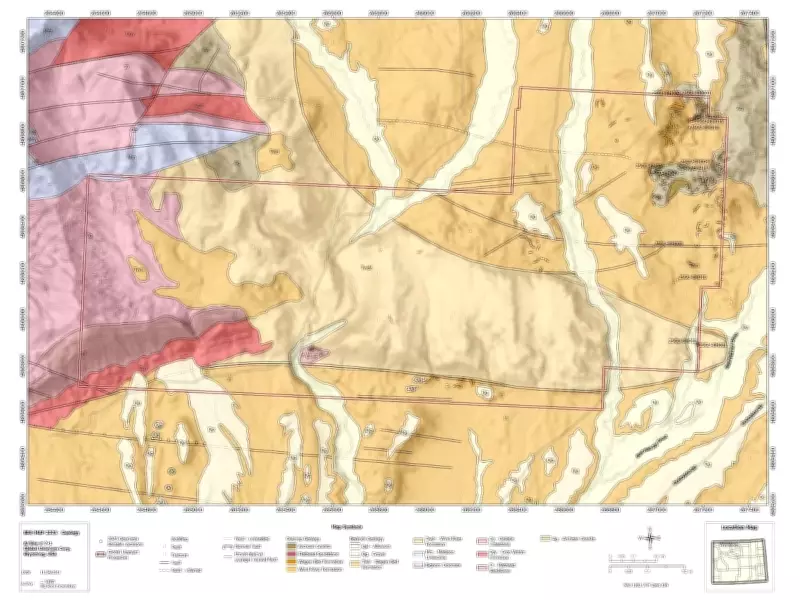
Global Uranium Corp. (CSE: GURN | OTC: GURFF | FRA: Q3J) has announced the completion of a detailed geological mapping program at its Airline Project, located in the Wind River Basin of central Wyoming. This initiative marks the first phase of the company's 2026 field program, which also includes a radiometric survey and the collection of hand samples for geochemical assay and mineralogical analysis. The results from these additional components will be disclosed as they become available.
Mapping Program Details and Key Findings
Conducted over one week in late October 2025 by Big Rock Exploration, the mapping effort has significantly enhanced the company's understanding of the stratigraphy and structural geology at the Airline Project. The study validated multiple key geological units across the area, including the widespread Tertiary Wagon Bed Formation, which exhibits characteristic tuffaceous sandstones, interbedded tuffs, and distinctive weathering textures.
Archean crystalline basement rocks, such as granite and monzogranite with abundant pegmatitic dikes, were mapped in several locations, showing deep weathering and bleaching near the overlying unconformity. Additionally, several Flathead Sandstone outcrops were identified on the western side of the study area. The contact between the Wagon Bed Formation and the Archean basement, mapped in multiple spots, remains a critical stratigraphic target due to earlier radiometric anomalies associated with this unconformity.

Priority Horizons and Mineralogical Observations
Two priority horizons have emerged from the fieldwork. The first is the unconformity between the Wagon Bed Formation and the Archean granite, where anomalous radioactivity, bleaching, and clay alteration were documented. The second is a discrete arkosic sandstone horizon, informally named the "Scorpion Unit," where radiometric highs align with favorable textures and local structures.
All accessible rocks on the property were found to be oxidized to varying degrees, with no reduced ground encountered. Hand samples collected near the unconformity displayed intense clay alteration, hematite replacing former pyrite crystals, and uranium-bearing minerals such as autunite and a possible occurrence of metatorbernite, visible under ultraviolet light. Mineralogical identification is pending thin-section work, and no conclusions have been drawn regarding mineral origin or paragenesis at this stage.
Future Integration and Exploration Plans
The mapping dataset will be integrated with forthcoming ground-based radiometric grid data, geochemical assays, and mineralogical results. This combined interpretation will support refined stratigraphic modeling and the development of drill targets for 2026. Future fieldwork may include additional focused mapping in the eastern and northeastern parts of the property, where further exposures of the unconformity and arkosic sandstone units could refine the exploration model. Additional work is also suggested in the northwest of the project area, where orthophotos indicate potential for contact zones between granites and Eocene sediments.