Collective Metals Commences Historic Drilling at Rocas Uranium Project
VANCOUVER, British Columbia – Collective Metals Inc. has officially launched its first-ever diamond drilling campaign at the Rocas Uranium Project, marking a significant milestone in the exploration of this promising mineral property located in the southeastern Athabasca Basin region of Saskatchewan.
Drilling Program Details and Timeline
The drilling activities commenced on March 16th, 2026, with field crews arriving on schedule to begin operations. The Phase I program is expected to span approximately five weeks and will consist of 1,200 to 1,500 metres of diamond drilling across six to eight drill holes. These targets are strategically positioned at shallow depths of less than 200 metres below the surface, making them particularly accessible for exploration.
Christopher Huggins, Chief Executive Officer of Collective Metals, expressed enthusiasm about the project's potential, stating, "With multiple high-priority targets defined through comprehensive geophysical surveys, surface mineralization analysis, and recent prospecting activities, we believe Rocas possesses substantial potential for hosting shallow, high-grade uranium mineralization. We are eager to test these targets and advance the project within one of the world's premier uranium districts."

Strategic Location and Geological Significance
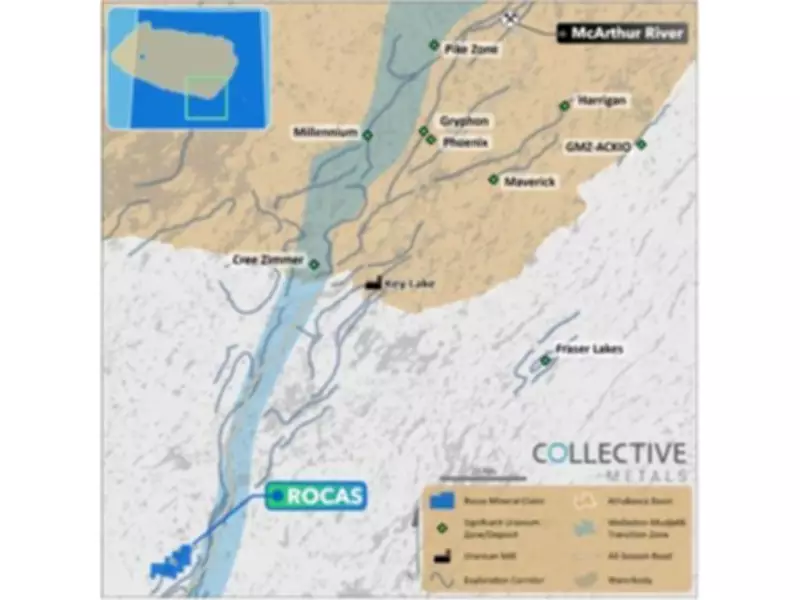
The Rocas Project covers an expansive area of 4,002 hectares across three mineral claims, situated approximately 75 kilometres southwest of the historic Key Lake Mine and Mill facilities along Highway 914. This strategic positioning near the margin of the Athabasca Basin provides favorable geological conditions with minimal glacial till cover over bedrock, enhancing exploration efficiency.
For the first time in the project's history, the company will drill test a significant 7.5-kilometre electromagnetic corridor on the Rocas property. This structural trend has shown promising historical surface mineralization, with grab samples returning uranium oxide (U3O8) concentrations up to 0.50%. Recent prospecting in 2025 further revealed high-grade rare earth element results reaching 9.83% total rare earth oxides (TREO) alongside uranium oxide values up to 0.41%.
Target Selection and Exploration Methodology
The target selection process for the 2026 drilling campaign followed an iterative approach developed in collaboration with Convolutions Geoscience Corporation. Extensive prospecting and mapping conducted across the project in fall 2025 identified multiple outcrops of favorable uranium and rare earth element host-rocks, including radioactive metasediments, pegmatites, and structured orthogneiss.
Targets were prioritized based on several critical factors:
- Geophysical signature analysis
- Geological and structural setting assessment
- Proximity to surficial uranium occurrences
- Historical lakebed geochemistry data
- Results from Standard Uranium Ltd.'s recent prospecting and mapping campaign
One diamond drill will specifically focus on high-priority target areas along prospective VTEM corridors that overlap with high-resolution ground gravity data. This exploration strategy follows the proven thesis of concentrating on major conductor trends associated with cross-cutting faults and surface radioactivity expressions.
Historical Context and Untested Potential
The Rocas Project represents untapped uranium potential with historical mineralized outcrop grab samples along approximately 900 metres of strike length returning values ranging from 587 parts per million uranium up to 0.498 weight percent uranium oxide. Remarkably, these mineralized zones have never been subjected to drill testing until now.
The Standard Uranium Ltd. team arrived on site on March 16th and has already begun drilling the first hole in the project's history. This winter/spring program follows the completion of a comprehensive ground gravity survey and multifaceted geophysical modeling conducted last year, which helped refine the exploration targets.

The company maintains that the Rocas Project is highly prospective for discovering shallow, high-grade basement-hosted uranium mineralization, positioning it as a significant exploration opportunity in one of the world's most renowned uranium-producing regions.