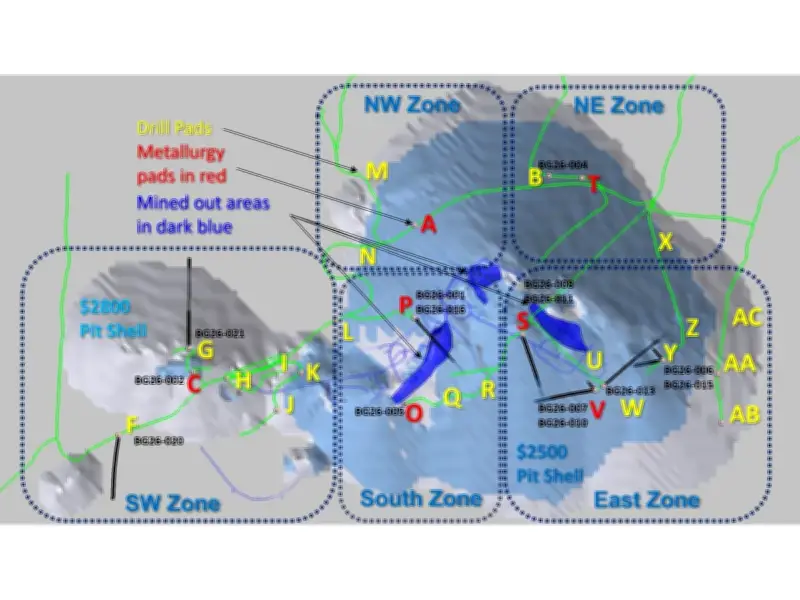
Blossom Gold Inc. (formerly 1290448 B.C. Ltd.) (TSX: BGAU) has released initial drill results from its 2026 exploration drilling program at the Rosebud Project in Pershing County, Nevada. Notable intervals include: BG26-002 – 41.2m at 0.385 gAu/t from 19.8m; BG26-005 – 18.3m at 0.794 gAu/t from 126.5m; BG26-007 – 81.5m at 0.385 gAu/t from 27.1m; BG26-008 – 24.4m at 0.549 gAu/t from 146.3m; BG26-010 – 18.3m at 0.509 gAu/t from 24.4m; BG26-011 – 13.8m at 0.685 gAu/t from 96.8m; BG26-016 – 99.5m at 0.392 gAu/t from 105.8m, including 42.8m at 0.557 gAu/t from 148.6m; and BG26-021 – 42.7m at 0.440 gAu/t from 143.7m, including 26.2m at 0.915 gAu/t from 160.2m.
Drilling Program Details
The bulk of drilling conducted since approval of the Rosebud Notice of Intent (NOI) has been technical drilling for metallurgical, geochemical, hydrological and geotechnical investigations, totaling 4,928m of the 9,337m drilled to date. This work is related to permitting and future feasibility studies. Permitted drill pads will continue to be used for multiple purposes, but exploration drilling is now the priority, focusing on expanding and upgrading the existing inferred open-pit resource of 70.8 million tons at 0.018 opt Au (0.62 gAu/t) and 0.189 opt Ag (6.49 gAg/t), containing 1.28 million ounces of gold and 13.4 million ounces of silver.
Zonal Targeting
Drill hole assay results are reported by zone over the approximately 2 km by 1.6 km open pit target, including the Northwest, Northeast, Southwest, South, and East Zones. In the East and South Zones, the target is the up-dip extension of South Ridge Fault Zone (SRFZ) mineralization above previously mined orebodies in areas of low drill density, due to historic focus on high-grade underground mineralization. The Northeast and Northwest zones are in the Rosebud Shear Zone with low historic drill density. Expansion drilling in these zones targets potential to add resource and push the resource pit shell northward. The Southwest Zone is also in the Rosebud Shear Zone domain and targets areas of low drill density to potentially expand the open pit resource to the property boundary in the southwest.

True Thickness and Reporting
Drill hole inclination is considered to determine true thickness of mineralized intervals from surface. All reported intervals are true thicknesses. Only gold values are reported. The silver-to-gold ratio at Rosebud is 10:1 based on the 43-101 technical report and historic production, adjusted for recoveries. However, Blossom reports gold only, not gold equivalent, until better information on forecast silver recoveries from metallurgical testing is available.

CEO Commentary
Rick Winters, CEO of Blossom Gold, stated: “The owners of Blossom Gold have been patient as we focused on the metallurgical, hydrologic, geochemical, and geotechnical sampling required to meet our permitting and feasibility critical path for planned construction the second half of 2028. The truth sticks are turning 24/7 and we are pleased to put out the initial results of our expansion and infill drilling. Rosebud is an open-pit, low-grade, heap-leach opportunity, and while there are some pretty flash intervals, the ones that most encourage me are the 294m true thickness at 0.245gAu/t in hole BG26-008, which clearly demonstrates pervasive low to medium sulfidation mineralization, both disseminated and in veinlets, from surface to the underlying sedimentary basement. BG26-020 and BG26-021 intersected above cut-off grade mineralization outside our pit shells nearly a kilometer west-southwest of the focus of historic drilling, demonstrating Rosebud is an extensive and expanding low-grade mineralized system and noting the conservative cut-off grade of 0.005opt (0.17gAu/t) includes a meaningful operating margin at current gold prices. We have learned that the deposit is oxidized to around 100m with little alteration transition and very little transition in the nature of the mineralization in fresh rock. We simply do not have high sulfide let alone refractory mineralization, nor have we seen much carbonate rock or other cyananoids that would impact recoveries. Precious metals mineralization at Rosebud is disseminated and hosted in veinlets in association with marcasite, pyrite and to a lesser extent base metal sulfides, principally lead and zinc. Higher grade precious metals mineralization is associated with electrum. We have a backlog of exploration holes awaiting cutting and assaying and expect to be putting out results on a regular basis through the end of the year as we continue surface drilling and get ready to open the underground in July to provide the stations for underground infill and upgrade drilling of the open-pit resource in Q4 2026.”