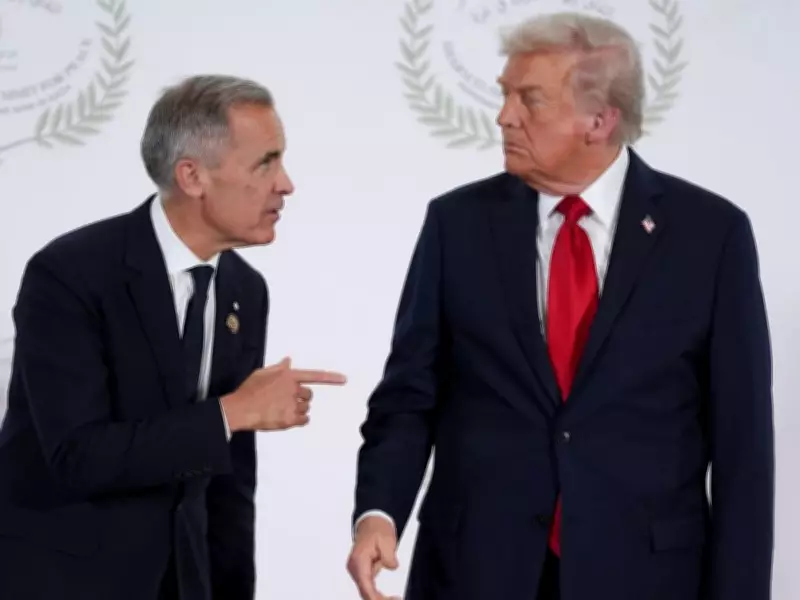
Trump Privately Considers Exiting CUSMA Trade Deal He Originally Negotiated
United States President Donald Trump is privately weighing the possibility of withdrawing from the North American trade pact known as the Canada-U.S.-Mexico Agreement (CUSMA), according to individuals familiar with internal discussions. This development introduces significant uncertainty into the crucial renegotiation process involving the United States, Canada, and Mexico.
Internal Discussions and Official Responses
The president has reportedly asked his advisors why he should not exit the agreement, which he signed during his initial term in office. However, he has not yet issued a definitive signal that he will take this step. The sources spoke on condition of anonymity to describe confidential internal deliberations.
A White House official, when questioned about these discussions, characterized Trump as the ultimate decision-maker who consistently seeks improved arrangements for American citizens. The official dismissed talk of potential withdrawal as baseless speculation until an official announcement is made by the president.

An official from U.S. Trade Representative Jamieson Greer's office stated that simply rubber-stamping the 2019 terms would not serve the national interest. The administration intends to keep all options available to President Trump and negotiate to resolve identified issues.
Separate Negotiations and Strained Relations
Both officials spoke anonymously and declined to directly address whether Trump is contemplating an exit from the trade pact. Greer confirmed on Tuesday that the administration would conduct separate bilateral talks with Mexico and Canada, noting that trade relations with Canada are currently more challenging.
"Generally speaking, these negotiations are going to proceed bilaterally and separately," Greer stated during an appearance on Fox Business. "The Mexicans are being quite pragmatic right now. We've had a lot of discussions with them. With the Canadians, it's more challenging."
Greer did not specify whether President Trump would approve an extension of the agreement.
Mandatory Review and Contentious Negotiations
The Canada-U.S.-Mexico Agreement is scheduled for a mandatory review before a potential extension on July 1. This process, initially expected to be routine, has evolved into a contentious negotiation. President Trump has demanded additional trade concessions from both Ottawa and Mexico City, while also pressuring them to address unrelated matters including migration patterns, drug trafficking concerns, and defense cooperation.
Greer's office indicated that the trade representative would recommend renewal only if a resolution incorporating input from industry stakeholders can be achieved. Key areas of concern include stronger rules of origin for important industrial goods, enhanced collaboration on critical minerals, improved worker protections, and measures against dumping practices.
Potential Consequences and Economic Impact
If the three nations agree to renew the pact, it would remain in effect for an additional sixteen years. Failure to reach an agreement could trigger annual reviews for a decade until the deal's expiration in 2036. Any participating country could announce its intent to withdraw with six months' notice.
Such a withdrawal would fundamentally disrupt one of the world's largest trading relationships, covering approximately US$2 trillion in goods and services. Even the mere threat of a U.S. departure would generate substantial uncertainty for international investors and global leaders, potentially destabilizing economic planning across North America.
The situation remains fluid as negotiations continue, with all parties monitoring President Trump's ultimate decision regarding the future of this critical trade agreement.