

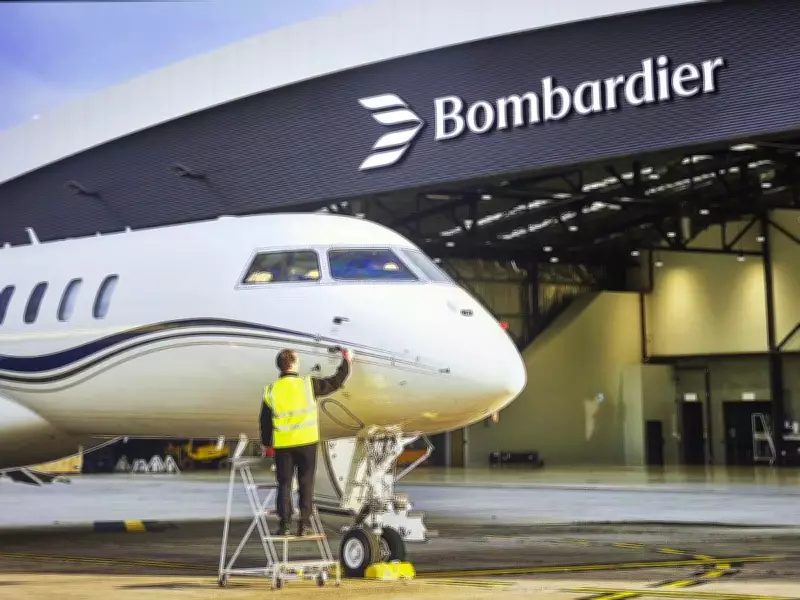
Quebec Government Mobilizes to Protect Aerospace Industry Following Trump's Bombardier Threats
The Quebec government has made a firm commitment to defend its vital aerospace sector in response to recent threats from former U.S. President Donald Trump targeting Bombardier aircraft. Meanwhile, federal officials in Ottawa are conducting intensive diplomatic efforts behind closed doors to address the escalating trade tensions.
Trump's Social Media Threats Target Canadian Aviation
In a Truth Social post on Thursday, Trump directed his criticism toward Bombardier, threatening to decertify the Bombardier Global Express and "all aircraft made in Canada" from U.S. airspace. The former president also proposed imposing substantial 50 percent tariffs on Canadian aircraft imports. Trump accused Canada of deliberately refusing to certify aircraft manufactured by Gulfstream, Bombardier's American competitor in the business jet market.
These threats carry significant economic implications for Quebec, where Bombardier employs approximately 10,000 workers in the Greater Montreal region alone. The aerospace giant represents a cornerstone of Quebec's industrial landscape and technological expertise.

Federal and Provincial Responses to the Crisis
Federal Industry Minister Mélanie Joly confirmed that diplomatic channels are actively engaged in addressing the situation. "A lot of people working on the diplomatic level are at work behind closed doors," Joly stated during a Friday interview with Radio-Canada. "We're gathering facts so that we can know exactly what's happening."
Joly contextualized the current threats within a pattern of recent trade tensions, noting that just last week, Canada faced "a 100 percent tariff threat" following Prime Minister Mark Carney's electric vehicle trade agreement with China. According to Joly, such threats "happen regularly and, up to date, we've been able to handle it all."
On the provincial level, Quebec Economy Minister Jean Boulet declared via social media that "Quebec will remain vigilant and fully mobilized to defend its companies, its jobs and the integrity of commercial and regulatory policies." Premier François Legault echoed this commitment, asserting that the province "will defend our aerospace industry."
Regulatory Realities and Industry Analysis
Trump's accusations that Ottawa is "wrongfully, illegally and steadfastly" refusing to certify U.S. aircraft face scrutiny from regulatory experts. While Transport Canada has approved some Gulfstream models, others remain under review through standard certification processes.
Karl Moore, a McGill University management professor with extensive aerospace industry experience, emphasized the independence of regulatory bodies. "Ottawa can't order Transport Canada to approve aircraft," Moore explained. Similarly, he noted that in the United States, the Federal Aviation Administration operates as an "arms length" organization staffed by "very serious people" who make determinations based primarily on safety considerations.
Moore expressed skepticism about the likelihood of actual decertification, stating, "I don't think we'll get to that because it doesn't make sense." He characterized the situation as potentially "a tempest in a teapot" that might resolve quickly, though he acknowledged the uncertainty: "The White House could move on and it might be largely over by next week. Or it might not."
Complex Economic Interdependencies
The Bombardier situation reveals intricate cross-border economic relationships that complicate potential trade actions. Beyond its 10,000 Montreal employees, Bombardier maintains 2,000 workers in the Greater Toronto Area and an additional 3,000 employees in the United States. The company also sources numerous components from American suppliers.
"There's a huge amount of U.S. content," Moore observed. "It is very much made in Canada and the U.S." This integration means that tariffs or restrictions could disrupt supply chains affecting both countries.

The competitive landscape between Bombardier and Gulfstream adds another dimension to the dispute. According to Moore, the two companies are "fierce competitors," with Bombardier having "some very new, great products that have actually done better than Gulfstream." Both manufacturers currently operate with multi-year order backlogs, providing some buffer against immediate order cancellations.
Potential Employment and Production Impacts
Should the trade tensions escalate without resolution, Moore warned of potential consequences for aerospace workers. "If this isn't cleared up soon, some people would be laid off," he cautioned. "If you don't make production, you don't need production people."
The threatened 50 percent tariffs would significantly advantage Gulfstream in pricing comparisons, though Moore noted that "there's a limited supply of these planes" in the luxury business jet market. More concerning for production continuity would be potential disruptions to the cross-border flow of aircraft components essential to manufacturing processes.
As Quebec mobilizes its defensive measures and federal diplomats pursue resolution strategies, the aerospace industry watches closely. The outcome will test Canada's trade diplomacy and potentially reshape North American aerospace competition in the coming months.





