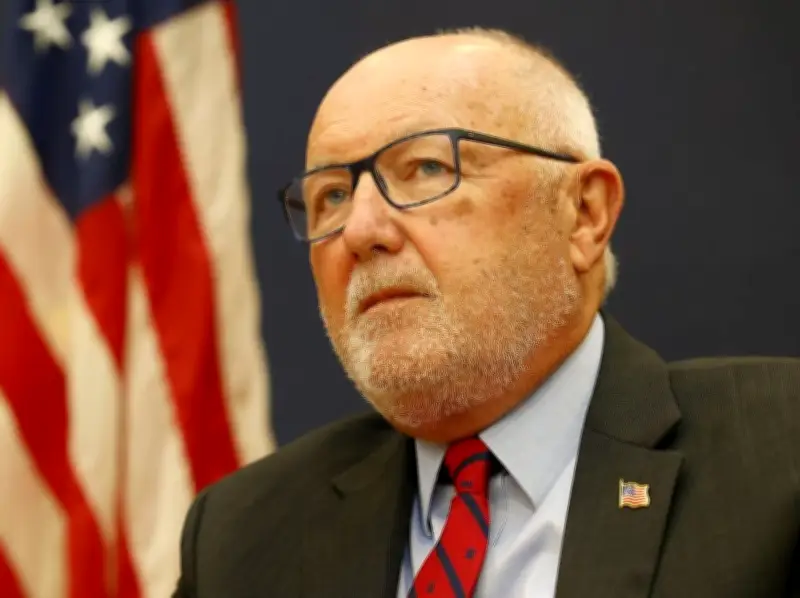
The Gordie Howe International Bridge will not open anytime soon unless Ottawa recognizes that the original deal has fundamentally changed, according to U.S. Ambassador Pete Hoekstra. In an exclusive interview on The Food Professor Podcast, Hoekstra indicated that anti-American political rhetoric from Canadian leaders, including Ontario Premier Doug Ford during last fall's trade tensions, helped erode the trust needed for productive negotiations between Canada and the United States.
Trust eroded by political rhetoric
While Hoekstra did not directly assign blame for the current impasse, he implicitly argued that such rhetoric undermined the bilateral relationship. This assessment, if reflective of Washington's thinking, explains why discussions surrounding both the bridge and the upcoming CUSMA review have become far more complicated than many Canadians realize. The narrative that the owner of the Ambassador Bridge, a prominent Republican donor, has been lobbying the White House to delay the bridge's opening has dominated headlines in Canada, but Hoekstra's comments suggest there is much more to the story.
Strategic importance of the bridge
The Gordie Howe International Bridge is one of the most strategically important trade corridors on the continent, particularly for agri-food. The Detroit-Windsor gateway carries roughly one-quarter of all merchandise trade between Canada and the United States, representing well over $300 billion annually. Food and agriculture account for a significant share of that commerce. Every day, trucks loaded with beef, pork, dairy ingredients, grains, processed foods, fresh produce, beverages and food packaging move across the border. Many products found on grocery store shelves cross this corridor multiple times before reaching consumers.

Economics evolved dramatically
Contrary to what many assume, the bridge was never expected to generate a dramatic increase in cross-border traffic. Its real value lies in improving reliability and resilience. Today, too much commercial activity depends on a single privately owned crossing that has served the region for nearly a century. A serious accident, customs disruption, or maintenance issue can delay thousands of shipments within hours. For highly perishable food products and just-in-time manufacturing, predictability is often more valuable than speed. The Gordie Howe Bridge's direct highway connections, expanded customs plazas and additional capacity will strengthen North America's supply chains and reduce costly bottlenecks.
The project's economics have also evolved dramatically. When it was announced in 2012, the bridge was expected to cost roughly $2.1 billion and open by 2020. Today, construction costs are approaching $6.7 billion, and the opening has been delayed by several years. Canada assumed virtually all of the upfront construction costs with the expectation that toll revenues collected over decades would eventually recover the investment. Since a significant portion of those tolls will ultimately be paid by American trucking companies, manufacturers and retailers, it is understandable that Washington may want to revisit elements of an agreement negotiated under very different economic circumstances.
Delays carry costs for both sides
Every additional month of delay carries a cost for businesses and consumers on both sides of the border. Americans have seen their share of delayed infrastructure projects, but they happen far more frequently in Canada. In the case of the Gordie Howe Bridge, the delays and cost overruns have fundamentally changed the project's business model. That is the point Washington is trying to make.

Broader lessons for Canada-U.S. relations
The lesson from the conversation with Ambassador Hoekstra extends well beyond one bridge. Infrastructure projects do not exist in a political vacuum. They depend on trust, credibility and constructive relationships between governments. If Washington genuinely believes that recent political rhetoric has weakened that trust, Canada cannot simply dismiss those concerns if it hopes to move negotiations forward. The Gordie Howe International Bridge remains one of the most important investments ever made in North America's integrated food economy. Getting it open should not be viewed as a political victory for one side or the other — it should be seen as an economic necessity for both.
– Sylvain Charlebois is director of the Agri-Food Analytics Lab at Dalhousie University, co-host of The Food Professor Podcast.