

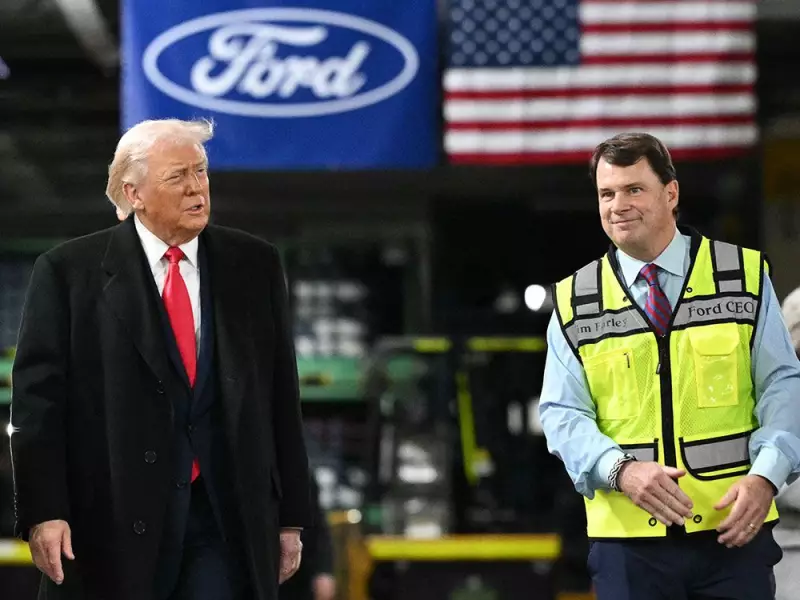
In a stark contrast to recent comments from U.S. President Donald Trump, Ford Motor Co.'s chief executive has emphasized the critical importance of the North American trade agreement to the automotive sector and called for its urgent revision.
Farley's Urgent Call for CUSMA Revision
Speaking in a Bloomberg TV interview on Thursday, January 15, 2026, Ford CEO Jim Farley underscored the foundational role of the trade pact. "We built our entire vehicle business as an industry between Canada, Mexico, and the U.S.," Farley stated. "We have to get this revised." His comments highlight the deal's significance for U.S. automakers, who have relied on duty-free movement of vehicles and parts across the three nations.
This sense of urgency stands in sharp opposition to the view expressed by President Trump earlier in the week. While touring Ford's River Rouge complex in Dearborn, Michigan, with Farley, Trump downplayed the agreement's value. "We could have it or not. It wouldn't matter to me," Trump said of the Canada-United-States-Mexico-Agreement (CUSMA). "I don't really care about it," he added, calling the pact "irrelevant."

Competitive Threats and Tariff Relief on the Agenda
Farley outlined a "long list" of issues requiring collaboration with the Trump administration. A key concern is the competitive threat from Chinese automakers, a topic Farley said he discussed directly with the president during the Michigan plant tour. He warned that Chinese companies, buoyed by government subsidies, are rapidly gaining market share in Europe with low-priced gas and electric vehicles, posing a significant threat to local labour.
"They pose a lot of threat to labour locally, they have huge subsidies from the government that they're exporting," Farley explained. "As a country, we need to decide what is a fair playing field."
The Ford CEO also pointed to the need for further relief from U.S. tariffs, particularly on aluminum, which is used extensively in the body panels of the best-selling F-Series pickup trucks. "We've made progress on mitigating some of the tariffs, but we have more work to do," Farley said. "We have a high exposure to aluminum."
Regulatory Changes and Industry Priorities
Farley did praise the administration's regulatory moves, specifically the elimination of penalties for not meeting fuel economy standards. He called this a "multibillion-dollar opportunity" that allows automakers to sell more profitable SUVs and trucks without the burden of offsetting them with electric vehicle sales.
"Those regulatory changes are really welcome frankly, and we're seeing that play out really in our business," Farley noted. He linked this relief partly to Ford's rising stock valuation, which is up nearly 40 per cent over the past year, stating, "Part of the reason why our valuation's increasing is because people understand we can build more profitable vehicles now."
Farley also referenced a previous trade deal with Japan, which lowered tariffs to 15 per cent. He argued this gave Toyota Motor Corp. a US$5,000 to US$10,000 cost advantage on SUVs over Ford, despite Ford building its SUVs domestically, illustrating the high stakes of trade policy for the industry.
Despite the differing views on CUSMA's importance, Farley characterized the working relationship with the administration as positive. "The administration's been great to work with, they always answer the phone," he said. "There's always a lot of big topics for the car industry because it's so important for our country." The looming potential renegotiation of CUSMA this year now appears set to be a central and contentious issue for the North American auto sector.






