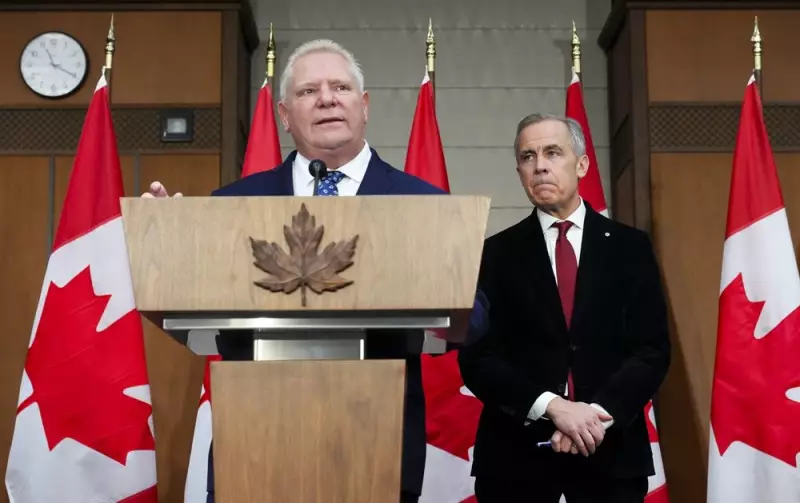
Ontario Premier Doug Ford has launched a fresh critique of Prime Minister Mark Carney, accusing him of sidelining the province and jeopardizing its auto industry following a pivotal trade decision with China.
A Deal That Strained a Partnership
At the heart of the dispute is Carney's recent move to eliminate the 100% tariff on Chinese electric vehicles, a policy shift that will allow an estimated 49,000 Chinese cars to enter the Canadian market. Speaking on Monday, Ford expressed deep frustration, not only with the economic implications of the deal but with the lack of prior consultation from the federal government.
"Well, at least I know where I stand now," Ford stated pointedly. He elaborated that true partnership requires communication, something he says was absent before Carney announced the agreement. "When someone doesn't communicate and preaches partnerships and goes out and makes a deal that isn't good for Ontario, you know where you stand," the Premier added.

Economic and Security Concerns Collide
Ford argued the deal is insufficient for Ontario and will have negative repercussions. He warned it could complicate the upcoming renegotiation of the auto section of the Canada-United States-Mexico Agreement (CUSMA) and directly threaten local employment. "I believe it's going to make it a lot more difficult... And they're going to cost the workers in the auto sector jobs," Ford predicted.
He also reversed his previous openness to Chinese automotive investment in Ontario, declaring on January 19, 2026, that "China will never ever... open up a manufacturing facility" in the province, citing the unlikelihood of the U.S. market accepting enough Chinese-made vehicles to make such a plant viable.
Further escalating his criticism, Ford labelled Chinese electric vehicles as potential "spy machines," drawing parallels to past controversies over Huawei technology. "It's Huawei 2.0 to come back into Canada, and we get nothing but potential job losses," he told an audience of municipal leaders.
Carney's Defence and the Broader Context
Prime Minister Carney dismissed Ford's apprehensions, framing the tariff removal as a trial measure essential for keeping Canada's auto sector competitive in a rapidly evolving global market. "We want to be competitive in the market of the future. That's what's going to get great jobs for Ontarians going forward," Carney asserted.
Ford's security warnings are not without international precedent. He referenced reports that the British military had instructed staff to park Chinese-made cars far from sensitive facilities over espionage fears. Similarly, Israel's military was reported to have phased out certain Chinese vehicles last November due to security concerns, including data collection via Bluetooth and cable connections.
The political drama is underscored by the revelation that Carney and his delegation used burner phones during their trip to China, a standard security practice highlighting the very concerns Ford is raising.
The clash reveals a significant fissure in federal-provincial relations, with Ford positioning himself as a defender of Ontario's economic interests and national security against a federal government he accuses of being too cozy with Beijing.