

Canada Confronts Severe Trade Crisis as Trump Threatens 100% Tariffs Over China Deal
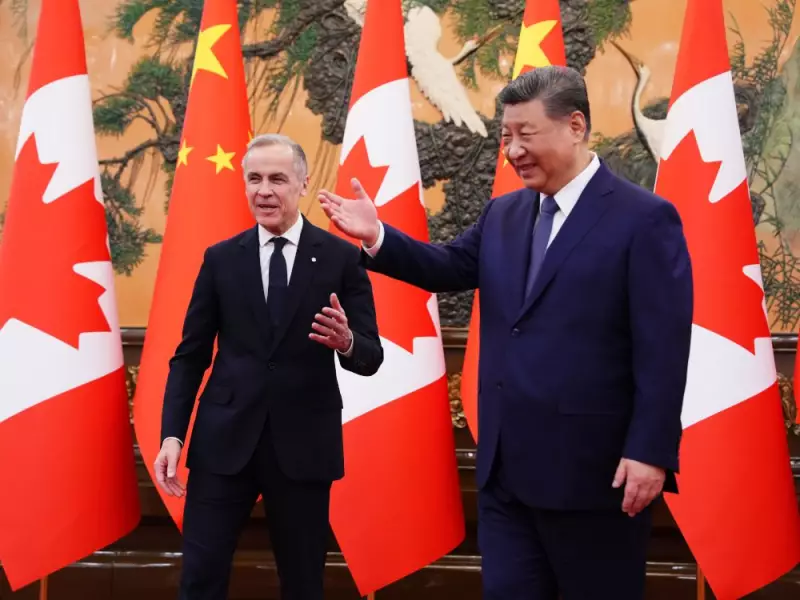
Prime Minister Mark Carney's diplomatic maneuvers have placed Canada at the center of a significant international trade dispute, with U.S. President Donald Trump issuing a stark warning of 100% tariffs on all Canadian goods. This dramatic escalation follows Carney's efforts to negotiate a trade arrangement with China, a move that has tested the structural limits of the Canada-United States-Mexico Agreement (CUSMA) and provoked a forceful response from the American administration.
The Provocation That Triggered the Crisis
On Saturday, President Trump delivered a characteristically blunt message, threatening to impose comprehensive tariffs if Prime Minister Carney proceeds with his proposed trade deal with China. The president's language was vivid, suggesting Canada would become a "drop off port" for Chinese goods and warning that "China will eat Canada alive, completely devour it." This confrontation represents what many analysts view as the predictable consequence of Carney's foreign policy approach.
The prime minister's strategy involved courting Beijing with discussions about electric vehicles and canola exports, seeking to establish preferential trade terms that would benefit Canadian industries. However, this initiative directly challenged the established framework of North American trade relations and triggered the protective mechanisms embedded within CUSMA.

The Legal Mechanism Behind the Threat
The core of this trade crisis lies in CUSMA Article 32.10, often referred to as the agreement's "poison pill" provision. This clause requires Canada to provide the United States with three months' notice before negotiating a "free trade agreement" with any "non-market country"—a designation that clearly applies to China under the agreement's framework.
The critical vulnerability of this provision lies in what it does not specify. CUSMA nowhere defines what constitutes a "free trade agreement," and under international law, specifically the Vienna Convention, undefined terms are interpreted according to their ordinary meaning and practical effect—not by what participating nations choose to call them. Any arrangement that exchanges preferential tariff reductions for market access would reasonably fit within functional definitions of trade liberalization, creating interpretive ambiguity that Washington can exploit to its advantage.
The Stakes for Canada's Economic Future
The potential consequences of this diplomatic confrontation are severe. If Washington determines that Canada's arrangement with China violates CUSMA terms, the United States retains the unilateral right to terminate the agreement entirely and replace it with a bilateral U.S.-Mexico trade pact. Such an outcome would effectively exclude Canada from the North American trading bloc, jeopardizing decades of economic integration and threatening numerous Canadian industries.
Carney appears to have believed he could navigate around these restrictions, announcing a trade arrangement with Chinese President Xi Jinping that would exchange market access for Chinese electric vehicles in return for lowered tariffs on Canadian canola. This announcement represented the first provocation to Washington, followed by a second diplomatic challenge when Carney warned of a "rupture" in the American-led world order during remarks in Davos, Switzerland—comments that President Trump clearly noticed and interpreted as directed at his administration.
The Broader Implications for Canadian Sovereignty and Security
While the prime minister's defenders argue he is standing up for Canadian sovereignty and pursuing independent trade relationships, critics question the wisdom of this approach. The livelihoods of Canadian workers across multiple sectors—including automotive, steel, aluminum, and softwood lumber—now hang in the balance as this high-stakes diplomatic confrontation unfolds.

This trade crisis represents what many experts consider the most serious threat to Canada's economic security in a generation. The prime minister's decision to simultaneously pursue closer ties with China while making remarks perceived as critical of the American president has created a perfect storm of diplomatic tension with potentially devastating economic consequences for Canadian industries and workers.
The coming weeks will determine whether diplomatic channels can de-escalate this confrontation or whether Canada faces the prospect of exclusion from its most important trading relationship. The outcome will have lasting implications for Canada's position in the global economy and its relationships with both superpowers.





