

Carney's China EV Agreement Delivers Political and Economic Blow to Ontario
Prime Minister Mark Carney's unexpected trade pact with China, which exchanges canola market access for reduced tariffs on Chinese electric vehicles, has ignited a fierce debate across Canada. While the merits of this agreement for the nation as a whole are contentious, its immediate impact on Ontario is unmistakably negative, striking at both the province's political standing and its economic core.
A Personal Betrayal and Political Snub
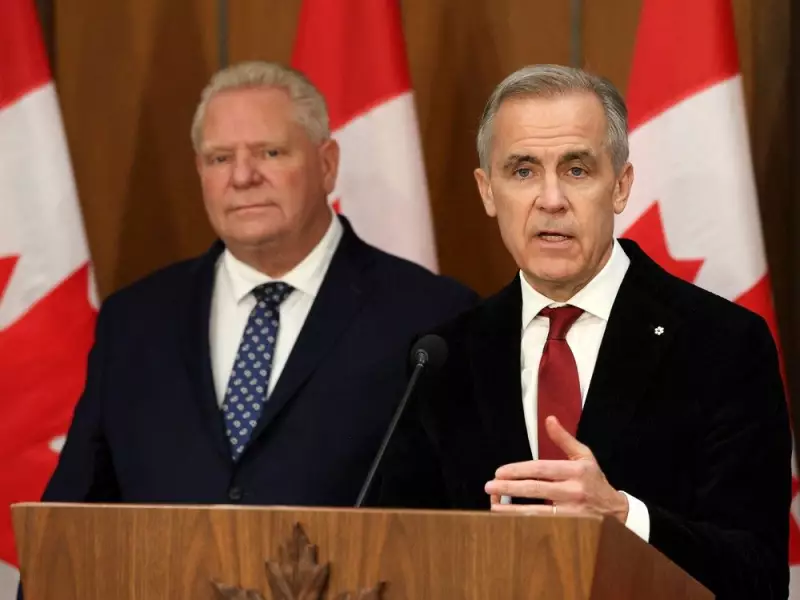
For Ontario Premier Doug Ford, the announcement felt like a profound personal betrayal. Ford, who considered Carney a close ally—hosting him at his cottage over the summer and enjoying casual chats at his home—was left reeling. "So much for the partnership," Ford remarked upon learning the news, adding pointedly, "At least I know where I stand now." The premier discovered the details merely hours before the public unveiling, not through a direct call from Carney, but via a delegated cabinet minister. Even after Ford's vehement criticism of the deal's handling and its potential repercussions for Ontario's automotive sector, Carney remained silent, deepening the rift.
Adding insult to injury, Carney extended a personal invitation to Saskatchewan Premier Scott Moe to witness the canola agreement in China, a courtesy never offered to Ford. This snub underscores a shifting dynamic in federal-provincial relations, where traditional alliances appear to be crumbling.

Economic Stakes and Electoral Calculations
The financial implications of Carney's decision are stark. Saskatchewan's canola deal, valued at approximately $3.1 billion, pales in comparison to Ontario's automotive exports. In 2024, vehicles constituted Canada's second-largest export at $46.5 billion, with 92% destined for the United States. For Ontario, automotive products represent 14.8% of total exports, making them the province's most significant export category.
Electorally, Ontario's importance is undeniable, with 122 seats—the largest contingent in the country—70 of which are held by Carney's Liberals. In contrast, Saskatchewan's 14 seats are predominantly Conservative, with only one Liberal representative. This move challenges the long-held assumption that Ontario's interests are paramount in federal decision-making, suggesting a new era where provinces must fend for themselves.
Assessing the Threat to Ontario's Auto Industry
Beyond the political fallout, the practical threat of Carney's EV deal warrants scrutiny. The agreement allocates about 3% of Canadian auto sales to Chinese manufacturers, assuming consumer uptake. While this percentage may seem modest, it signals a concerning disregard for the intricacies of Canada's automotive ecosystem. Ford has already urged a boycott of Chinese vehicles, highlighting the potential for job losses and economic disruption in Ontario's manufacturing heartland.
This episode reveals a broader shift in Carney's governance approach, where personal relationships and provincial loyalties are subordinated to broader trade objectives. For Ford, the path forward is clear: he must advocate forcefully for Ontario's interests in the public sphere, as demonstrated in his recent press conference. The era of relying on friendship with the prime minister has evidently passed, ushering in a more confrontational and independent stance for provincial leaders.






