

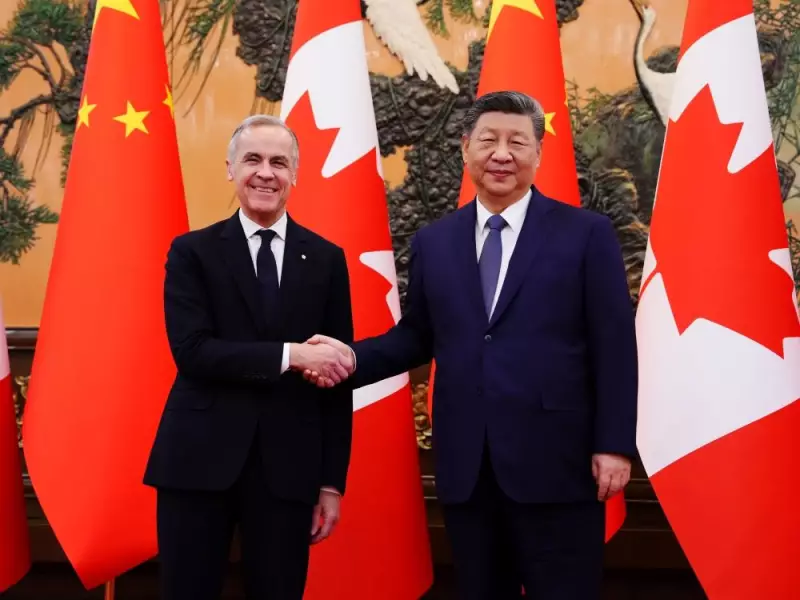
Carney's China Agreement: Strategic Triumph or Diplomatic Gamble?
Prime Minister Mark Carney's recent diplomatic mission to Beijing has ignited a fierce debate across Canada's political and economic landscape. Against a backdrop of years marked by diplomatic expulsions, agricultural bans, and trade tensions, Carney's meeting with Chinese President Xi Jinping yielded an unexpected bilateral agreement that could reshape Canada's international trade relationships.
The Historic Beijing Agreement
The deal, announced on January 16, 2026, represents a significant shift in Canada-China relations. Beijing has committed to reducing canola seed tariffs from 85 percent to just 15 percent by March 1, while completely eliminating tariffs on canola meal, lobsters, crabs, and peas. Canadian officials estimate these changes could unlock approximately CA$3 billion in annual exports.
In return, Canada will permit 49,000 Chinese electric vehicles to enter the Canadian market at a preferential tariff rate of 6.1 percent. This represents a dramatic departure from the 100 percent EV tariffs implemented in 2024. Additionally, both nations have signed memorandums of understanding concerning energy and clean technology cooperation, potentially paving the way for future collaborative ventures.

Divergent Expert Perspectives
Reactions to the agreement reveal deep divisions among geopolitical analysts and economists. Professor Reza Hasmath of the University of Alberta hailed the arrangement as "a master stroke" that achieves multiple strategic objectives simultaneously:
- Increased Chinese investment through joint ventures
- Resolution of longstanding agricultural trade issues affecting Prairie provinces
- Enhanced negotiating leverage with the United States by demonstrating alternative market access
However, Stephen Nagy, a senior fellow at the Macdonald-Laurier Institute, expressed significant concerns about potential repercussions. Nagy warned that China's concessions might represent a calculated attempt to "drive a wedge" between Canada and its most important trading partner. He cautioned that the Trump administration could interpret the China deal as a violation of CUSMA principles, potentially jeopardizing the entire agreement during its upcoming review this summer.
The CUSMA Conundrum
The timing of Carney's China initiative coincides with a particularly delicate period in Canada-U.S. relations. President Donald Trump has recently characterized CUSMA as "irrelevant" while acknowledging that "Canada would love it. They need it." This rhetoric has raised concerns about the agreement's future stability.
Nagy emphasized the disproportionate risk Canada faces: "We trade about $900 billion a year with the United States, and 70 percent of our trade is with the U.S. Losing even 10 percent of that market would significantly damage the Canadian economy."
Political Implications and Strategic Positioning
Prime Minister Carney framed the agreement as establishing "a new strategic partnership that builds on the best of our past, reflects the world as it is today, and benefits the people of both our nations." He further noted that Canada's relationship with China has become "more predictable" than its relationship with the United States, positioning Canada advantageously for what he termed "the new world order."
Initial U.S. response has been measured, with President Trump stating simply: "If you can get a deal with China, you should do that." However, this apparent endorsement comes alongside ongoing tariff threats related to Canadian support for Greenland, creating a complex diplomatic landscape that Carney must navigate carefully.
Broader Economic Considerations
The agreement represents more than just immediate trade benefits. By diversifying Canada's trade relationships beyond overwhelming dependence on the United States, Carney's administration seeks to:

- Strengthen economic resilience against potential U.S. protectionism
- Secure access to growing Asian markets for Canadian agricultural products
- Position Canada as a bridge between Western and Eastern economic systems
- Accelerate clean technology development through international cooperation
As Canada approaches the CUSMA review this summer, the China agreement will undoubtedly influence negotiations with Washington. Whether this represents strategic foresight or diplomatic overreach remains the central question dividing experts and policymakers alike.





