Prime Minister Mark Carney's recent diplomatic mission to Beijing struck a markedly different chord from his past rhetoric, culminating in a new "strategic partnership" with China. The visit, which took place from January 16-19, 2026, was conducted under stringent security protocols that underscored the persistent underlying tensions between the two nations.
A Stark Pivot in Tone and Policy
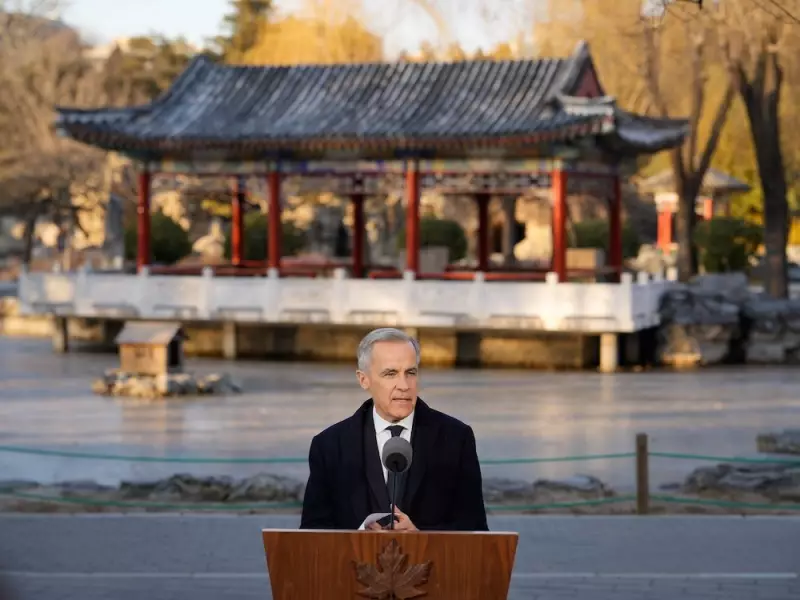
The defining moment of the trip occurred on Thursday, January 16, 2026, when Carney stood at a podium in Beijing's Ritan Park to announce a framework aimed at boosting trade, communication, and collaboration. The centerpiece of the new partnership is a strong push for Chinese investment in Canada's electric vehicle (EV) sector, with the long-term goal of establishing a Chinese EV manufacturing plant on Canadian soil.
This announcement represented a dramatic shift from Carney's stance just nine months prior. During the federal election leaders' debate in April 2025, he had unequivocally identified China as the "greatest threat to Canada's national security." When pressed on this contradiction by reporters in Beijing, Carney offered a nuanced, non-specific response.

"The security landscape continues to change in a world that is more dangerous and divided. We face many threats," Carney stated. "My responsibility as prime minister is to manage those threats by building resilience, building security."
Security Precautions and Geopolitical Calculations
The high-stakes nature of the engagement was evident in the extraordinary security measures taken by the Canadian delegation. Before entering Chinese airspace, all political staff were required to power down their usual work and personal devices and store them in a faraday bag to prevent any potential electronic surveillance or data interception.
This caution aligns with assessments from Canada's national security agencies, which describe China as the most sophisticated threat actor facing the country. Carney emphasized that his government discussed clear expectations and "red lines" with Chinese officials regarding foreign interference and public safety issues.
According to Liberal ministers accompanying Carney, the pivot is largely a response to the "transformational" presidency of U.S. President Donald Trump. With the U.S. posing a less predictable trade partner under Trump—evidenced by threats of new tariffs and a National Security Strategy aiming to restore "American preeminence in the Western Hemisphere"—Canada is actively seeking to diversify its economic partnerships.
The EV Imperative and Inherent Risks
China's globally dominant EV industry presents a prime opportunity for Canada's fledgling electric vehicle sector. The Carney government views collaboration as a way to attract capital, technology, and manufacturing expertise. However, this courtship is not without significant risk.
There are widespread concerns, including within Canadian security circles, that technology embedded in Chinese-made vehicles could be used for espionage or pose other national security threats. The government maintains that the new partnership includes safeguards and that engagement, coupled with vigilance, is the best path forward in a complex geopolitical landscape.
The trip to Beijing, therefore, encapsulates the Carney government's delicate balancing act: openly acknowledging a strategic threat while simultaneously pursuing a strategic partnership, all under a cloak of heightened security and driven by urgent economic diversification needs.