

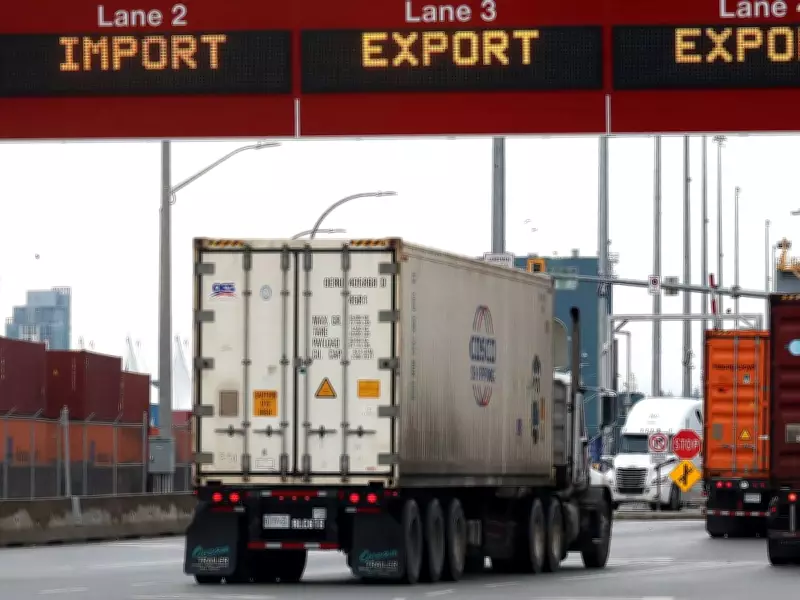
Canada's Trade Deficit Widens Significantly in November, Surpassing Expectations
Canada's trade balance deteriorated more than anticipated in November 2025, with the national trade deficit expanding to $2.2 billion, according to the latest data released by Statistics Canada. This figure substantially exceeded the $690 million deficit forecast by economists surveyed by Bloomberg, highlighting unexpected weakness in key export sectors.
Gold Shipments Lead Export Decline
Total Canadian exports fell by 2.8 percent during the month, with the most pronounced decrease occurring in metal and non-metallic mineral products. This category experienced a dramatic 24.4 percent decline, primarily driven by reduced shipments of unwrought gold, silver, platinum, and their alloys.
The gold sector alone saw exports plummet by 36 percent in November, with significant reductions in shipments to major trading partners including the United Kingdom, the United States, and Hong Kong. Statistics Canada noted that gold has been the most volatile component of Canadian exports in recent months, contributing substantially to monthly fluctuations.

Despite this recent downturn, year-to-date gold export values remain approximately 40 percent higher than previous levels, largely due to elevated gold prices in global markets. On a volume basis, however, gold shipments have shown little change throughout the year.
Automotive Sector Faces Multiple Challenges
The automotive industry also contributed significantly to the export decline, with motor vehicle and parts exports falling by 11.6 percent to reach their lowest level in three years. Statistics Canada attributed this decrease to ongoing semiconductor shortages that continue to disrupt global automotive production.
Import figures mirrored this trend, with inbound shipments of motor vehicles and parts declining as well. This reduction coincided with decreased production of passenger cars in the United States, where manufacturers faced shortages of essential materials and components.
Energy Exports Provide Some Relief
Amid the broader export decline, the energy sector offered a rare bright spot. Energy exports increased by 8.5 percent in November, driven primarily by higher crude oil shipments. This recovery followed a sharp decline in October, when temporary shutdowns at U.S. refineries reduced demand for Canadian crude oil.
Overall import activity showed minimal change, declining by just 0.1 percent for the month. Energy imports decreased alongside the automotive sector reductions, while other categories showed mixed performance.
Trade Relationship with United States Shows Significant Shifts
The Canada-U.S. trade relationship demonstrated notable changes in November. Exports to the United States fell by 1.8 percent, while imports from the U.S. declined by 5.4 percent to reach their lowest level since 2022. On an annual basis, these figures represent declines of 13.3 percent and 11.6 percent respectively.
Despite these reductions in bilateral trade volume, Canada's trade surplus with the United States actually widened to $6.6 billion for the month, reflecting the disproportionate impact on imports.
Broader Economic Context and Future Outlook
The November trade data emerges against a backdrop of ongoing trade policy uncertainty. Bank of Canada Governor Tiff Macklem recently commented that "rules-based trade with the U.S. was 'over,'" highlighting concerns about the future of North American trade relationships.
Additional factors influencing Canada's trade outlook include:

- The upcoming review of the Canada-U.S.-Mexico Agreement scheduled for 2026
- Persistent U.S. tariffs on Canadian steel, aluminum, automobiles, and lumber
- Ongoing supply chain disruptions affecting multiple industries
- Global commodity price fluctuations, particularly in precious metals
In volume terms, the November data revealed a 0.9 percent decline in export volumes alongside a 0.9 percent increase in import volumes, suggesting that price changes played a significant role in the nominal trade figures.
The November trade deficit expansion underscores the vulnerability of Canada's export-dependent economy to sector-specific challenges and global market conditions. As key industries navigate supply constraints and international trade uncertainties, policymakers will likely monitor these trends closely in the coming months.





