Trans Mountain Accelerates Pipeline Expansion Amid Global Oil Demand Surge
Trans Mountain Corporation is moving aggressively to fast-track projects that would significantly boost the capacity of its critical oil pipeline system. The federally owned Crown corporation aims to launch one expansion initiative a full year ahead of the original schedule, responding to mounting international demand for Canadian heavy crude.
International Demand Drives Acceleration
Trans Mountain CEO Mark Maki recently returned from business trips to China and Singapore, where he encountered enthusiastic interest from customers in both nations. "Love Canada. Love Canadian heavy oil. Wish we could get more of it," Maki recalled hearing consistently during his meetings. The executive emphasized that international buyers are actively seeking additional Canadian oil supplies, creating what he described as a matchmaking opportunity between Canadian producers and global consumers.
This international appetite comes at a time of significant geopolitical uncertainty in global oil markets. With Middle Eastern shipping routes through the Strait of Hormuz facing disruptions due to conflicts, the strategic importance of Canadian export infrastructure has become increasingly apparent. "Everything that's happening right now puts a big exclamation point on what the longer-term plans for Trans Mountain are," Maki stated in an interview.

Expansion Projects and Timelines
The corporation is currently advancing two major optimization projects that together would increase the pipeline system's capacity by approximately 300,000 barrels per day. One initiative involves adding drag-reducing agents—chemical additives that minimize pipeline friction—which could boost capacity by about 90,000 barrels daily with a relatively modest investment under $20 million.
Trans Mountain has already submitted regulatory applications for this enhancement and, pending approvals, could begin moving additional oil through the system by early next year. This represents a significant acceleration from the original timeline, demonstrating the corporation's commitment to meeting growing market demands more rapidly.
Historical Context and Recent Success
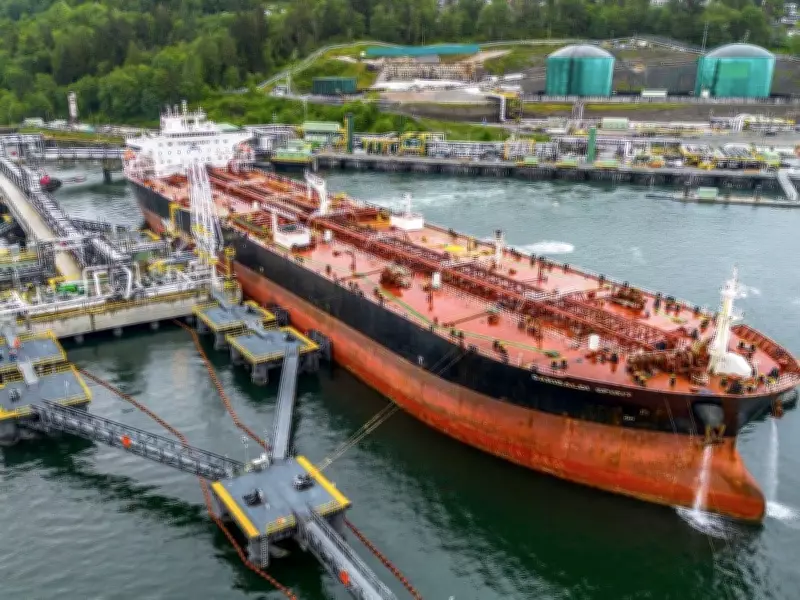
The Trans Mountain pipeline system, originally constructed in 1953, spans 1,180 kilometers from the Edmonton area to Burnaby, British Columbia. The Canadian government purchased the pipeline eight years ago to ensure completion of a massive expansion project that nearly tripled its capacity to 890,000 barrels per day. This $34-billion enhancement, completed in May 2024, has already proven its value by opening access to growing Asian markets.
Last year, more than 65 percent of oil exported from Trans Mountain's Westridge Marine Terminal in Burnaby was destined for countries in the Asia-Pacific region. This successful market penetration has created momentum for further expansion as Western Canadian oil production continues to increase.
Strategic Importance for Canada
Maki emphasized the national significance of accelerating pipeline capacity expansion, noting that earlier completion could positively impact Canada's economy by reducing the price differential between Canadian and international oil benchmarks. "As we evaluated the schedule, the importance of getting this online sooner is significant to the country," he explained. "It has lots of value and if we can bring the oil price differential in, it makes a difference to Canada."
The corporation's proactive approach reflects both immediate market opportunities and longer-term strategic positioning. With global energy security concerns mounting and traditional supply routes facing challenges, Canada's ability to reliably deliver oil to international markets has taken on renewed importance. Trans Mountain's accelerated expansion plans represent a direct response to these evolving global dynamics while supporting continued growth in Canada's energy sector.