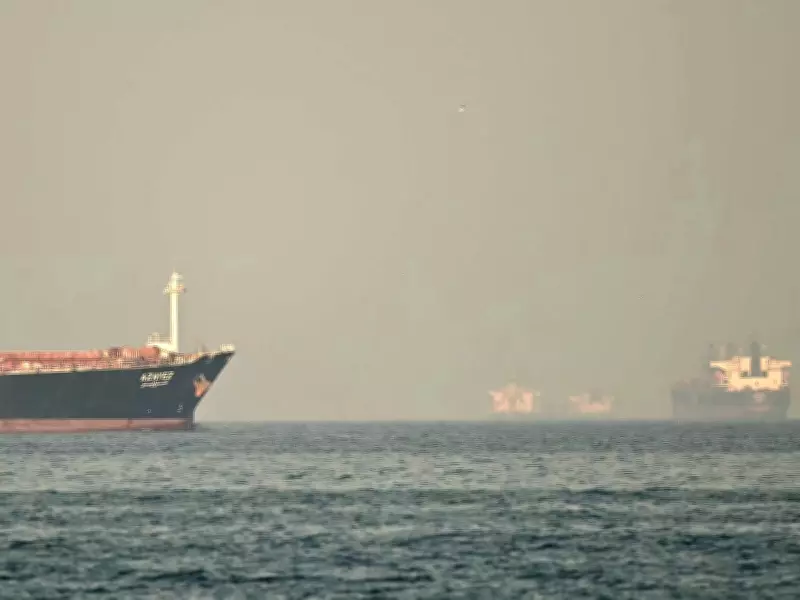
Three Oil Supertankers Navigate Strait of Hormuz Amid Fragile Ceasefire
In a significant development for global oil markets, three supertankers loaded with crude oil have successfully sailed through the strategically vital Strait of Hormuz. This movement represents the most substantial day of oil exits through the waterway since conflict between the United States and Iran caused shipping traffic to nearly halt six weeks ago.
Details of the Tanker Movements
The maritime activity involved two Chinese supertankers – the Cospearl Lake and the He Rong Hai – which sailed through the strait hours after a Greek vessel named the Serifos had already navigated the passage. According to tracking data, the Serifos and He Rong Hai loaded their cargoes in Saudi Arabia, while the Cospearl Lake took on crude in Iraq.
Notably, none of these vessels are carrying oil from Iran or have obvious direct links to the Islamic Republic, according to available information. The three tankers collectively possess a transport capacity of approximately 6 million barrels of crude oil.

Strategic Importance of Hormuz Reopening
The reopening of the Strait of Hormuz carries critical implications for the world's oil trade. The waterway's closure over recent weeks has resulted in the loss of millions of barrels of supply to global markets. A sustained resumption of traffic would help alleviate pressure on increasingly tight physical markets worldwide.
Under normal circumstances, the Strait of Hormuz handles about one-fifth of the world's oil supply and a similar portion of liquefied natural gas. However, almost all traffic through this crucial passage ground to a halt within a day of the war starting on February 28.
Political Context and Navigation Details
This increased shipping activity comes days after a fragile ceasefire was announced between the United States and Iran. The two nations are scheduled to hold peace talks in Islamabad in the coming days, adding diplomatic significance to the tanker movements.
All three vessels appear to have followed a northerly route through the strait that has been demanded by Tehran. This path passes through Iranian waters and along the coasts of Qeshm and Larak Islands, staying well away from the traditional Hormuz shipping lanes that typically hug the southern coast of the waterway.
Chinese Participation and Market Impact
The two Chinese supertankers represent the first observed instances of vessels from the Asian nation taking barrels out of the Persian Gulf since the conflict began. While this development provides some relief for Beijing, it also underscores how China has been economically squeezed by the regional tensions.
In terms of oil flow, the current exits remain significant but still substantially below peace-time levels. For context, Iran – the only country consistently sending barrels through the strait recently – exported at a rate of about 1.7 million barrels per day last month. The recent tanker movements would imply roughly half the normal rate of shipments through the waterway, and only on a single day.
Additional Shipping Details
There is also a third Chinese tanker, the Yuan Hua Hu, which had been waiting close to the first two vessels before they moved to depart the Persian Gulf. This vessel was not signaling its position on Saturday, according to available data.
The Greek tanker Serifos was signaling for Malacca in Malaysia, whose media reported on Friday that permission had been granted for the country's freighters to depart. Malacca serves as a waypoint for ships heading elsewhere in Asia.
Iran has stated that vessels are allowed to sail through the waterway but must obtain permission to do so. While digital ship-tracking can sometimes be subject to manipulation, the signals from these three ships appear consistent with genuine vessel movements.