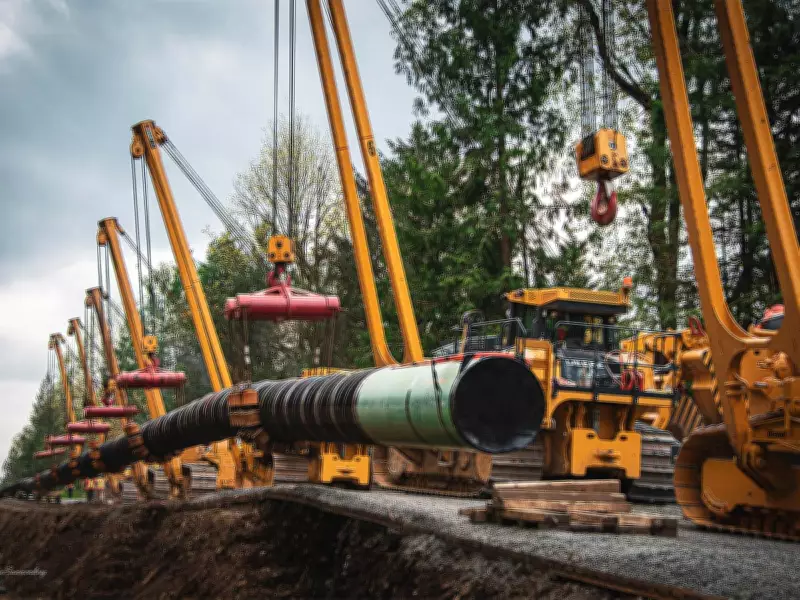
A new report highlights the substantial economic benefits that could flow from expanding Canada's oil pipeline infrastructure, projecting a potential $31.4 billion annual boost to the country's gross domestic product and the creation of more than 112,000 jobs over nearly a decade.
Economic Impact of Pipeline Expansion
The joint study conducted by Studio.Energy and ATB Economics examines the implications of adding 1.5 million barrels per day of additional pipeline capacity from Western Canada. According to the findings, this expansion would increase Canada's real GDP by an estimated $31.4 billion, or 1.1 percent on average, between 2027 and 2035.
Job Creation and Investment Opportunities
The report indicates that the proposed pipeline projects, combined with the Pathways carbon capture network and increased industry investment to fill the new capacity, would support an average of 112,000 additional jobs across Canada during the same period. This comes as welcome news for a nation grappling with sluggish productivity levels and seeking to diversify its export markets beyond the United States.

"There's a big prize here, in terms of boosting investment and creating long-term economic prosperity," emphasized energy economist Peter Tertzakian, founder of Studio.Energy. "I can't think of anything else that would give such a large jolt to the Canadian economy over a 10-year period," added ATB chief economist Mark Parsons.
Pipeline Projects Under Consideration
The study analyzes the economic effects of several key initiatives:
- The Alberta government's proposal for a new bitumen pipeline capable of shipping one million barrels per day to the Pacific Coast for export
- Plans by Enbridge, Trans Mountain Corp., and South Bow Corp. to increase capacity on their existing systems
- The assumption that approximately half-a-million barrels of new export capacity will become operational by 2035
These developments would require substantial investment, with an estimated $41 billion needed for construction—including $35 billion for the proposed West Coast pipeline alone. Additionally, filling these expanded pipelines would necessitate over $100 billion in production increases and approximately $20 billion for the Pathways carbon capture project.
Regional Economic Benefits
The economic uplift would be felt nationwide, with Alberta experiencing particularly significant gains. The province's GDP is projected to increase by an average of 5.1 percent relative to a base case between 2027 and 2035, driven largely by expanded oilsands production.
"We get a significant impact from the build-out, the construction of the pipelines and filling the pipelines . . . and then, as construction winds down, we get the lift from export," explained Parsons.
For a country striving to enhance its economic resilience and global competitiveness, these pipeline projects represent more than infrastructure development—they offer a potential pathway to sustained prosperity through increased investment, job creation, and export diversification.