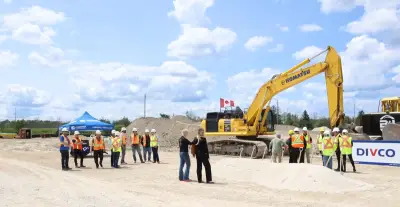
The federal government released its nuclear strategy on Monday, promising to enable the construction of up to 10 new nuclear reactors and grow the industry's export potential. The plan aims to take advantage of what it describes as a 'global nuclear renaissance,' with Canada holding structural advantages in the industry.
Minister Hodgson Highlights Ambitious Goals
“Our nuclear energy strategy is ambitious; it has to be,” said Natural Resources Minister Tim Hodgson during a press conference in Newmarket, Ont., on Monday. “Because the scale of the opportunity, I hope you understand at this point, is immense, but it’s not an opportunity that should intimidate us, it’s an opportunity that should remind us who we are as Canadians.”
The strategy complements the federal government’s intention to double the capacity of Canada’s electricity grid by 2050. Nuclear energy was presented as a key part of the government’s electricity strategy, which was presented last month.

Nuclear Energy Essential for Net Zero
“To put it simply, if our goal is to double our grid and reach net zero by 2050 there is no credible plan for Canada to do that without nuclear energy and the clean, reliable base load power it provides,” said Hodgson. Currently, Canada has 17 nuclear reactors, which generate 15 per cent of the country’s electricity. There are two reactors under construction, expected by 2035, and five more planned by 2040. Most reactors are in Ontario, with one operating in New Brunswick.
The strategy’s key objectives include enabling up to 10 new large-scale nuclear reactors, with at least one outside Ontario, and updating the CANDU reactor by 2030. The CANDU reactor, developed in Canada, operates on natural uranium. A senior government official noted that the last CANDU reactor was built in the 1990s, and codes and standards have changed since the Fukushima Daiichi incident in 2011.
Job Creation and Export Expansion
Hodgson said if provinces roll out their nuclear plans, employment in the industry is set to double from 90,000 jobs to 180,000 jobs in the “coming decades.” The strategy also aims to double uranium exports by 2040. Canada ranks second globally in uranium production and exports, according to Natural Resources Canada. Saskatchewan hosts most uranium deposits, with mills owned by Cameco Corporation.
The government has set a goal of finding four additional international markets for the CANDU reactor. Currently, Canada has sold reactors to India, Pakistan, Argentina, South Korea, Romania, and China.
Regulatory Streamlining and R&D Investment
The strategy will streamline the regulatory framework for nuclear projects and increase investment in research and development to drive innovation. “As part of the set of initiatives that Minister MacKinnon and Minister LeBlanc have initiated, one of the goals we’re looking at is to bring all of the approval and assessment into one agency, the Canada Nuclear Safety Commission,” said Hodgson.