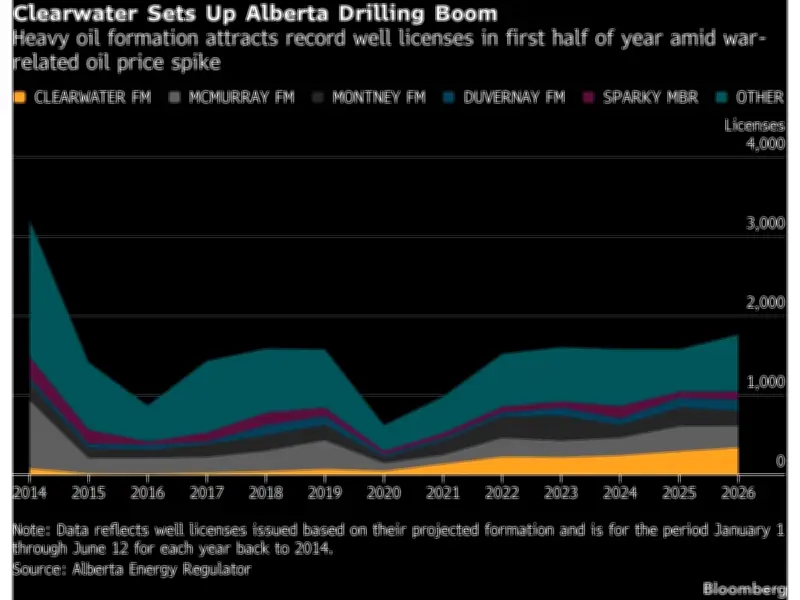
Alberta issued 1,764 drilling licenses between the start of the year and June 12, the most for a similar period since 2014, according to provincial data. Nearly one in five permits targeted the Clearwater formation, the highest share on record, as producers shifted away from long-cycle oil sands to a low-cost conventional oil play that allows faster supply response.
Clearwater Formation Attracts Major and Small Producers
For decades, Canada’s oil industry has been defined by the oil sands, where multi-billion-dollar projects can take years to build. The Clearwater formation is changing that equation. As the Iran war exposed the vulnerability of global oil supplies, the formation gave Alberta producers the opportunity to respond to higher prices with new production in months, rather than years.
The Clearwater yields dense, high-sulfur crude oil similar to that found in Canada’s oil sands. However, unlike the oil sands, the crude can be extracted at a lower cost using conventional multilateral drilling techniques, without the need for pumping steam into the ground. That enables production to be brought on more quickly.

Key Producers and Capital Investments
The formation has attracted some major producers including Canadian Natural Resources Ltd., Canada’s biggest oil company. But the Clearwater has mostly been the playground of smaller firms. Once minnows, Clearwater drillers Spur Petroleum Ltd. and Tamarack Valley Energy Ltd. have risen into the ranks of the top 10 oil producers in Alberta, rivalling some oil sands companies.
“It doesn’t take a whole bunch of capital to get started, and therefore it’s quite cost efficient,” said Brian Schmidt, chief executive of Tamarack Valley Energy Ltd., one of the two largest Clearwater producers. “It’s phenomenal. There’s no conventional play that compares.”
Tamarack Valley Energy Leads Drilling Surge
Tamarack has received 89 drilling licenses this year, up by 37 from the same period last year, the biggest increase of any company in the province, according to Alberta Energy Regulator data. Wells targeting the Clearwater accounted for 80 of those licenses, second only in volume to privately-held Spur Petroleum.
The company sold its position in the Charlie Lake region for $804 million in May to focus entirely on the Clearwater. Schmidt said by phone that Tamarack has made “modest” increases in its capital budget to between $430 million and $450 million. He emphasized that the advent in recent years of multilateral, horizontal drilling has made the Clearwater viable. Tamarack and others have been injecting water into the reservoir to push out more oil.
Headwater Exploration Increases Capital Budget
Headwater Exploration Inc., another major Clearwater producer, increased its capital budget to $250 million from $185 million after raising the company’s forecast oil price by more than US$15 to US$78.85 a barrel amid the Iran war. Production will grow by 10 per cent this year, versus eight per cent in earlier forecasts. Most of the growth is coming from investing in equipment to inject water into the reservoir, which roughly doubles the amount of oil that can be recovered at less than double the cost per well, Jeff Magee, the company’s vice president of engineering, said by phone.