

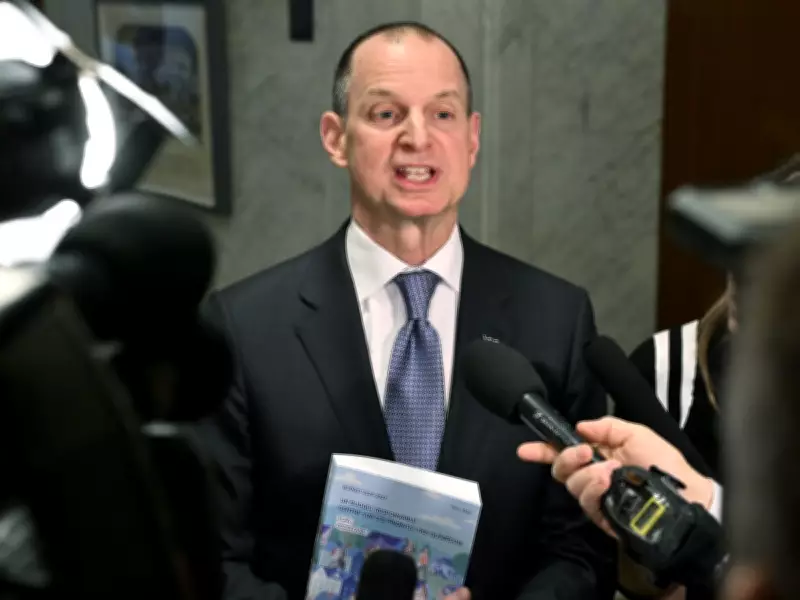
Quebec Finance Minister Eric Girard unveiled the province's 2026-27 budget on Wednesday, outlining a financial plan that increases spending on businesses, hospitals, and public transit while steadily reducing the deficit. Girard expressed confidence in Quebec's economic trajectory, stating the province has "every reason to be optimistic about the future" despite global uncertainties.
Deficit Reduction and Balanced Budget Projections
The budget reveals significant improvement in Quebec's fiscal situation. The deficit for 2025-26 is projected at $9.9 billion, approximately $3.7 billion lower than previous estimates. Girard emphasized that Quebec's deficit as a percentage of gross domestic product is expected to be among the lowest in Canada.
According to government projections, Quebec is on track to achieve a balanced budget by 2029-30. However, critics have noted a $2-billion gap in the Coalition Avenir Québec government's balanced budget plan, with no specific details provided about how spending cuts or revenue increases will address this shortfall. The last time Quebec posted a balanced budget was in 2019-20, during the CAQ's first full year in office.

Major Infrastructure Investments
Quebec plans to invest an additional $12.6 billion in infrastructure maintenance and upgrades. This substantial commitment includes $3.6 billion for hospitals and medical equipment, $1.2 billion for public transit improvements, and $631 million for higher education facilities.
Girard stated these infrastructure investments will stimulate Quebec's economy and help protect approximately 4,400 jobs annually. Over the next decade, the province expects to spend $167 billion on maintaining and expanding infrastructure across Quebec.
Despite these significant allocations, critics highlighted that the infrastructure plan does not include funding for rebuilding Montreal's dilapidated Maisonneuve-Rosemont Hospital. Québec solidaire co-spokesperson Ruba Ghazal criticized this omission, noting the reconstruction has been in planning stages for twelve years and accusing the CAQ government of neglecting Montreal's needs.
Health and Education Funding Increases
Healthcare Investments
Quebec's healthcare system, the province's largest expense, will receive an additional $2.2 billion over five years. These funds aim to strengthen front-line access and improve healthcare services. The budget also allocates $136 million over four years to support caregivers, with specific details of the government's action plan scheduled for announcement this spring.
Education Funding
The education sector receives substantial new funding, with $639 million allocated over five years for elementary and high school networks. This investment addresses school space requirements and supports worker recruitment efforts.
Higher education benefits from an additional $392 million over five years, including $150 million specifically for programs encouraging students to pursue engineering and information technology studies. This strategic investment aims to bolster Quebec's expertise in critical sectors such as defense, artificial intelligence, cybersecurity, and critical minerals.
Business Support and Economic Transformation
Quebec is dedicating $1.7 billion over five years to accelerate economic transformation amid trade uncertainties and technological changes. This comprehensive package includes $410 million for businesses in promising sectors and just under $600 million to support small- and medium-sized enterprises through regional economic initiatives, tourism promotion, and bio-food sector assistance.
A significant $500-million fund will provide loan guarantees enabling Indigenous communities to participate in economic projects, representing a notable commitment to inclusive economic development.
Political Context and Economic Outlook
Girard presented this budget less than a month before the Coalition Avenir Québec elects a new leader and premier to replace François Legault, with a provincial election scheduled for October. The budget leaves $250 million per year in discretionary spending for the incoming premier, whether Christine Fréchette or Bernard Drainville, a provision Liberal Leader Charles Milliard criticized as a CAQ "electoral fund."

Girard acknowledged multiple challenges facing Quebec's economy, including trade tensions with the United States, the impact of artificial intelligence, the war in the Middle East, and the pending renegotiation of trade agreements with the U.S. and Mexico. Despite these uncertainties, he projected economic growth of 1.1 percent in 2026 and 1.4 percent in 2027, following modest 0.8 percent growth in 2025.
The Liberal opposition questioned Girard's optimistic projections, noting uncertainties about the duration and economic impact of conflicts in the Middle East. Nevertheless, the budget reflects Quebec's commitment to strategic investments while working toward fiscal stability in challenging economic times.





