Trump's Expansionist Ambitions Meet Canada's $17 Trillion Reality Check
In a striking analysis that gains renewed relevance, author Diane Francis has revealed that any potential U.S. acquisition of Canada would face an insurmountable financial barrier. Her 2013 calculations, detailed in her book "Merger of the Century," determined that Canada's value exceeded that of the United States by a staggering $17 trillion at that time.
The Greenland Precedent and Canadian Concerns
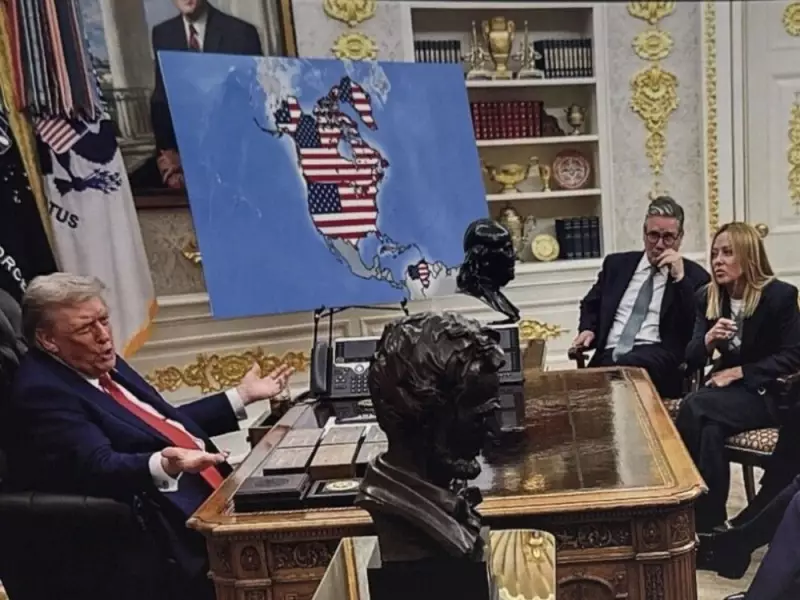
Recent actions by U.S. President Donald Trump have raised alarms about potential expansionist ambitions that could extend beyond his well-documented interest in Greenland. Trump's social media post showing Canada covered by an American flag has sparked concerns that the northern neighbor might become a target for similar acquisition strategies.
Trump has openly pursued Greenland, estimating a $700 billion price tag for its acquisition, despite European and Greenlandic resistance. This aggressive posture toward territorial expansion has led experts to question whether Canada might face similar pressure given its strategic importance and resource wealth.

Canada's Strategic Vulnerabilities
Francis has long warned about Canada's military and security shortcomings, noting that the country has consistently failed to meet NATO commitments and adequately defend its Arctic territories. "For years, Canada has not met its NATO commitments or bolstered its security," Francis writes, adding that she warned Americans would eventually "gobble up Canada" if these vulnerabilities persisted.
The author points to Canada's neglected military capabilities as a particular concern, especially given the shared NORAD responsibilities between the two nations. These security gaps, combined with Canada's vast resource wealth, create what Francis describes as an irresistible combination for expansion-minded leaders.
The $17 Trillion Valuation Breakdown
Working with investment banking experts and utilizing data from the CIA World Factbook, Francis developed a comprehensive valuation model that revealed Canada's extraordinary worth:
- Natural Resources: Canada's largely untapped Arctic wealth in oil, gas, minerals, and metals was valued between $9 trillion and $15 trillion in 2013, with values increasing significantly since then due to exploration and inflation
- Landmass and Geography: Occupying nearly seven percent of the world's land mass, Canada's territory exceeds that of the United States and includes massive water and forestry potential
- Energy Assets: The country possesses incredible untapped hydro-electric potential, vast oil reserves, uranium deposits, natural gas, rare earth elements, and critical minerals
- Arable Land: Significant underutilized agricultural land exists throughout the country
Modern Implications and Financial Reality
When adjusted for today's dollars and population growth, the $17 trillion valuation from 2013 translates to approximately $23 trillion in contemporary terms. This amounts to what would have been $485,714 for each of Canada's 30 million citizens in 2013, equivalent to about $561,000 for today's population of 41 million Canadians.
"My book didn't advocate for Canada being bought," Francis clarifies, "but speculated that this may happen, and was written to establish what Canadians would deserve." The analysis serves as both a warning about potential acquisition attempts and a valuation benchmark for Canadian assets.
Geopolitical Context and Future Considerations
The timing of Francis's revelations coincides with increasing geopolitical tensions and Trump's expressed desire to build what he describes as a "Golden Dome" over Greenland, Alaska, and Canada to prevent enemy attacks. This ambitious defense project, combined with Trump's history as a takeover artist in the business world, creates what Francis describes as a perfect storm of expansionist ambition.

Despite these pressures, the financial reality remains clear: Canada's valuation makes any acquisition attempt economically unfeasible. The country's combination of strategic vulnerabilities and extraordinary resource wealth creates a complex geopolitical situation that will likely continue to evolve as global power dynamics shift and resource competition intensifies.