

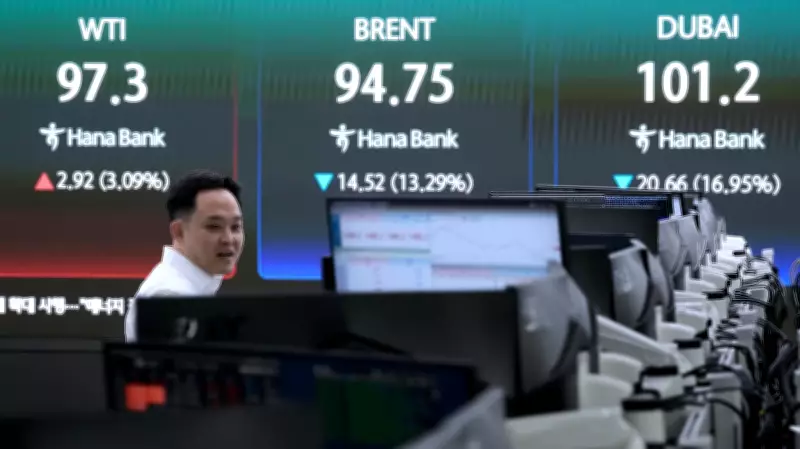
Oil Prices Rebound Above $97 as Ceasefire Skepticism Grips Markets
Oil prices surged back above $97 per barrel on Thursday, reversing earlier losses, while Asian stock markets traded predominantly lower as investors expressed deepening skepticism regarding a fragile two-week ceasefire between the United States and Iran. The renewed market volatility underscores persistent concerns over Middle East stability and global energy supply chains.
Asian Markets React to Geopolitical Tensions
Major Asian equity indices reflected the cautious sentiment. Tokyo's Nikkei 225 declined by 0.7% to settle at 55,895.32. South Korea's Kospi experienced a more pronounced drop, losing 1.6% to close at 5,778.01. Hong Kong's Hang Seng index fell 0.4% to 25,793.49, while the Shanghai Composite index decreased by 0.7% to 3,966.17. Australia's S&P/ASX 200 provided a slight counterpoint, edging up 0.2% to 8,973.20. Taiwan's Taiex gained 0.3%, whereas India's Sensex dropped 0.8%. U.S. stock futures also pointed downward, declining more than 0.2%.
The initial market optimism following the temporary ceasefire announcement proved short-lived. Investor confidence wavered significantly after a round of intense Israeli strikes on Lebanon, which resulted in hundreds of casualties. In a retaliatory move, Iran once again closed the critical Strait of Hormuz, a vital maritime chokepoint through which approximately one-fifth of the world's oil supply typically transits.

Energy Market Volatility and Analyst Commentary
Benchmark crude oil prices exhibited sharp volatility. Brent crude, the international standard, climbed 2.4% to reach $97.03 per barrel. This marked a notable recovery from its brief plunge below $92 a barrel immediately after the ceasefire was declared. Similarly, the benchmark U.S. crude price increased by 3.1% on Thursday, trading at $97.30 per barrel.
Analysts from ING Bank, Ewa Manthey and Warren Patterson, highlighted the direct link between ongoing hostilities and energy prices in a research note. "Oil prices rebounded as fighting in the Middle East continued, and the ceasefire outlook deteriorated, keeping uncertainty around the Strait of Hormuz firmly in focus," they wrote. The closure of the strait persists despite repeated demands from the United States for its reopening, maintaining a cloud of uncertainty over global energy logistics.
Wall Street's Previous Rally and Sector Movements
The previous trading session on Wall Street had closed higher, fueled by the initial announcement of the ceasefire. The S&P 500 jumped 2.5% to 6,782.81, the Dow Jones Industrial Average rose 2.9% to 47,909.92, and the Nasdaq composite increased by 2.8% to 22,635.00. This rally translated into significant gains for sectors sensitive to fuel costs and travel demand.
Shares of United Airlines surged 7.9%, American Airlines climbed 5.6%, and cruise ship operator Carnival jumped an impressive 11.2%. These movements partially recouped losses incurred since the onset of the Iran conflict, which had been driven by fears of escalating fuel expenses.
Diplomatic Developments and Precious Metals
Diplomatic efforts to secure a permanent resolution are tentatively scheduled to commence in Pakistan on Saturday. Vice President JD Vance is anticipated to lead the U.S. delegation. Concurrently, President Donald Trump reiterated a firm stance on his Truth Social platform, stating that U.S. military presence around Iran would continue "until such time as the REAL AGREEMENT reached is fully complied with."
In other commodity markets, precious metals faced downward pressure. The price of gold dropped 0.9% to $4,734.10 per ounce, while silver fell 1.8% to $74.04 per ounce. Currency markets saw the U.S. dollar strengthen slightly against the Japanese yen, rising to 158.83 yen from 158.57 yen. The euro also gained modestly, trading at $1.1668 compared to $1.1663.
The interconnected reactions across oil, equity, and currency markets vividly illustrate the global financial system's acute sensitivity to geopolitical developments in the Middle East, with the Strait of Hormuz remaining a central flashpoint for economic anxiety.






