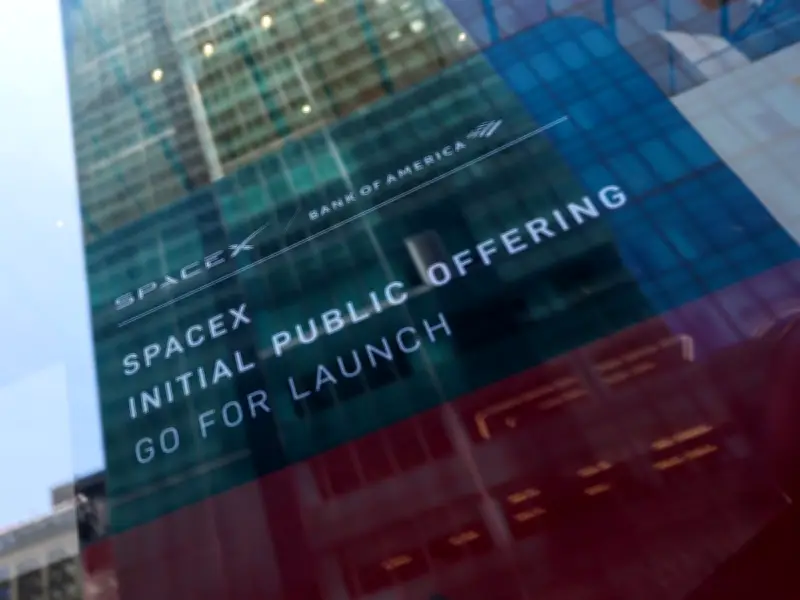
Wall Street has spent months debating how much SpaceX is worth. Behind the scenes, a different challenge has occupied the institutions responsible for bringing it public: preparing the plumbing systems needed to support what could become the largest IPO in history.
Preparations for the SpaceX IPO
S&P Global Inc.'s Equity Bookbuild group, which helps underwriters capture and allocate investor demand during initial public offerings, has spent weeks expanding the efficiency and capacity of its infrastructure ahead of SpaceX's Friday trading debut. At Depository Trust & Clearing Corp., staff plan to spend the weekend monitoring systems and communicating with industry peers.
A blockbuster IPO is not just a test of investor demand. It is also a test of the technology, communications networks and risk-management systems responsible for processing millions of orders, messages and transactions at near-instantaneous speeds. Brokers, exchanges, market makers and clearing firms must all operate in sync as orders are routed, trades executed and transactions settled.

SpaceX's Unique Demands
SpaceX amplifies those demands. The company is expected to attract outsized interest from institutions, retail investors and exchange-traded funds alike. The offering has already generated more orders than shares available, according to people familiar with the matter, raising expectations that trading volumes could rank among the largest ever seen for a newly public company.
At S&P Global's Equity Bookbuild platform, preparations began roughly six weeks ago. The team used artificial-intelligence tools to identify potential bottlenecks and capacity constraints in what executives described as a "premortem" exercise designed to uncover weaknesses before they emerged in live trading. The result: a tripling of order-handling capacity and a fourfold improvement in response times.
"The biggest worry is slowness in the system, orders not getting booked," said Darren Thomas, head of enterprise solutions at S&P Global Market Intelligence.
Lessons from Past IPOs
The memory of past mishaps still lingers. The 2012 IPO of Facebook, now known as Meta Platforms, was marred by technical failures that left traders uncertain whether orders had been executed. More recently, exchange outages and bouts of volatility have highlighted how quickly disruptions can cascade across markets increasingly dependent on technology.
Nasdaq Inc., a listing venue for both Facebook and SpaceX and thousands of other IPOs in between, declined to comment.
Industry-Wide Coordination
For market operators, attention often extends beyond major exchanges or clearinghouses. A smaller broker, market maker or service provider that proves less prepared than its peers can quickly become a source of disruption, according to Frank La Salla, president and chief executive at DTCC.
Because clearinghouses sit at the centre of the financial system, DTCC's focus has been on ensuring the broader ecosystem is prepared as much as on its own capacity. The firm has been conducting industry-wide coordination exercises and stress tests, including simulations designed to ensure its systems can process volumes roughly double the peak average during a period.